The still lifes of the Haarlem painter Pieter Claesz are usually praised for their modesty, which is an odd compliment to pay a painter. Modesty is what we say about work that declines to show off. Claesz spent the 1620s learning to show off, and then spent most of his career unlearning it, and the unlearning is the achievement. So here is the claim this essay defends: his defining picture is not the loaded banquet that first got him noticed, but the small, grey, half-empty ledge he arrived at by stripping that banquet down to almost nothing. Read him backward from the quiet pictures and the whole career snaps into focus.
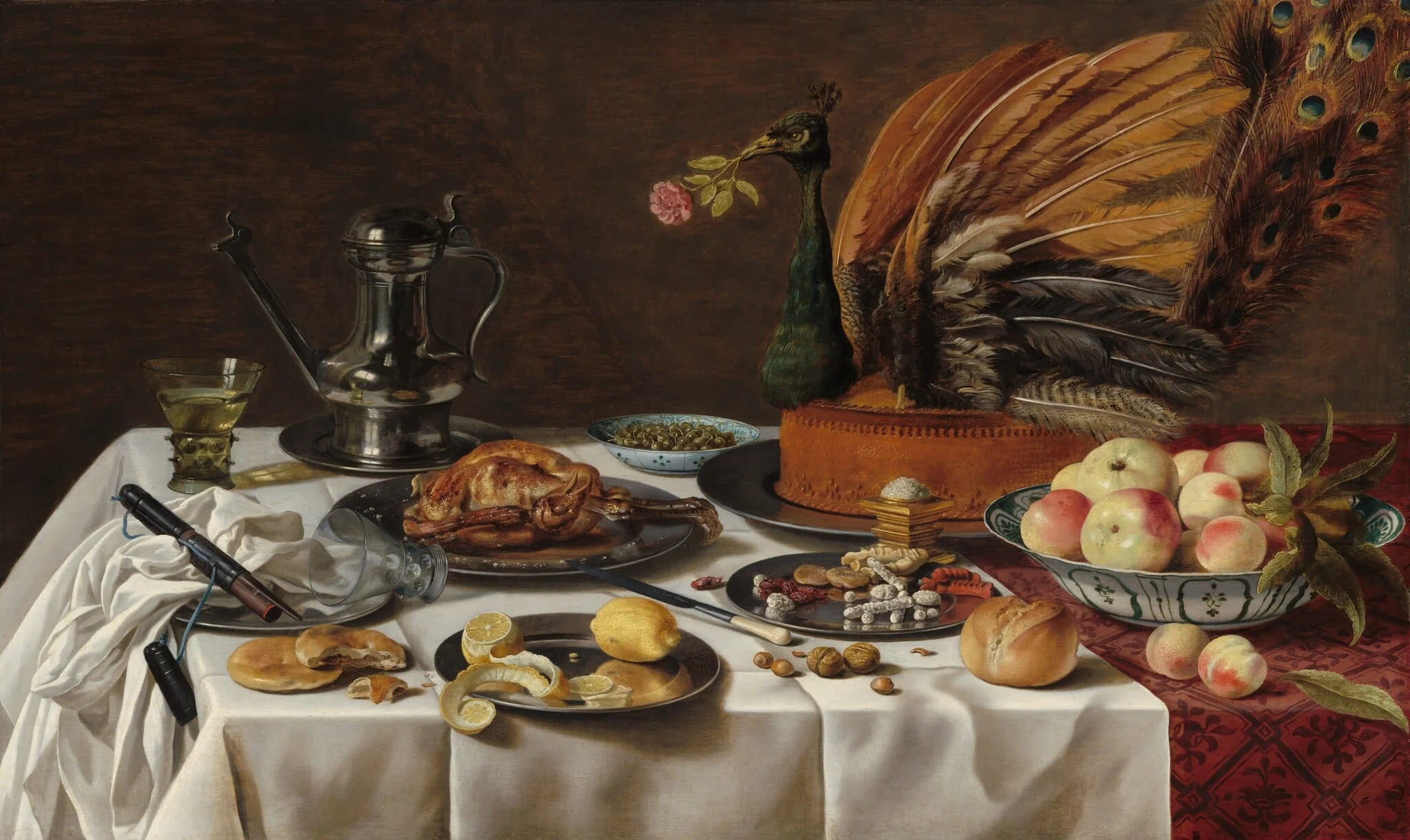
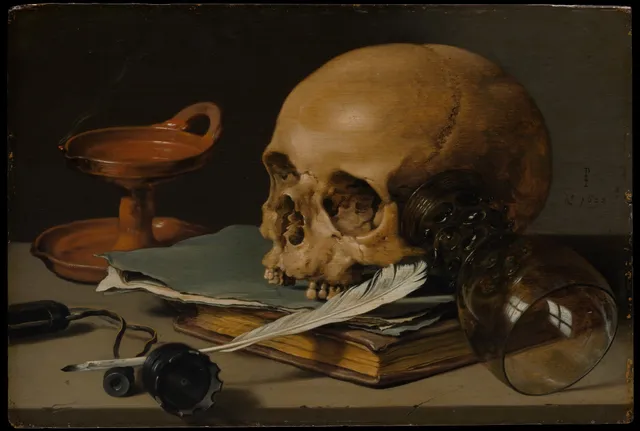
The work I want at the center is a vanitas of 1628, now in New York: a skull, a tipped-over glass, a watch, and a guttering oil lamp set on a bare stone shelf. Put it beside the Still Life with Peacock Pie he signed only a year before, and the shape of his development becomes legible in two canvases. The peacock piece needs a peacock. The skull needs almost nothing. Everything Claesz is remembered for lives in that gap, and a slow look at the smaller picture explains why the larger one now reads like a young man's painting, brilliant and slightly anxious to please.
The corner of a table he made his own
Claesz worked in Haarlem from around 1620 until his death in 1660, and for most of that span he and Willem Claeszoon Heda were the two men who defined what a Dutch breakfast picture, an ontbijt, could be. The standard account, which the basic biographical record states plainly, is that both painters worked with subdued, almost monochrome palettes, letting the handling of light and texture carry the expression rather than colour or incident (Wikipedia: Pieter Claesz). That sentence is easy to nod at and hard to feel. What does it mean for texture to do the expressing? It means the painting stops being about the objects and starts being about the act of looking at them.
Consider what a breakfast piece actually shows: a roll torn open, a wedge of cheese, a pewter plate pushed to the table edge, a glass of beer or wine half drunk. Nobody is present. The meal has been interrupted, and we have walked in on the aftermath. Claesz builds the entire drama out of that absence. A knife juts toward us over the lip of the table so that its handle breaks the plane between our space and the painted one. A lemon is half peeled, its rind dropping in a single curling ribbon that catches the light along its cut, sour face. He is not cataloguing food. He is staging the moment just after something happened, and asking us to reconstruct it.
This is where the so-called monochrome matters. By the 1630s Claesz had narrowed his colour to a band of olive, grey-brown, ash, and oyster, with a single hot accent allowed in, the yellow of a lemon or the soft red of a ham. Against that hush, a glint off a pewter rim reads like a struck note. The restraint is not poverty. It is editing. He removed everything that competed with light, so that light became the subject. A painter who can make a dented tankard hold your attention for a full minute has discovered something about seeing that a peacock cannot teach.
One table, 1628
Stand close to the Still Life with a Skull and a Writing Quill, an oil-on-wood panel the Metropolitan Museum dates to 1628 (The Metropolitan Museum of Art). It is not large. The first thing to register is how little is in it and how far that little has been pushed toward us. The skull sits at the left, tilted back so the eye sockets catch shadow rather than light, resting on a closed book whose pages have gone the colour of old butter. A overturned roemer, the thick Dutch wine glass with a prunted stem, lies on its side at the right, its foot toward us, its empty bowl pointing away. Between them an oil lamp has just gone out; a thread of smoke would still be rising if the paint allowed motion. A quill leans in an inkwell. A pocket watch lies open.
Now look at how the glass is painted, because the glass is the whole argument. Claesz renders the roemer as a cylinder of trapped light. He lets the far edge of the table show through its body, distorted and dimmed, then lays a single sharp highlight along the upper rim where the studio window strikes it. The glass is empty, lying down, finished with. In a banquet piece a full glass says abundance. Here a drained glass on its side says the meal is over, and the human who drank it is the skull beside it. The two objects rhyme. He has placed them so that the curve of the cranium answers the curve of the bowl, bone and blown glass, both hollow, both catching the same grey light from the same window we cannot see.
The watch and the spent lamp are doing the conventional vanitas work. Tate's definition of the mode is exact and worth keeping in mind: a still life of symbolic objects assembled to remind the viewer of mortality and the emptiness of worldly pleasure (Tate: vanitas). Time runs, the flame dies, the wine is gone, the head is bone. A lesser painter would stop at the inventory and trust the symbols to moralize on their own. Claesz refuses that shortcut. He makes the symbolism almost beside the point by making the looking so absorbing that the lesson arrives through the eye rather than the index finger. You do not read the skull as a sign first. You see a grey object catching light, and only then understand what it is, and the small delay is the painting.
That delay is why I call this the defining work. It compresses his entire method into a panel you could cover with two hands. The restricted palette, the raking window light, the few objects shoved to the table edge so the still life leans into your space, the refusal to let allegory do the work that observation should do. He would paint grander things and busier things across the next three decades. He never painted a clearer statement of what he was for.
What the peacock could not do
Back up one year. The Still Life with Peacock Pie is dated 1627 and hangs at the National Gallery of Art in Washington, a banquet piece crowded with imported luxury foods (National Gallery of Art). The centerpiece is a great pie crowned with the reassembled head and tail of a peacock, its feathers fanned to display, the table around it loaded with vessels and plate. It is a young painter's bid for the high end of the market, the kind of spread a wealthy Haarlem burgher would commission to announce that he could afford the impossible: a bird more spectacle than supper.
It is a good painting and an instructive one, because you can watch Claesz fighting the very thing the commission demands. The peacock's tail is a problem. It is meant to dazzle, and so it pulls toward exactly the iridescent, many-coloured surface his mature work will renounce. The composition has to carry a dozen competing objects, and the eye, given a dozen things to admire, settles on none of them. Compare that with the 1628 skull, where the eye has nowhere to go but into the light on the glass. The Washington picture wins your admiration. The New York picture holds your attention. Those are different powers, and Claesz spent his career trading the first for the second.
Set the two side by side and a thesis about the whole Dutch still-life tradition comes into view. The genre got more powerful as it got poorer. The early banquet pieces flaunt what the new merchant republic could buy. The mature breakfast pieces flaunt what only a painter could do, which is to make a pewter plate worth the same long look as a peacock. Claesz is the hinge. Within roughly twelve months he moved from the first proposition to the second, and the move was not a loss of ambition. It was ambition finding a harder target.
The grammar of pewter and glass
Once you have read the 1628 panel closely, the other works in the archive start to read as variations on a fixed grammar. Look at the Still life with a salt cellar and you find the same instincts at work: a single tall object given pride of place, surfaces chosen for how differently they take light, the table edge brought forward until the nearest object overhangs it. The salt cellar is there because salt was costly and because a faceted metal vessel scatters highlights in a way a loaf of bread never will. Claesz picks his props the way a cellist picks notes for their timbre.
His real subject across all of these is the behaviour of light on three materials. Pewter takes light as a soft, broad sheen, a smear rather than a point. Glass takes it as a hard pinpoint plus a ghost of whatever lies behind. Damp food, a cut lemon, an oyster sitting in its own liquor, takes it as a wet glaze that the dry tablecloth refuses. Set those three responses next to each other and the painting becomes a small treatise on how surfaces answer a window. The two undated panels held simply as Still Life and a second Still Life in our collection are unsigned essays in exactly this problem, and you can date them by eye to the mature years because the colour has drained out and the light has taken over.
The Vanitas Still Life with the Spinario shows him reaching for higher culture, building a memento mori around a small bronze of the Spinario, the antique boy pulling a thorn from his foot. It is the rare Claesz that wants you to know its maker had read something. Even here the painterly interest is the bronze, a fourth kind of surface, dark metal that drinks light and gives back only its edges. The learning is genuine, but the eye is still doing the thinking. Claesz never quite trusts an idea he cannot render as a highlight.
Works discussed in this article
A workshop, a son, and an afterlife in numbers
Claesz was successful in his own time, successful enough to run a workshop and to be entangled in the guild's records. One detail there is worth pausing on. He was registered in the Haarlem Guild of St. Luke in 1634 as the teacher of his own son, the future landscape painter Nicolaes Berchem, who declined to follow his father into still life and turned instead to sunlit Italianate countryside (Wikipedia: Pieter Claesz). It is a quietly telling fact. The son trained by the master of the indoor grey table walked straight out into the open air. You can browse the path Berchem took and see the rebellion: golden light, herders, distance, everything the breakfast piece shut out.
What survives, and how it is spread, tells its own story. Our own holdings bear out the picture of a productive, widely collected hand: the gallery's archive gathers 46 paintings under his name, drawn from 26 different museum collections, with the dated examples running from roughly 1624 to 1656. That spread across more than two dozen institutions is the real measure of his standing. He was not a local taste. The 1624 to 1656 span our dated works describe sits comfortably inside the longer working life the reference literature assigns him, and the two best-known anchors fall right at its front: the Peacock Pie of 1627 and the skull panel of 1628. The campaign that mattered most was over within a few years of his arrival.
Place this within the broader development of the Dutch Golden Age and the genre of still life more generally, and Claesz's narrowing looks less like personal temperament and more like a discovery the whole century was making. A republic newly rich in things found a painter willing to look at one thing at a time. The market wanted abundance. Claesz gave it attention instead, and attention has aged better. The peacock has dated. The empty glass on its side has not.
So return one last time to that 1628 ledge and notice what he leaves you holding. The lamp has just gone out. The watch is open and running. The wine is drunk and the glass has fallen. He has painted the precise minute after a life, and he has painted it so that the next thing to happen is your own slow understanding of what the objects mean. The painting does not close. It waits for the viewer to finish it, and every viewer finishes it the same way, by looking until the grey turns into light.
Sources & further reading
- Pieter Claesz — Wikipedia
- Still Life with a Skull and a Writing Quill (1628) — The Metropolitan Museum of Art
- Still Life with Peacock Pie (1627) — National Gallery of Art
- Vanitas (art term) — Tate
- Pieter Claesz, Dutch painter (active 1597-1660) — The J. Paul Getty Museum
- Still Life with a Skull and a Writing Quill (digitized record) — Internet Archive