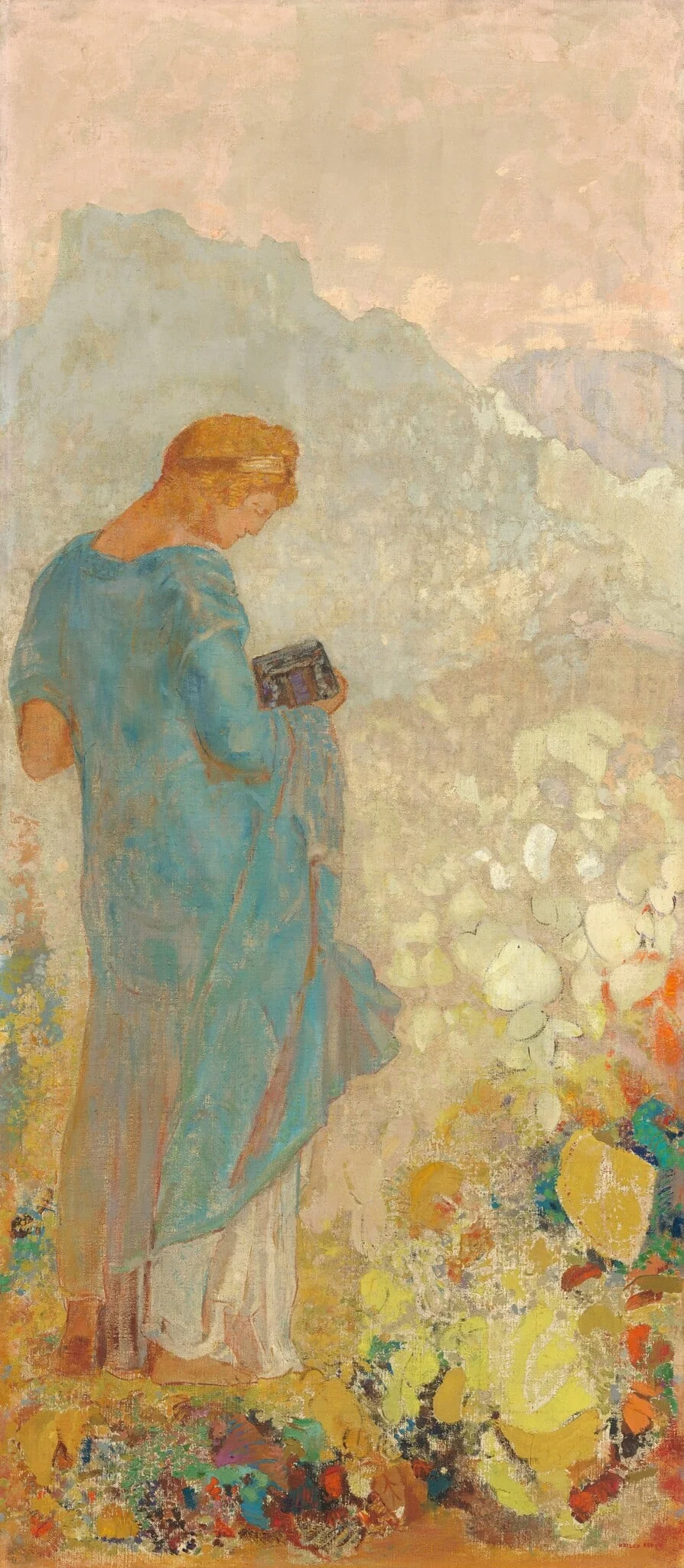
The visionary spider, the smiling severed head, the eye that floats up like a balloon toward infinity: the imagery of Odilon Redon is so strange that it is easy to talk about it as if it arrived fully formed from the unconscious. It did not. This essay argues something more concrete and more useful: Redon's style was manufactured at the level of material and method, and the dreams followed the technique rather than commanding it. He learned to build an image out of black before he learned to flood one with color, and the order of that education is written into everything he made.
Put bluntly: Redon is what happens when a draftsman spends two decades pressing charcoal and lithographic crayon into a sheet, training his hand to coax light out of darkness, and then, late, lets that habit loose inside a box of pastels. The famous fantastical content is real, but it is downstream of a working procedure. He worked from the dark toward the light, additively, the way a printmaker thinks. Understand the charcoal stick, the greasy crayon on the stone, the friable pastel stick crushed into paper tooth, and you understand why a Redon looks like nothing else in nineteenth-century France. The biography of the imagination is, in his case, a biography of his hands.
An academic start he refused
Redon was born in 1840 and died in 1916, and the long arc of those years matters, because his reputation arrived only in the second half of his life. He briefly studied painting under Jean Léon Gérôme at the École des Beaux-Arts in 1864, an episode he remembered with discomfort. Gérôme wanted contour, finish, the smooth licked surface of the academy, the painstaking historicism you can still read in his canvases. Redon could not work that way and knew it early. The lesson he took from the academy was a negative one: he would not describe the visible world by closing every line. He needed a medium that let him leave things open, suggestive, half-emerged.
He found two teachers who mattered more than Gérôme. The botanist Armand Clavaud showed him the half-world under the microscope, the organisms that are neither quite plant nor quite animal, and that border zone became a lifelong subject. The etcher Rodolphe Bresdin taught him to love the dense, teeming black of the print, the page worked until it nearly suffocates. From Clavaud came the content; from Bresdin came the method. Both pointed away from the smooth oil surface and toward the worked, granular, monochrome sheet.
The noirs: making light by subtraction
For roughly the first half of his career Redon was, to anyone who knew his work at all, a man who drew in black. He called these charcoal drawings and lithographs his noirs, because both their substance and their resonance were black, as the Metropolitan Museum's account of Symbolism puts it. The word is a technical fact before it is a mood. Charcoal is pure carbon, matte and fragile, and it sits on the surface as dust until it is fixed. You do not paint a highlight onto a charcoal sheet. You leave the paper, or you lift the carbon back off with a kneaded eraser, a stump, a fingertip. Light in a noir is an act of removal.
That single mechanical fact drives the whole look. Charcoal drawing was perfected in nineteenth-century France and pushed to new expressive limits by artists including Georges Seurat and Redon, working the velvet blacks and erased lights that the medium allows. Redon's blacks are not flat fills. They are built in layers, rubbed and re-darkened, so that a head or a flower seems to condense out of the gloom rather than to be placed against it. The figure is never cut out from its ground. It is the same dust, slightly less disturbed. This is why his apparitions feel like apparitions: materially, they are emerging from the surface, not standing on it.
Lithography extended the same logic into multiples. Redon published his first album of lithographs, Dans le Rêve, in 1879, a suite of ten plates. The stone suited him for the same reason charcoal did. You draw with a greasy crayon, the ink clings to the grease, and the tonal transitions are continuous, smoky, capable of an inky depth no pen line can reach. Crucially, the stone let him issue the same vision again and again, which is how the noirs traveled and how a private, almost hermetic imagination began to reach a public at all.
The novel that made him visible
Redon remained relatively unknown until 1884, when Joris-Karl Huysmans' cult novel À rebours, or Against Nature, hung the noirs on the walls of its decadent anti-hero and made them notorious. The novel's protagonist, Des Esseintes, collects Redon's drawings precisely for their morbid strangeness, and the fictional endorsement did the work no exhibition had managed. The full text of the period editions is digitized and freely readable, and it remains the best contemporary witness to how shocking these black sheets felt to a sophisticated reader of the 1880s.
Two years later the literary world handed Redon a label. The term Symbolism was coined in 1886 by the French critic Jean Moréas to describe the poetry of Stéphane Mallarmé and Paul Verlaine, and it was quickly stretched to cover painters who suggested rather than described, Redon foremost among them, according to the Tate's account of the movement. The fit was real but slightly accidental. Redon had arrived at suggestion through his materials a decade before the critics had a word for it. He did not illustrate Symbolist theory. He had already built the technique that the theory would go looking for.
Looking at Pandora
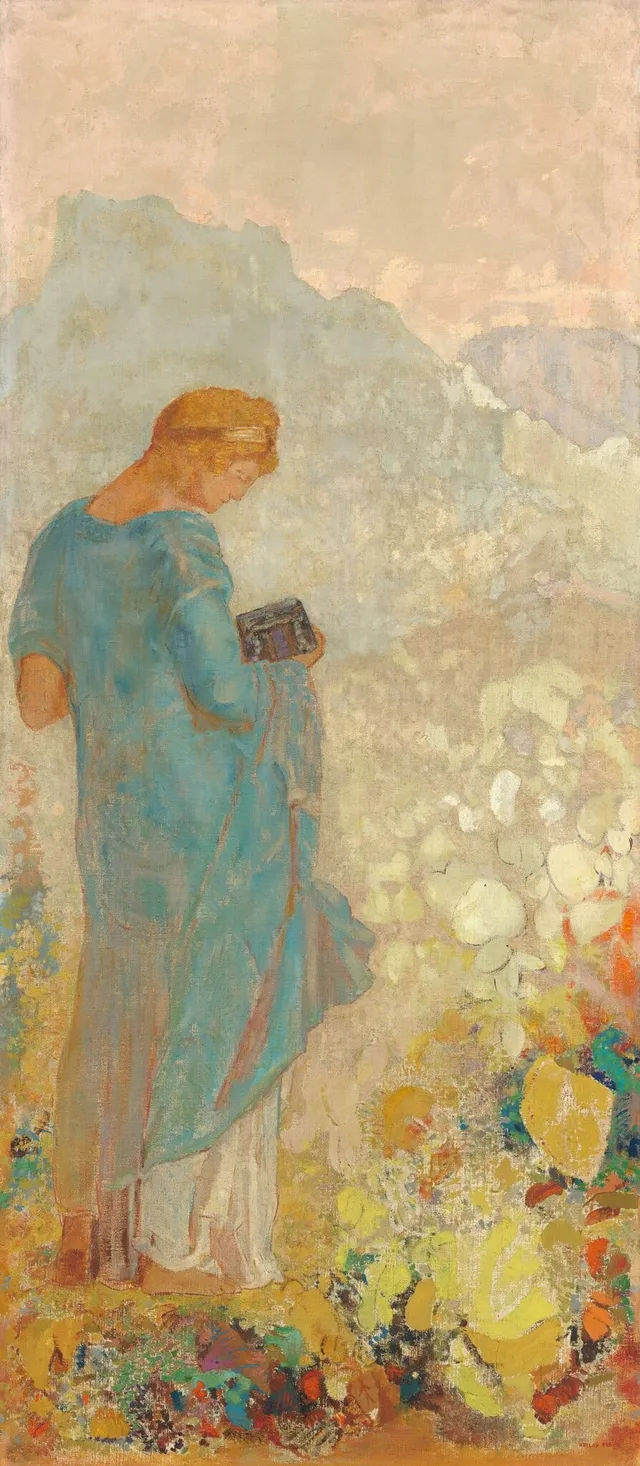
Stand in front of Pandora and you can watch the noir habit operating in full color. The nude stands at the center, pale and faintly luminous, but Redon has not drawn her against a landscape so much as let her condense out of one. The field around her is a smolder of mottled blues, greens and ochres, blossoms scattered through it without stems, without ground, without the gravity that would tell you where the earth stops and the air begins. The flowers are not bouquets. They are points of pigment dropped into a haze, the same gesture he used to lift a highlight off a black sheet, now reversed into the laying-on of bright dust.
Look at how little is described and how much is implied. Her box, the fatal vessel of the myth, is barely an event in the picture; the drama is entirely in the surface, in the way her body shares its substance with the bloom behind her. The contour that Gérôme demanded is nowhere. Edges dissolve. She is built the way a charcoal apparition is built, by tone gathering until a form becomes legible, except the tones here are saturated rather than carbon-black. This is the proof of the thesis on a single sheet: change the pigment, keep the method, and the visionary woman who once surfaced out of darkness now surfaces out of light.
The turn to color
The switch was sudden in reputation and gradual in fact. Until about 1890 Redon was known almost exclusively for monochromatic work, and by 1900 he was producing mostly oil paintings and pastels, as the Getty Museum's account of his career records. A man in his fifties who had spent thirty years in black began, almost overnight to outside eyes, to make some of the most intensely colored images of the era. The astonishing thing is how little had to change in his hand. Pastel is dry pigment in stick form. Like charcoal, it is applied as friable matter that grips the tooth of the paper. Like charcoal, it can be smudged, layered, lifted. It is, in the most literal sense, charcoal's chromatic cousin.
So the color did not require a new artist. It required a new box of sticks. Everything Redon already knew about building a surface from granular dust transferred directly. He kept working additively, kept letting forms emerge rather than drawing them shut, kept treating the ground and the figure as one continuous tissue of marks. What had been a vocabulary of grays became a vocabulary of oranges, violets and acid greens, but the grammar was identical. This is why the late pastels feel both shockingly new and deeply continuous: the eye registers the color as a rupture while the hand is doing exactly what it always did.
His oils followed the pastels rather than leading them, and they often behave like pastels that happen to be wet. He thinned and scumbled, let the weave of the canvas show, kept his edges soft. Compare the working assumptions of his Impressionist contemporaries. Camille Pissarro and Alfred Sisley were outdoors measuring light as it fell on real fields. Redon faced inward. The color in his pictures answers to feeling and decoration, not to an observed motif. When Paul Gauguin and the Symbolist painters argued that color should be expressive rather than descriptive, Redon had already proved it with a fistful of pastel sticks.
The flower pieces, read as method
Nowhere is the technique clearer than in the late flower pieces, which look at first like a retreat into pretty subject matter and are in fact his most radical demonstrations of how he worked. In Bouquet of Flowers and Bouquet in a Chinese Vase, the blossoms sit in a vague, breathing ground that never resolves into a table, a wall, a window. The vase is the only concession to the still-life tradition. Above it the flowers float, each one a separate detonation of pastel, weightless, lit from no consistent source.
A botanist's son painted these, and you can feel the microscope in them: the flowers are observed enough to be named and abstracted enough to be unreal. They are the noir apparition again, the form gathering out of an undefined field, only now the field glows and the apparition is a poppy. Redon understood that his strongest effect was the suspension of an object in an undescribed space, and the flower piece let him repeat it in a form a collector would happily hang. The decorative subject is a delivery system for a deeply non-decorative procedure.
The same procedure powers his mythological and religious pictures. The Chariot of Apollo takes a subject the academy had rendered a thousand times with crisp horses and a legible sky, and dissolves it into a flare of light and color where the chariot is less a vehicle than a burst. Saint Sebastian keeps the martyr's body soft and surfacing, the arrows almost incidental beside the glow of the flesh. Even his rare society portrait, Madame Arthur Fontaine, treats the sitter the way he treats a flower, her thoughtful face emerging from a worked and ambiguous ground of pastel that refuses to harden into a room.
What the spread of the work tells us
The shape of Redon's surviving output backs the argument up. Artifact World Gallery holds 252 works by Redon, drawn from 16 different venues and spanning roughly 1865 to 1916, which is to say across the whole working life from the early black sheets to the last pastels. A body of that size, scattered across that many collections, is not the trace of an artist who made a handful of precious masterpieces. It is the trace of a prolific maker who repeated a method, again and again, on paper and stone, for half a century. The fantastical reputation can make Redon sound like a producer of rare visions. The numbers describe a working draftsman with an enormous, consistent practice.
That consistency is the point. The National Gallery of Art, which holds him across charcoal, pastel, oil and prints, preserves exactly this range, and seeing the media side by side makes the through-line obvious: the same hand, the same additive logic, four different materials. The career is not a story of reinvention. It is a story of one technique migrating across pigments, which is a rarer and more interesting thing than a sudden conversion to color.
Works discussed in this article
A method, not a mood
It is tempting to file Redon under temperament: a melancholic dreamer who painted his inner weather. The temperament was real, but it explains nothing about why the pictures look the way they do. Plenty of melancholic dreamers painted in crisp academic oil. What separates Redon is the decision, made early and held for life, to work in friable matter on a worked surface, building images by accretion and erasure rather than by drawing them closed. The dream is the alibi. The carbon, the crayon and the chalk are the cause.
There is a useful contrast to draw with his great Spanish predecessor in the imagination of monsters. Francisco Goya etched his nightmares with the bitten, biting line of the aquatint plate, all hard contour and acid shadow. Redon's nightmares have no contour at all. The difference is not one of feeling but of process. Goya's monsters are incised; Redon's are exhaled. Hold the two against each other and you see that in the nineteenth century the technique was the imagination, that what an artist could dream was bounded by what his materials would let him do.
Redon's lesson outlived him precisely because it was technical and therefore teachable. The Nabis took his color and his decorative flatness. The Surrealists took his floating, contextless apparitions. Neither group inherited a mood. They inherited a set of moves: suspend the object, dissolve the ground, build the form from the surface out. The next time you stand in front of one of his glowing pastels, watch for the moment the figure stops being paper and starts being a presence. That moment is not magic. It is a man who learned, in the dark, how to make light out of dust, and never once unlearned it.
Sources & further reading
- Symbolism — Tate
- Symbolism (Heilbrunn Timeline of Art History) — The Metropolitan Museum of Art
- Odilon Redon — Wikipedia
- Odilon Redon (exhibition) — The J. Paul Getty Museum
- Odilon Redon — National Gallery of Art
- Drawing with charcoal: historical techniques of 19th-century France — Smarthistory
- À rebours (Against Nature), J.-K. Huysmans — Internet Archive