Artwork
Pandora
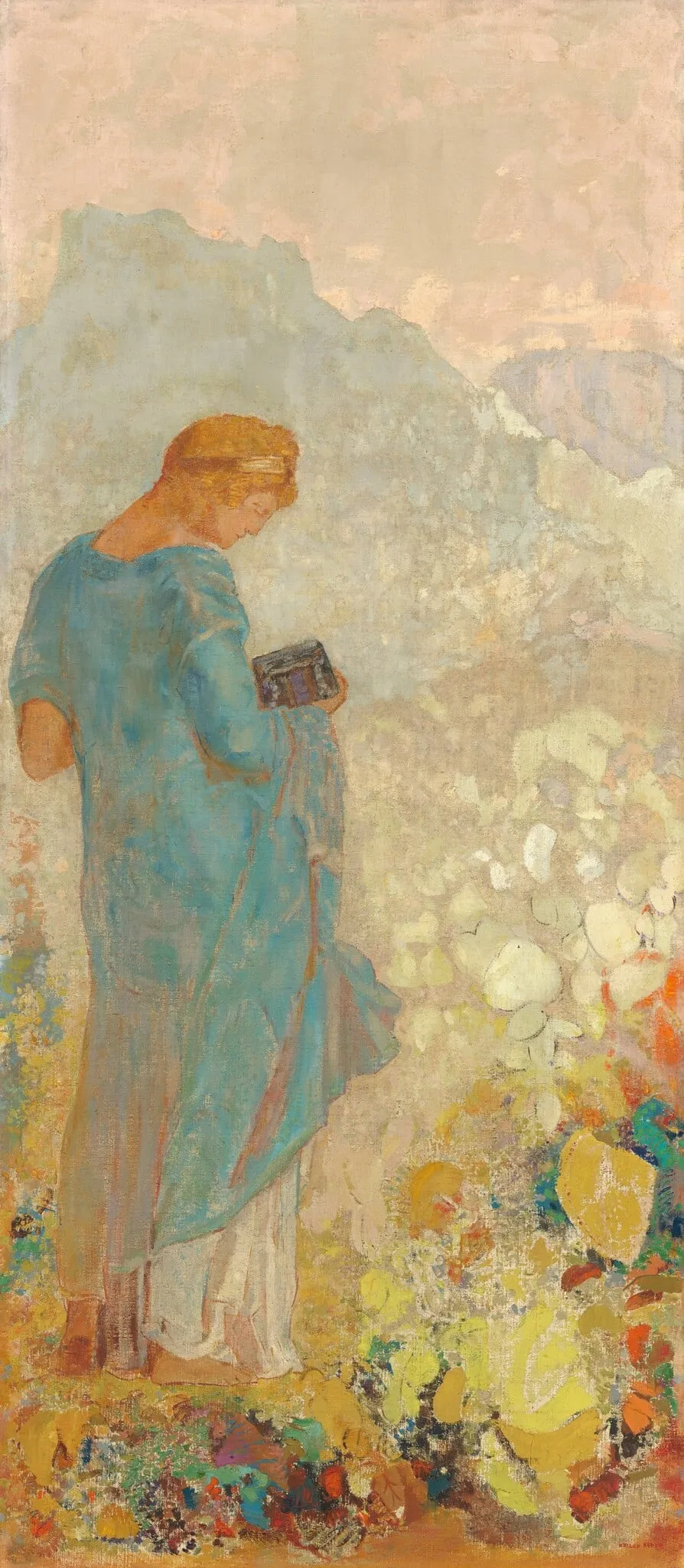
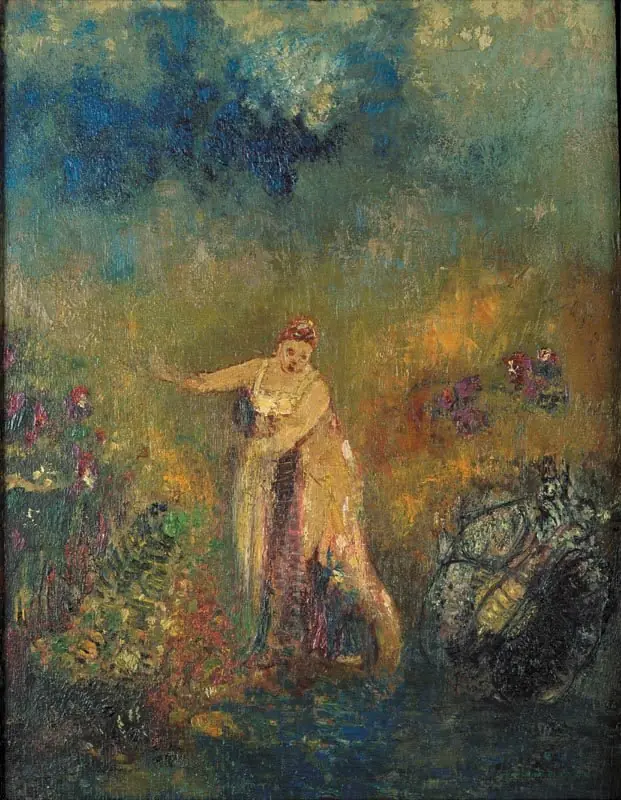
Pandora is an oil painting by the Symbolist artist Odilon Redon. It dates from 1911 and is held in the collection of the National Gallery of Art.
- Inscription
- Inscribed:lower right: ODILON REDON
About this work
A pale young woman with copper-orange hair and a turquoise robe stands in a soft, pastel landscape, her slender form filling the unusual vertical canvas.
A pale young woman with copper-orange hair and a turquoise robe stands in a soft, pastel landscape, her slender form filling the unusual vertical canvas. Odilon Redon signed it in the lower right during one of his most intense periods of oil painting, between 1910 and 1912. It reached the National Gallery of Art in 1963 as part of the Chester Dale Collection and now hangs in the West Building, Gallery M80.
Subject & Meaning
The painting depicts Pandora, the first woman of Greek mythology, standing in a rural landscape with blond hair, a headband, and flowing drapery. She holds or is near a casket, identifiable as Pandora's box, the container from which she released evils into the world, leaving only hope inside. The inclusion of a flower and the pastoral setting, with mountains and sky, contrasts with the ominous casket, creating a tension between innocence and hidden consequences.
As a Symbolist work by Odilon Redon, the image likely explores themes of curiosity, temptation, and the duality of beauty and danger. The serene exterior of the figure belies the mythic narrative of unleashed misfortune, inviting reflection on the human condition.
Technique & Style
Executed in oil on canvas, Pandora measures 143.5 by 62.9 cm, a tall vertical format characteristic of Odilon Redon’s late mythological subjects. The work belongs to the Symbolist movement, employing a muted, atmospheric palette and soft handling to evoke a dreamlike, symbolic rather than naturalistic scene. The composition depicts the standing figure of Pandora, her blond hair and flowing dress set against a rural backdrop with mountains, sky, and flowers, while the casket (Pandora's box) rests nearby.
Redon’s technique emphasizes flat, decorative planes and delicate contours, with minimal chiaroscuro, resulting in a stylized, ethereal quality. Condition details are not documented in available sources.
History & Provenance
Odilon Redon painted Pandora around 1910–1912. The painting first belonged to Jules Chavasse in Paris and was sold at Hôtel Drouot in 1922. By 1928 it was with Mrs. A. Bing of New York, then with Reinhardt Galleries and subsequently owned by Mrs. Lotus Robb Smith from circa 1927/28 until at least 1931.
After her divorce around 1937, the work was sold by an anonymous collector to Julius H. Weitzner, who in turn sold it on 20 October 1950 to Chester Dale. Dale donated the painting to the National Gallery of Art, Washington, in 1963.
The painting is held in the collection of the National Gallery of Art, Washington, D.C., to which it was gifted by Chester Dale in 1963. Its exhibition history includes a loan by Mrs. A. Bing to an exhibition at Cesar de Hauke's New York gallery in 1928.
Context
Odilon Redon's Pandora (c. 1910–1912) is a Symbolist mythological painting, aligning with the artist's wider exploration of dreamlike and allegorical subjects. The work's placement in the National Gallery of Art, Washington, D.C., confirms its institutional recognition within the Symbolist canon. The available sources, however, do not provide specific critical reception or scholarly analysis of this painting.
Overview
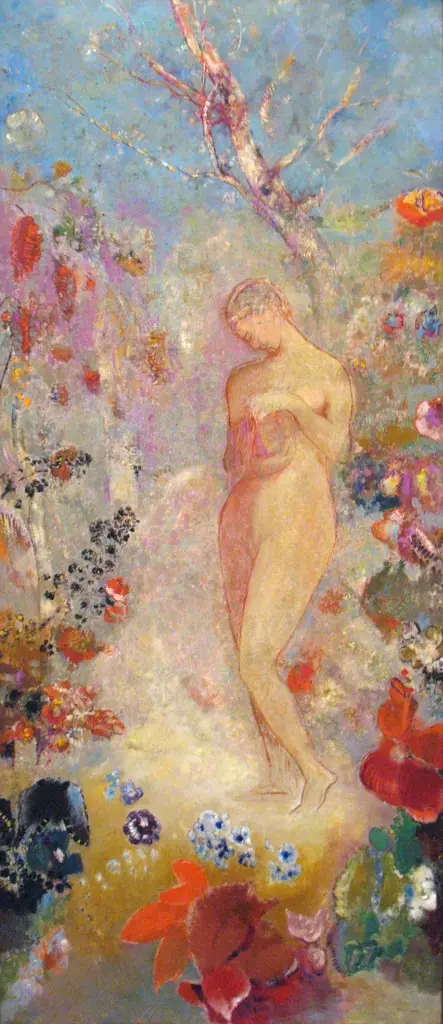
Odilon Redon's oil on canvas, Pandora, was created between 1910 and 1912. This painting, measuring 143.5 by 62.9 centimeters, depicts the mythological figure Pandora within a dreamlike, colorful landscape. The work is characteristic of the French Symbolist's later career, marked by a departure from his earlier monochromatic charcoal drawings towards vibrant hues and classical themes. It is currently housed in the collection of the National Gallery of Art.
Artist & collection

Artist
Odilon Redon (born Bertrand Redon; French: ; 20 April 1840 – 6 July 1916) was a French Symbolist draftsman, printmaker, and painter.

 Studied in the Color & Light course
  Studied in the Mythology in Art course