It is easy to file the river landscapes of Alfred Sisley under "pure Impressionist" and stop there. He was the one member of the group who never strayed far from a willow bank or a wet sky, the man who painted weather while Monet chased haystacks and Renoir chased flesh. But that tidy verdict misses what the pictures are actually about. Look at where Sisley plants his easel and you find him at thresholds: a bridge mid-span, a town half-drowned by a swollen river, the first snow settling on a field that was bare the week before. His true subject was passage, the moment a thing is no longer one state and not yet the next.
That is the argument this essay carries from work to work: Sisley painted transit, and his art lived in transit too. He was an English citizen who spent almost his whole life on French soil and was refused naturalization a year before he died. His motifs are water in motion and roads going somewhere out of frame. And the body of work itself crossed the Channel in both directions, fed by the British landscape painters his parents' generation prized, then carried back across that same water when he set up to paint the Thames near Hampton Court. Our own catalog at Artifact World Gallery runs to 116 paintings by Sisley scattered across forty-four separate venues, the dates clustering through the back half of the nineteenth century. That scatter is not an accident of collecting. It mirrors a life and a practice that never settled in one place.
A foreigner who never left
Sisley was born in Paris on 30 October 1839 to English parents recently settled there, where his father ran a business in artificial flowers and luxury textiles. The family meant him for commerce and sent him to London in the late 1850s to learn the trade. He spent his hours instead in front of Constable and Turner at the public galleries, and he came back to Paris wanting to paint. By the mid-1860s he was in Charles Gleyre's studio alongside Monet, Renoir and Bazille, and the four of them began taking their canvases out of doors, working directly from the motif in the forest at Fontainebleau. The Metropolitan Museum notes that although Sisley spent nearly his entire life in France, he was never able to become a French citizen, a status that shadowed his career and emptied his estate.
The legal fact matters because it rhymes with the pictures. Sisley belonged to French art completely and to the French state not at all. He showed at the very first independent exhibition that opened in Paris on 15 April 1874, the show whose participants called themselves the Société Anonyme des Artistes and whom a hostile critic soon rechristened, after one of Monet's titles, the Impressionists. Sisley returned to the group in 1876, 1877 and 1882, more faithfully than almost anyone. He was, as the Tate puts it, the most consistent of them in his devotion to landscape painted in the open air. Consistency was his temperament and, in the end, his limit. He found a register early and deepened it rather than breaking it.
Water that will not hold still
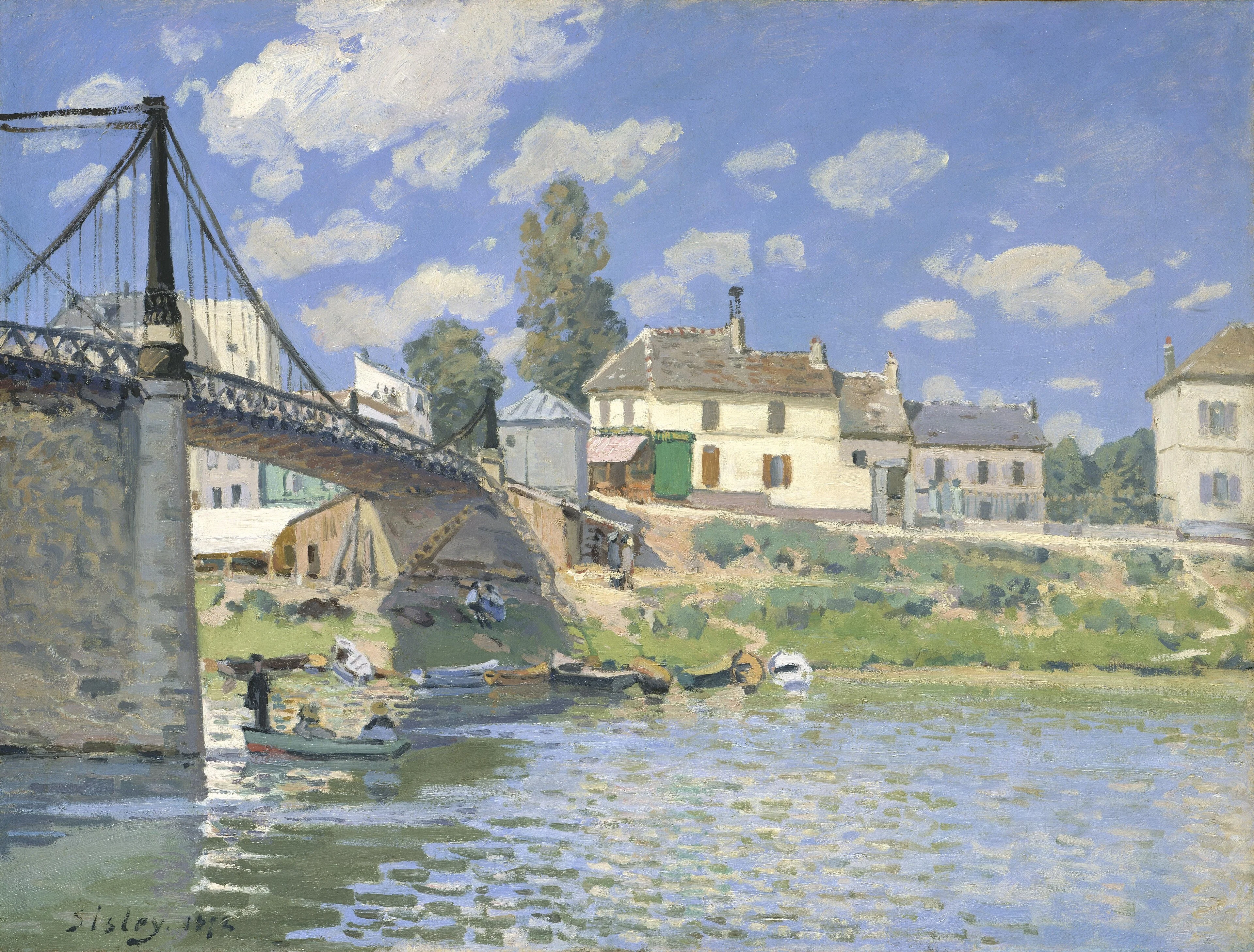
Start with the picture that anchors his early maturity. The Bridge at Villeneuve-la-Garenne, painted in 1872 on a stretch of the Seine just north of Paris, is built around a single span of pale stone that crosses the canvas left of center and carries the eye out toward a far bank of low buildings. The bridge is the load-bearing structure of the composition in the most literal sense. Everything hangs off it. Beneath the arch the water sits in flat bands of blue and grey-green, broken by the short vertical reflections of the piers, and a couple of small boats are tied up at the right where a figure in a straw hat stands in a moored skiff. The near bank runs along the bottom edge in dabs of warm ochre and sand.
What Sisley does with the sky is the lesson. It takes up nearly half the surface, a high pale field of broken cloud that he keeps deliberately quiet so the water can do the singing. He is not interested in drama. He is interested in the way light comes apart on a moving surface and reassembles a fraction of a second later. The bridge gives the scene its only hard geometry, and against that fixed horizontal the river reads as pure flux. You can feel the painter's decision: anchor the eye on the one immovable thing, then let the rest dissolve into weather and current. A man crosses the bridge on foot, small and unhurried, going from one bank to the other. He is the whole essay in miniature, a body in transit over water that never stops.
Get close to the paint and the discipline shows. Sisley lays the water in short horizontal strokes that never fully blend, so the surface keeps a faint corrugation, the record of a brush moving fast while the light held. The pier reflections are not drawn but stacked, dab over dab, each one a slightly different value of the same grey. He trusts the viewer's eye to fuse them at a distance into the shiver of a real river. Nothing is outlined. The far buildings are blocks of warm tone with a darker accent for a window or a roof, set down once and left alone. This is painting that refuses to correct itself, and the refusal is what keeps it alive on the canvas long after the afternoon it records.
The Channel, both directions
Sisley's debt to British painting was first-hand and lifelong. The two artists he had studied as a young man, John Constable and Joseph Mallord William Turner, had each, in different ways, taught European landscape that the sky was an active subject and not a backdrop. Constable's plein-air oil sketches caught cloud and damp as fleeting fact. Turner pushed light to the edge of legibility. Sisley sits squarely between them, closer to Constable's measured observation than to Turner's incandescence, but carrying a memory of both every time he leaves that much room at the top of a canvas for the weather to move.
Then the influence physically reversed course. After the first Impressionist exhibition closed, Sisley spent several months near London in 1874, the guest of a French baritone who had taken refuge in England. While he was there he painted a tight series of nearly twenty views of the non-tidal Thames at East Molesey and below Hampton Court Bridge, according to the record kept at Wikipedia. The Englishman who had learned to paint in France carried the French open-air method back to an English river and trained it on the regattas and the green water under that bridge. The art had crossed the Channel as influence going one way and as practice going the other, and the bridge motif followed him home from Villeneuve-la-Garenne to Hampton Court without missing a beat.
It is worth holding Sisley against the older French landscape men to see how far this had traveled. Jean-Baptiste-Camille Corot had loosened the silvery light of the Barbizon school but still composed his views like memories, softened and arranged. Gustave Courbet brought a heavy palette knife and a quarryman's weight to the same countryside. Sisley took the open-air commitment from one and the directness from the other, dropped the studio finish, and let the brushwork stay visibly wet on the surface. Where his friend Paul Cézanne would soon push Impressionism toward architecture and structure, Sisley went the other way, deeper into atmosphere, refusing to let a scene firm up into anything you could call permanent.
The flood at Port-Marly
If transit is the theme, the flood pictures are its purest expression, and they are the works on which Sisley's reputation now most securely rests. In the winter and spring of 1876 the Seine broke its banks at Port-Marly, west of Paris, and Sisley painted the inundation as a series. Flood at Port-Marly shows a wine merchant's house with its shopfront standing in still water, a boat poled along what used to be the street, the lower windows mirrored in a surface that has quietly taken over the town. There is no catastrophe in the handling. The disaster is rendered as calm. The water is glassy, the sky soft and silver, and the building keeps its dignity while the world around it has changed state entirely.
That is the Sisley paradox in one canvas. A flood is the most temporary thing imaginable, and he paints it as if it were a lasting condition. He understood that an emergency, observed closely enough, becomes a kind of stillness. The same instinct governs the snow scenes. In First Snow at Veneux-Nadon he catches the precise hour when a landscape is converting from autumn to winter, the ground still showing through a thin, uneven cover, the trees bare, the light gone flat and bluish. Snow, like a flood, is weather caught mid-arrival. Sisley returned to both again and again because they let him paint his real subject, which was change itself, slowed down until you could see it.
Look hard at the flood canvas and the structure is almost severe. Sisley splits it down the middle: a vertical stack on the left where the merchant's house rises out of the water, and an open expanse of flooded street and reflected sky filling the right. The bare trees lean in from the far bank like a row of thin sentries. Their trunks repeat in the water below, doubled and faintly broken where the surface stirs. He paints the reflection with the same care as the thing reflected, which is the whole point. For Sisley the mirror image is not a trick of finish but the subject itself, the world caught in the act of becoming its own double. Stand back and the doubling reads less like damage to the town than like a second, quieter town hanging beneath the first.
The suburban towns he worked through in these years read now like a route map. Boulevard Héloïse, Argenteuil gives us a wide, muddy provincial street under a grey sky, the kind of unglamorous modern view the Impressionists insisted was worth a painting. The Seine at Bougival returns him to the river bank a few miles downstream, water and willows and the low riverside houses of the boating villages where Paris went to relax on Sundays. He kept moving along the Seine the way a man follows a current, west and a little north, town by town, never quite arriving.
Downstream to Moret
In 1880 Sisley left the immediate orbit of Paris for good and settled in the country around Moret-sur-Loing, southeast of the capital where the gentle Loing meets the Seine. He stayed in that small district for the rest of his life, working the same handful of motifs in every season and every light. The river, the canal, the poplars, the bridge and church at Moret, the grain barges. Saint-Mammès, Loing Canal is typical of the late work, a quiet stretch of canal where the village meets the water, the composition organized by the long horizontal of the bank and the verticals of the moored boats and their masts. The brushwork has tightened a little with age and the palette cooled, but the preoccupation is unchanged. Once again he is at the edge where the town gives way to moving water.
The discipline of staying put paid off in a way Sisley could not have planned. Working one small district for nearly two decades, he built a record of how the same water looks under a hundred skies, the canal silver one morning and pewter the next, the poplars green then bare then green again. He was not repeating himself so much as testing a single place against time. Monet would later make this idea famous with his serial canvases, the haystacks worked through every season and hour of the day, but Sisley had been doing the same patient kind of looking for years, motif by motif, without the theory or the fanfare. The repetition that critics held against him was in fact a method, and a rigorous one.
These final years were lean. Sisley never found a reliable market in his lifetime and leaned hard on the dealer Paul Durand-Ruel and a few loyal collectors. His first solo show came in 1883 at the gallery attached to the journal La Vie Moderne, and it did little to change his fortunes. In 1898 he applied formally for French citizenship and was refused, the biographical record confirms, so he died a British national in his adopted country on 29 January 1899, his wife having died only months before. The recognition arrived almost immediately afterward, at the estate sales, when the prices his work had never commanded in his lifetime suddenly appeared.
Late in life Sisley also tried his hand at printmaking, producing a small group of etchings of the Loing. The medium suited a man whose whole career had been about water and line. The National Gallery of Art reports that with its 2022 acquisition of four Loing River etchings it became the only institution outside Paris to hold impressions of all six of Sisley's prints, keeping them beside seven of his paintings. The detail says something about how thinly his graphic work survives, and how recently the major collections have moved to consolidate it.
Works discussed in this article
What survives, and where
Sisley's posthumous reputation has tracked his lifelong condition of being slightly between things. He is admired and rarely headlined, present in every major collection and the marquee name of almost none. That spread is exactly what our archive shows: 116 works dispersed across forty-four venues, no single house owning the man the way the Musée d'Orsay owns a Monet wall or the Courtauld a Manet. He is everywhere in modest quantity, which is its own kind of fate for a painter of the in-between.
His influence flowed onward as well. The generation that came up reading Impressionism took different things from it. Paul Gauguin kept the bright independent palette and threw out the deference to observed nature entirely. Cézanne kept the observation and threw out the shimmer. Sisley kept all of it and changed almost nothing, and for a long time that loyalty was read as a lack of ambition. It looks different now. He held a single idea, that landscape is a record of passage, across thirty years and refused to let it harden. The faithfulness was the point.
Sources & further reading
- Alfred Sisley — Wikipedia
- How the Impressionists Got Their Name — Smarthistory
- Alfred Sisley, Heilbrunn Timeline of Art History (64.287) — The Metropolitan Museum of Art
- National Gallery of Art Acquires Alfred Sisley Etchings — National Gallery of Art
- Alfred Sisley — Tate
- The Road from Moret to Saint-Mammès — The Metropolitan Museum of Art
- Alfred Sisley (1839-1899), reproductions — Internet Archive