Artwork
The Bridge at Villeneuve-la-Garenne
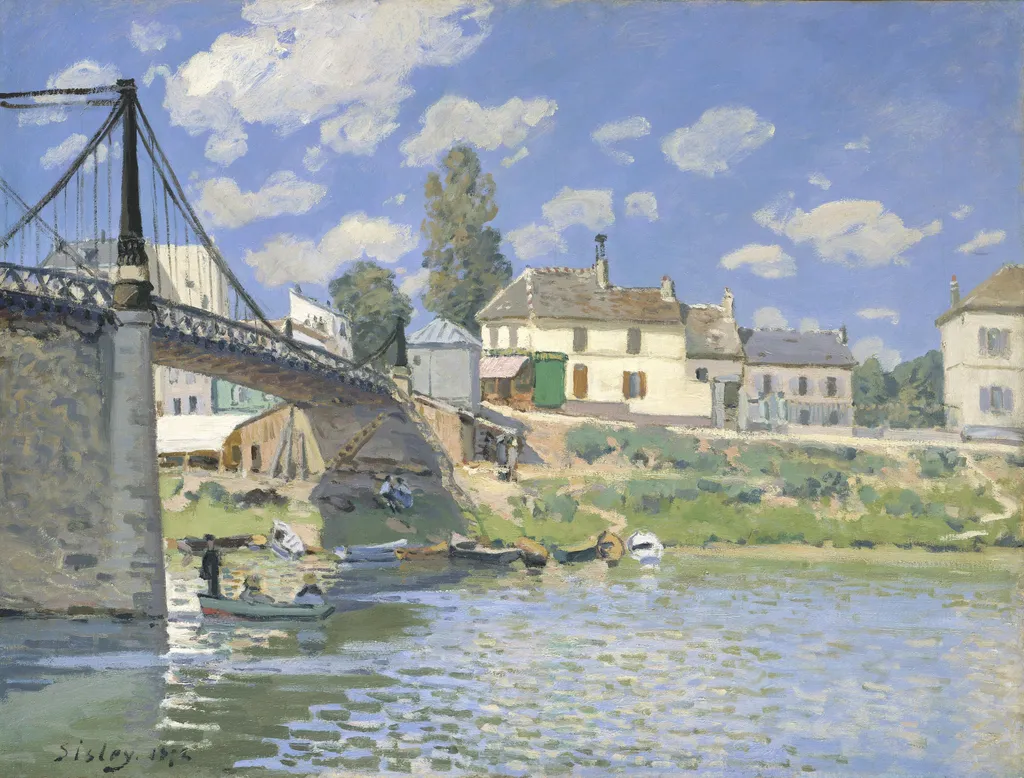
The Bridge at Villeneuve-la-Garenne is an oil painting by the Impressionist artist Alfred Sisley. It dates from 1872 and is held in the collection of the Metropolitan Museum of Art.
About this work
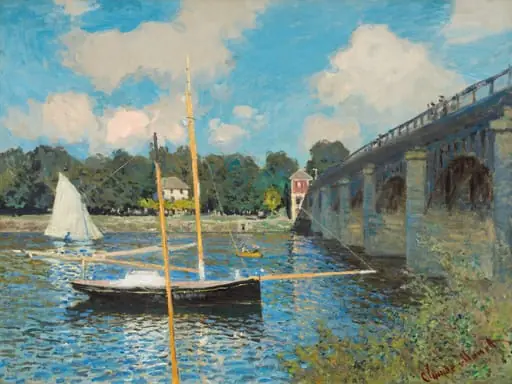
Flat strokes of sky blue and chalk white catch the summer light.
On 24 August 1872, Paul Durand-Ruel bought the canvas straight from Alfred Sisley, a sun-drenched view of the cast-iron suspension bridge linking Villeneuve-la-Garenne to Saint-Denis. From nearly water level, Sisley cropped the left pier and let the bridge deck cut diagonally across the scene, filling the foreground with holidaymakers on the Seine. Flat strokes of sky blue and chalk white catch the summer light.
Subject & Meaning
The painting depicts the suspension bridge crossing the Seine toward Villeneuve-la-Garenne, with holidaymakers along the riverbank and boats reflecting the area's river traffic. Sisley painted the bridge from the Île-Saint-Denis, emphasizing the modern infrastructure that connected the commune to Paris. Bridges held symbolic value for the Impressionists as emblems of contemporary progress, and Sisley's work captures this interplay between industry and leisure.
The scene also documents a specific time and place, the entrance to Villeneuve-la-Garenne before the original 1844 bridge was replaced around 1900, and includes local details like houses and a former tobacco shop. The painting thus represents both a literal view and a broader commentary on modernization and the changing landscape of the Seine.
Technique & Style
Executed in oil on canvas, this Impressionist landscape measures 49.5 by 65.4 cm. Sisley employed a light, high-keyed palette and juxtaposed contrasting colors in short, broken brushstrokes to capture the shimmering reflections of light on the Seine. Despite the dissolution of form typical of early Impressionism, the painting retains a clear sense of traditional spatial depth, particularly through the receding lines of the suspension bridge and riverbanks. The handling is brisk and sketch-like, applied wet-into-wet to convey fleeting atmospheric effects. The canvas is in stable condition, with no noted major restoration issues.
History & Provenance
Alfred Sisley painted The Bridge at Villeneuve-la-Garenne in the summer of 1872 as part of a series of works executed that year around the Île-Saint-Denis. The canvas was purchased directly from the artist on 24 August 1872 by the dealer Paul Durand-Ruel for 200 francs. Durand-Ruel sold it on 15 April 1873 to the baritone and collector Jean-Baptiste Faure for 360 francs.
After passing to Faure's daughter-in-law, the painting was sold in 1919 to Durand-Ruel and Georges Petit. It then passed through the hands of Alfred Bergaud, was auctioned in 1920 to Gérard Frères, and by 1930 belonged to politician Fernand Bouisson. The work was acquired by Henry Ittleson Jr. and his wife in 1957, and they donated it to the Metropolitan Museum of Art in 1964.
The painting is held at the Metropolitan Museum of Art in New York, where it has been since its donation in 1964 by Henry Ittleson Jr. and his wife. It was accessioned as part of this gift. The work has been exhibited in the museum's special exhibition “Discovering the Impressionists: Paul Durand-Ruel and the New Painting.”
Context
Considered a masterwork of Alfred Sisley's early Impressionist period, 'The Bridge at Villeneuve-la-Garenne' exemplifies the painter's use of light colors and short brushstrokes to render reflections on the Seine. Scholarship situates the canvas within a series of works Sisley executed in 1872 in and around Argenteuil and Villeneuve-la-Garenne, often working alongside Claude Monet. Art historians note Sisley's retention of traditional perspectival depth even as he adopted the Impressionist palette and technique.
The painting's inclusion in the exhibition 'Discovering the Impressionists: Paul Durand-Ruel and the New Painting' underscores its significance in the movement's early dissemination. Its provenance, bought directly from the artist by the dealer Durand-Ruel and later owned by the baritone Jean-Baptiste Faure, reflects the key role of early patrons in establishing Impressionism. Now housed at the Metropolitan Museum of Art, it remains a touchstone for studies of Sisley's œuvre and early Impressionist landscape painting.
Legacy
The Bridge at Villeneuve-la-Garenne is regarded as one of Alfred Sisley's masterpieces, a key work of early Impressionism. Since 1964 it has been housed in the Metropolitan Museum of Art, New York, where it remains a highlight of the collection. The painting was featured in the major exhibition “Discovering the Impressionists: Paul Durand-Ruel and the New Painting,” reflecting its continued scholarly and public interest.
In Villeneuve-la-Garenne itself, the riverside road running north from the bridge depicted was renamed Quai Alfred Sisley, a local tribute that underscores the painting's enduring connection to the site and its legacy as a celebrated impressionist view.
Overview
Alfred Sisley's 1872 oil painting, The Bridge at Villeneuve-la-Garenne, captures a modern industrial structure with an innovative perspective. Executed during Impressionism's formative years, the work depicts the suspension bridge connecting Villeneuve-la-Garenne to Saint-Denis. Sisley employs a close-up, low vantage point, emphasizing the bridge's diagonal thrust across the canvas.
This approach, combined with his distinctive brushwork, transforms an everyday scene into a vibrant study of light and reflection, characteristic of the emerging Impressionist style.
Own this work as a print
Artist & collection
Artist
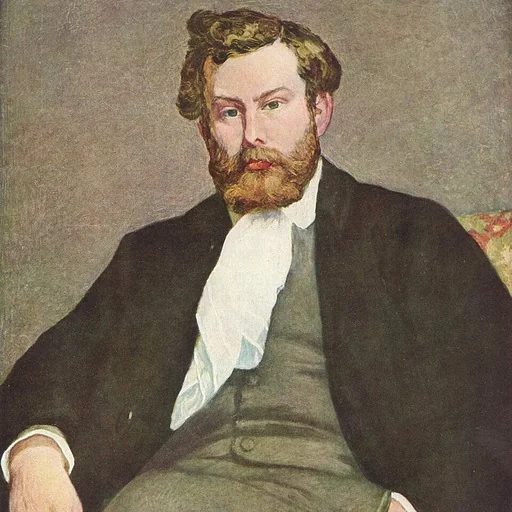
Alfred Sisley (; French:; 30 October 1839–29 January 1899) was a French-Born British Impressionist landscape painter who was born to British parents, but spent most of his life in France.