Where flowers sat before they sat for their portraits
Look at where flowers were kept before anyone thought to paint them for their own sake. They edged the margins of a Book of Hours. They circled a painted Madonna like an offering left at her feet. They lay flat and labeled across the page of a printed herbal, specimens shown with their roots so a reader could name them. The Floral genre was, in its first decades, an argument against all of that. It was the claim that a single cut tulip standing on a stone ledge deserved the same long, careful looking a painter would give to a saint or a magistrate. The flower stepped out of the border and into the center of the panel, and it did so over the objection of everyone who thought the center belonged to higher things.
That argument never ended. It only changed opponents. Each generation of flower painters picked a quarrel with the one before it, and the picture they made was the form the quarrel took. The Dutch founders argued with the herbal and the altarpiece. Their eighteenth-century heirs argued with the founders' dark restraint. The Americans argued with the sealed European vase and put the bloom back outdoors. Van Gogh argued with the lot of them by leaving his brush marks where everyone else had polished theirs away. So here is the thesis this essay defends: a flower picture is never only a flower picture. It is a position taken against a predecessor. Read the genre that way and its whole history opens up as a sequence of rebuttals, each one painted.
The margin makes its case
The independent flower piece arrived late and arrived fast. Painters in the Northern Netherlands began treating cut flowers as a stand-alone subject in the first years of the seventeenth century, and within a single working lifetime the format had hardened into a convention: a bouquet in a glass or earthenware vessel, set on a stone ledge, lit hard from one side against a near-black ground. The Metropolitan Museum's survey of Northern still life credits this first wave to a tight circle of specialists, among them Ambrosius Bosschaert the Elder, Balthasar van der Ast, Roelandt Savery and Jacob Vosmaer, painters who worked with printed herbals at their elbow and who thought nothing of crowding blooms from different countries and different seasons into one vessel.Heilbrunn essay on Northern still life
Bosschaert is the name to hold onto. He was among the first artists to make flower painting a stand-alone subject rather than a decorative accessory, fixing the template of the tight, jewel-bright bouquet weighted toward tulips and roses.Bosschaert's specialization His support of choice tells you something about his ambition. He often painted on copper, a hard, enamel-smooth surface with no canvas weave to drag at the brush, so a petal could be given a clean, glassy edge. The flower painter wanted to out-finish nature, and the material was chosen to let him try.
What were these painters arguing against? Two predecessors at once. The first was the herbal, the botanical plate where a plant was drawn for identification, splayed flat and shown whole, roots and seed-pods included. The flower painters kept the herbal's precision and threw out its purpose. Their tulip is not a specimen to be catalogued but an object to be wanted. The second predecessor was the devotional image, where flowers had always carried duties: the lily for the Virgin's purity, the rose for her love, a garland to fence off a sacred scene. The Dutch bouquet took those same flowers down from the altar and set them on a table. In doing so it changed the question the viewer was meant to ask. No longer what does this mean in the scheme of salvation, but how was this made, and how long can it possibly last.
The academies turned that low question into a verdict. When the French Academy codified its ranking of the genres in the seventeenth century, still life sat dead last, fifth behind history painting, portraiture, scenes of everyday life, and landscape.the academic hierarchy of genres Cut-flower painting was the bottom of the bottom rung. The entire later history of the genre carries that insult folded in its pocket. A flower painter working at the height of her craft was, by the official scheme, excelling at the thing held cheapest, and the strongest of them painted as though to make the ranking look ridiculous.
The impossible bouquet
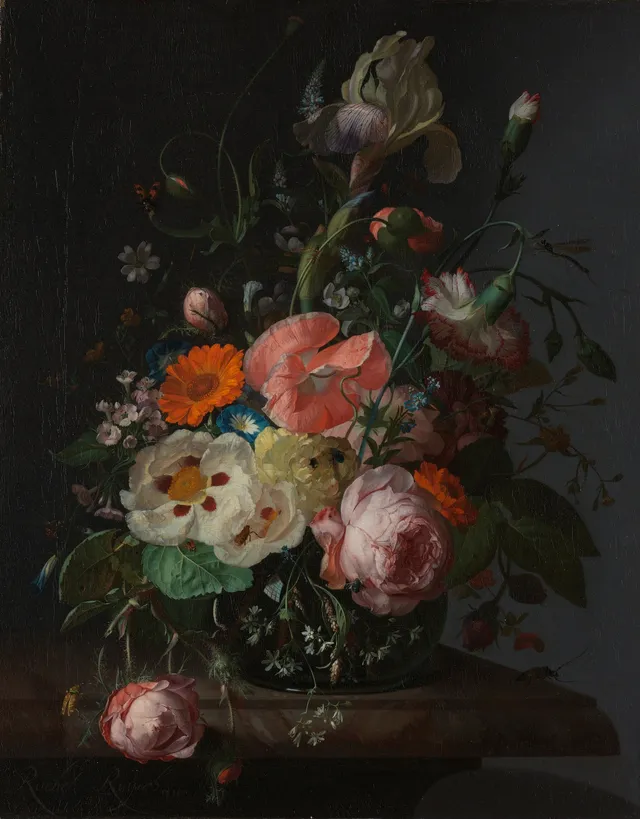
No one pressed the case harder than Rachel Ruysch. Stand in front of her Still Life with Flowers on a Marble Slab and the first thing the picture does is hide its own staging. The ground behind the bouquet is so deep a brown it reads as no place at all, and out of that void the flowers lean and twist on a single rising diagonal, the heaviest blooms tipping forward over the cold grey edge of the marble. A pale rose flops open at the front, past its best, its outer petals already curling. Higher up, smaller buds are still tight and green. Ruysch sets a flower at every stage of its short life into one stem-cluster, and she lets a few insects work their way across the leaves so you cannot pretend the scene is sealed against time.
Then comes the argument, and it is an argument with nature itself. The blooms gathered here flower in different months and could never be cut and arranged together on any one day of the year. Close looking at Ruysch has long noted the habit: she assembled species from across the seasons into a single vase, a feat of the studio rather than the garden.Smarthistory on Ruysch's flower still life This is not a record of a vase someone actually filled. It is a composite, assembled from studies made across whole seasons, a thing that exists only because a painter willed it into one frame. The earlier generation had begun this practice as a convenience. Ruysch turns it into a boast. Her predecessors painted what could be gathered. She paints what cannot, and dares you to notice the difference.
Haverman inherits the quarrel
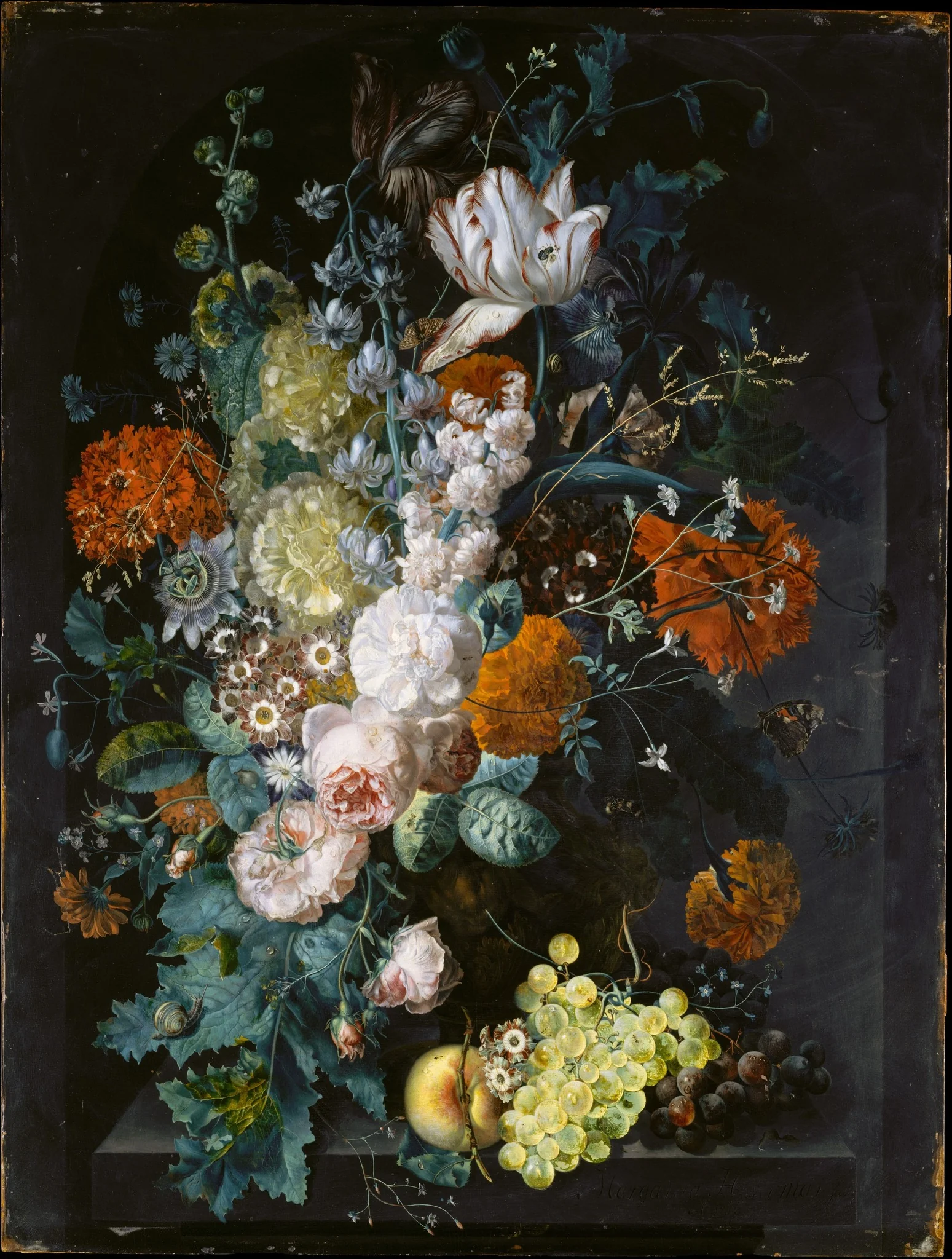
By the early eighteenth century the founders' dark, frontal bouquet had itself become the thing to argue with. Margaretha Haverman learned the genre at that turning point, in the Amsterdam studio of Jan van Huysum, the most admired and most guarded flower painter of his day. Van Huysum had lightened the old formula. He set his bouquets against pale, luminous backgrounds, looped fruit and birds' nests into the arrangement, and loosened the rigid pyramid into something that breathes. Haverman took the whole of that revision into her work.
Her A Vase of Flowers shows what she learned and where she pushed. The bouquet rises off a stone ledge in a loose S-curve, not the older symmetrical mound, and it leans into the light as if reaching for it. A bird's nest with pale eggs sits at the foot of the vase, that signature van Huysum motif, anchoring the arrangement to the idea of a garden rather than a shop counter. Look closely at the surfaces. A single drop of water beads on a leaf and throws back a tiny window of light. An insect rests on a petal, painted small enough that you find it only on the second pass. The finish is so smooth the brush has vanished, exactly the enamel perfection the genre had chased since Bosschaert worked on copper.
The reception of Haverman herself is the sharper story. She was admitted to the Paris Academy on the strength of a flower piece, one of very few women let through its doors, and her membership was later revoked amid grumbling that the work could not be her own. The objection is worth sitting with. A flower picture so accomplished that the institution refused to believe a woman had painted it, in the genre that same institution ranked at the very bottom. The contradiction is the whole condition of floral painting in one anecdote. Only a small number of works are firmly given to her hand today, which makes the survival of this one a piece of luck.
Brueghel's basket: the founder's encyclopedia
To see what Ruysch and Haverman were refining, go back one move to Jan Brueghel the Elder, who stood at the very start of the tradition. His Flowers in a Basket and a Vase is an act of assembly more than composition. Brueghel, called Velvet Brueghel for the nap of his finish, packs the field with species, a basket spilling toward a vase, every bloom turned to show its most legible face. The instinct here is still close to the herbal: gather, display, identify, leave nothing out. It is the bouquet as a collector's cabinet.
That impulse to catalogue is precisely what the next century pruned. Where Brueghel adds, van Huysum and Haverman edit. Where Brueghel turns every flower to the front, Ruysch lets half her blooms fall into shadow and twist away. The genre's internal argument is already visible across these two generations. The founders proved that a flower deserved a frame. Their heirs argued about what to leave out of it.
Works discussed in this article
The window opens
The nineteenth century picked a different fight. By then the cut bouquet had two hundred years of authority behind it, and a Berlin painter like Eduard Gaertner could quietly question its central premise: why must the flower be cut at all? His The Family of Mr. Westfal in the Conservatory moves the genre indoors and back into life at the same time. The plants here are growing, rooted, climbing a glass house, and a family sits among them. The flower has been returned to its habitat and given owners.
This is a quieter rebellion than Ruysch's, but a real one. The Dutch still life had cut the flower from the garden to study it as an object. Gaertner, working in an age of glasshouses and bourgeois plant-collecting, lets the flower stay alive and attached to people who can afford to keep it warm through a Prussian winter. The painting is half portrait, half conservatory record. It says the meaning of flowers now lives in cultivation and class, not in a vase on a ledge. The predecessor here is the still life's own founding act of cutting, and Gaertner declines to make the cut.
Heade lets the air get wet
The most physical rebuttal comes from across the Atlantic. Martin Johnson Heade spent years on a project of tropical flowers and hummingbirds, and his Hummingbird and Passionflowers throws out almost everything the Dutch vase stood for. The format is wide and low, not the upright pyramid. There is no ledge, no vessel, no parlour. A passionflower vine hangs across the foreground, dark and waxy, and behind it the background dissolves into the haze of a humid forest, distant hills smudged into wet light. A hummingbird hovers at the bloom, its throat catching an iridescent flash. Heade paints the air itself as something heavy and damp, the opposite of the Dutch void.
Set that beside his Hummingbird and Apple Blossoms and the program is clear. Heade rips the flower out of the European interior and bolts it back onto the living branch, in the bird's territory, at the bird's eye level. Where Ruysch had boasted that her bouquet could not exist in nature, Heade boasts the reverse: that his flower is caught in the exact wild minute a hummingbird would find it. The bloom is no longer a trophy of the painter's patience. It is an event in an ecosystem. The Dutch had made the flower hold still. Heade insists it keep moving.
Van Gogh leaves the brush in
The last move in this long disagreement is the most famous, and it attacks the genre's oldest pride: its finish. Every flower painter from Bosschaert to Haverman had labored to make the brush disappear, to leave a surface so smooth the petal seemed to have grown there. Vincent van Gogh did the opposite on purpose. He loaded the paint thick, dragged it, and left every stroke standing on the canvas where you can count them. His flower canvases keep a single species, often past its prime, the heads going dry and curling, and the labor of painting is left fully visible rather than buffed away.
This is the genre arguing with the one quality it had always treated as proof of mastery. The Dutch said skill means you cannot see how it was done. Van Gogh said skill means you feel exactly how it was done, stroke by loaded stroke, with the painter's hand pressed into every ridge of pigment. He kept the lowly subject the academy despised and used it to overturn the academy's idea of finish. The bottom of the hierarchy became the place where the rules of the whole hierarchy were broken.
What the archive holds
Seen as one collection, the genre's argumentative habit shows up in the numbers. Artifact World Gallery holds 3,080 Floral works, made by 929 different artists and kept today across 130 venues, with dates running from roughly 1109 all the way to 2007. That span is the real surprise. Nearly nine centuries of people deciding that flowers were worth a frame, and 929 separate temperaments deciding it in 929 different ways. A genre the academy filed under fifth-of-five turns out to be one of the most continuously practiced subjects in Western painting.
That breadth is exactly what you would expect from a subject defined by disagreement. A figure painter inherits a body and is more or less stuck with it. A flower painter inherits a flower and a long line of predecessors who each insisted the flower meant something specific, the herbal's specimen, the altar's symbol, the Dutch boast, the American habitat, the visible brush. Every artist who entered the genre had to decide which of those claims to keep and which to overturn. The bloom on the ledge is the calmest-looking battlefield in art.
Sources & further reading
- Still-Life Painting in Northern Europe, 1600-1800 — The Metropolitan Museum of Art, Heilbrunn Timeline (Walter A. Liedtke)
- Ambrosius Bosschaert — Wikipedia
- Still life (the hierarchy of genres) — Tate
- Rachel Ruysch, Flower Still Life — Smarthistory
- Flower Still Life (Ambrosius Bosschaert the Elder, 1614) — The J. Paul Getty Museum
- Still Life with Flowers and Fruit (Jan van Huysum) — National Gallery of Art
- Dutch Flower Painting, 1600-1720 (Paul Taylor) — Internet Archive / Yale University Press, 1995