Artwork
Hummingbird and Apple Blossoms
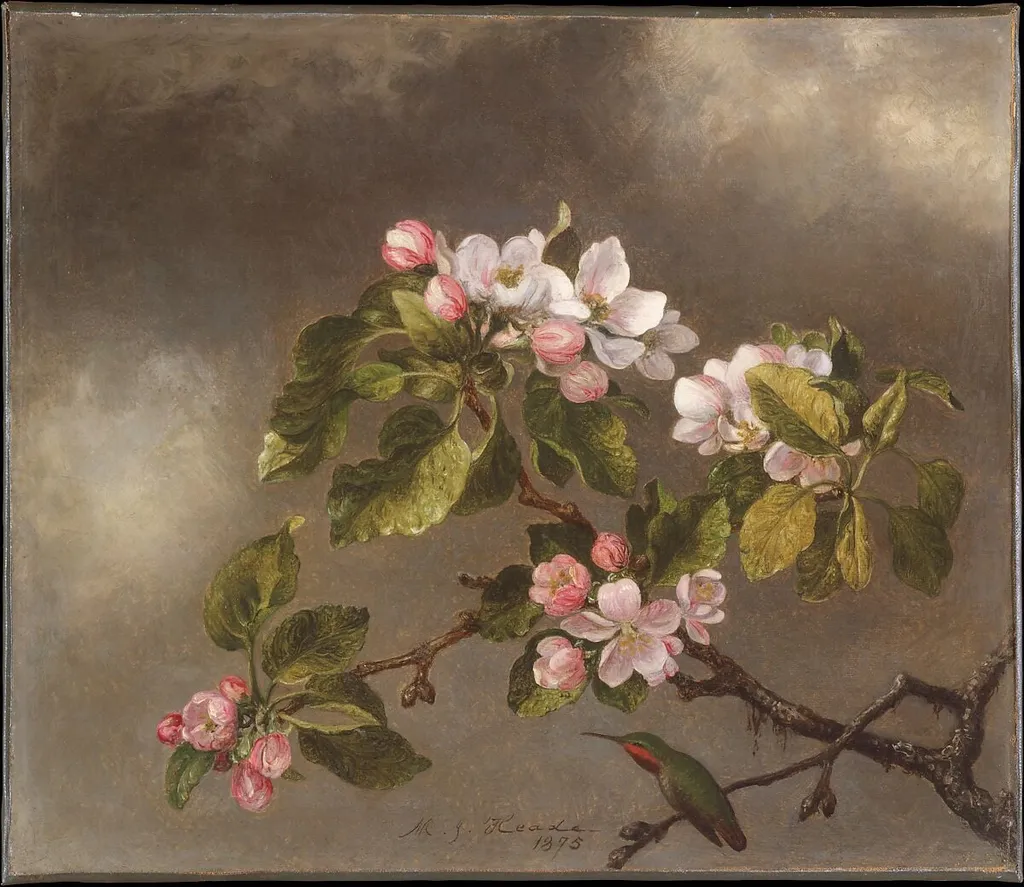
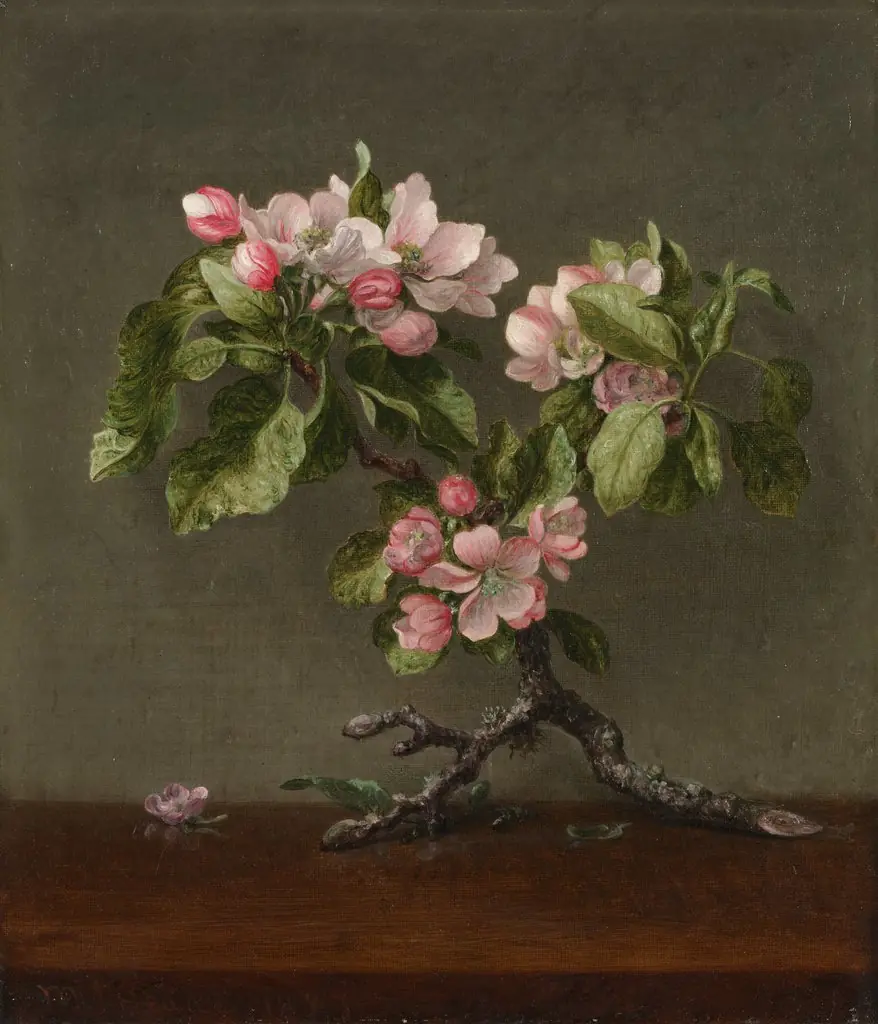
Hummingbird and Apple Blossoms is an oil painting by the Hudson River School artist Martin Johnson Heade. It dates from 1875 and is held in the collection of the Metropolitan Museum of Art.
About this work
A hummingbird hovers near a branch of apple blossoms, its wings blurred like a fan. Pink and white petals crowd the left side, a single green apple tucked behind them. Heade painted it in 1875, when hummingbirds were still exotic to most Americans, and kept a live bird in his studio to study its movements.
Technique & Style
The handling reveals precise brushwork to render botanical and avian details, though no specific condition or conservation notes are available from the sources.
Executed in oil on canvas, the work aligns with Martin Johnson Heade's characteristic medium. The support is a canvas of dimensions 31 by 35.9 (likely centimeters), contributing to an intimate scale typical of still-life compositions. Classified as a still life, the painting blends floral and animal genres, depicting apple blossoms and a hummingbird in a formal arrangement.
The handling reveals precise brushwork to render botanical and avian details, though no specific condition or conservation notes are available from the sources. The style merges naturalistic observation with a decorative, carefully balanced composition, reflecting Heade's interest in both scientific illustration and aesthetic harmony.
History & Provenance
Martin Johnson Heade painted Hummingbird and Apple Blossoms in 1875, executing the work in oil on canvas. The painting entered the collection of the Metropolitan Museum of Art, where it is held in the American Wing. No further details of commission or intermediate ownership are recorded in the available sources.
Overview
Martin Johnson Heade's Hummingbird and Apple Blossoms, executed in 1875, is a small-scale oil on canvas that exemplifies the artist's unique synthesis of still life and naturalist observation. The composition centers on a hummingbird captured in mid-flight, its wings rendered as a translucent blur to convey rapid motion against a dark, atmospheric background. To the left, a dense cluster of pink and white apple blossoms dominates the frame, with a single green apple partially visible behind the floral arrangement.
Heade, a figure associated with the Hudson River School yet distinct for his focus on tropical and domestic nature studies, created this work during a period when he frequently explored the intersection of birds and flowers. Unlike the grand landscapes typical of his contemporaries, this piece offers an intimate, almost microscopic view of nature, emphasizing the delicate relationship between the pollinator and the bloom. The painting reflects Heade's mature style, characterized by a soft, diffused light and a meticulous attention to botanical and ornithological detail, distinguishing his contribution to 19th-century American art through this specialized genre of flower-and-bird studies.
Subject & Meaning
The painting features a hummingbird with wings blurred by motion, hovering near a branch laden with pink and white apple blossoms. A small green apple is visible among the foliage, adding a subtle element of the life cycle. For many Americans in 1875, hummingbirds were still considered exotic creatures, making their depiction a point of fascination and wonder, highlighting nature's intricate beauty and the artist's keen observation.
Context
Created in 1875, this work reflects a period when the natural world, particularly its more unusual inhabitants, held significant appeal. Hummingbirds, native to the Americas but still largely unfamiliar to many, represented a marvel of nature. Heade's dedication to capturing these creatures contributed to a broader public understanding and appreciation of American fauna, blending scientific curiosity with artistic representation during the late 19th century.
Artist & collection

Artist
Martin Johnson Heade (August 11, 1819 – September 4, 1904) was an American painter known for his salt marsh landscapes, seascapes, and depictions of hummingbirds, often depicted with orchids, as well as lotus blossoms and other still lifes.