The standard account of German Romanticism is a story about feeling: moonlight and ruins, the lonely soul before an indifferent sky, a generation that turned away from reason toward longing. That account is true as far as it goes, and it explains nothing about why these paintings look the way they do. The argument of this essay is narrower and, I think, more useful. The German Romantics did not simply pour new emotion into the inherited container of landscape and portrait painting. They rebuilt the container. The break was formal before it was sentimental, and it happened in three places at once: in the composition, where the picture was reorganized around emptiness instead of incident; in the treatment of light, which became a metaphysical event rather than a way of making objects legible; and in the handling of paint, where the brushstroke was deliberately suppressed so that the image would read as a vision rather than as a made thing.
Hold those three together and the movement stops looking like a mood and starts looking like a method. Romanticism across Europe reached its height between roughly 1780 and 1830, setting a new emotionalism against the prevailing ideas of classical restraint, as the Tate glossary puts it. But emotionalism is a description of intent, not of craft. What made the German wing of the movement decisive for everything that followed was that its leading painters found a pictorial grammar for that intent. They learned to compose with absence, to paint a light that has no obvious source, and to finish a surface so smoothly that the viewer forgets a hand was involved. Caspar David Friedrich is the figure who carried all three furthest, which is why he anchors the case here, but the break was a collective achievement and it spread fast across the North.
What the classical picture promised, and what Friedrich withheld
A well-made eighteenth-century landscape is a machine for guiding the eye. It opens with a darkened framing element at one side, a tree or a bank of rock, leads you across a sunlit middle ground busy with figures and animals, and parks you at a luminous distance where a temple or a mountain gives the composition its moral. Nothing is wasted. Every zone of the canvas does a job. The theoretical scaffolding for the German break came not from painters at all but from writers: the Jena circle, active from about 1798 to 1804, laid down the intellectual basis for Romanticism in its journal, the Athenaeum, driven by the brothers August Wilhelm and Friedrich von Schlegel, as the survey of Jena Romanticism records. The Schlegels argued for an art of fragments and infinities, an art that pointed past its own edges. A painter who took that seriously could no longer fill the canvas with reassuring incident.
Friedrich's answer was to leave the middle ground empty. Look at the device that recurs through his work: a small figure seen from behind, placed near the lower edge, facing into a void that occupies most of the picture. Smarthistory's reading of his notorious Monk by the Sea is that the lone back-turned figure before a near-empty expanse is a compositional instrument, one that invites the viewer to stand inside the figure rather than watch him from outside, an account you can read in full at Smarthistory. The classical picture asked you to admire a scene. Friedrich's picture asks you to occupy a position. When the writer Heinrich von Kleist confronted the same canvas in 1810, he described the spectator as becoming the single living thing in an expanse given over to death, the solitary point at the center of a solitary circle, a reaction preserved in the full text of German Masters of the Nineteenth Century. That is a formal effect producing a psychological one, not the other way round.
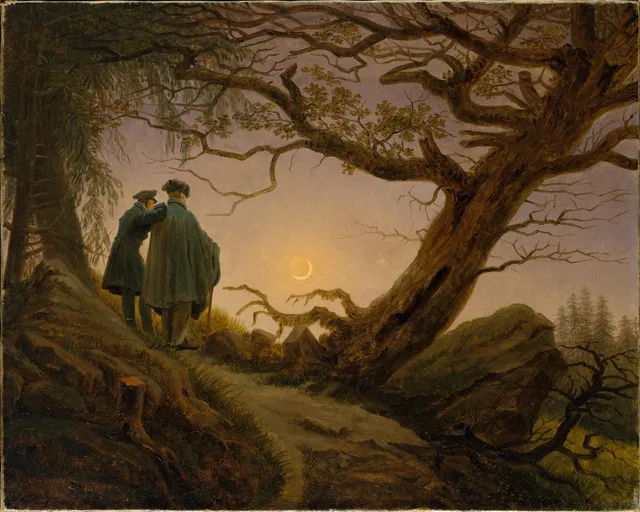
Take the close-looking to one painting. In Two Men Contemplating the Moon, two men in old-German dress stand on a track at the lower right, their backs to us, one leaning lightly on the other. They are small. The composition does not center them, and it does not center the moon either. What dominates the canvas is a dead oak, uprooted and tilting across the upper space, its bare branches clawing toward the pale disc of the moon and the warm haze around it. The ground falls away to the left into shadow. The sky is graded from a low band of amber up through grey-green to a deep blue that swallows the top of the picture.
Now watch what the arrangement does. The men's gaze, the lean of the tree, and the bare twigs all point to the same spot, and that spot is nearly empty. Friedrich builds an entire system of directional lines and aims them at a void with a single small light in it. The eye arrives where there is almost nothing to see, and the almost-nothing becomes the subject. Notice too that he refuses the classical exit: there is no luminous distance to escape into, only a dark hillside and the screen of the sky. You are held at the edge of the path with the two men, looking at the same vacancy they are looking at. The picture is composed, with real precision, to deny you the comfort of a finished scene.
Light as event, not illumination
Classical and Baroque painting use light to model form. A raking sun gives a column its roundness and tells you where the figures stand in space. The German Romantics kept the descriptive power of light when they wanted it, then learned to switch it off and let light behave as something closer to a presence. Friedrich's moons and his low band of dawn do not so much illuminate the landscape as visit it. The glow sits on the horizon like a held breath. Objects between you and the source go flat and dark, read as silhouette rather than as modeled mass, because the point is the radiance itself and not the things it falls on.
Carl Gustav Carus, a physician and natural scientist as well as a painter, pursued the same idea with a cooler temperament. In Schloss Milkel in Moonlight, the manor sits low and dark against a pale night sky, its windows giving back no warmth, while the water below holds a long silvered streak of the moon. Carus, who wrote at length on the science of landscape, treats the reflection almost as a measurement: here is the light, here is its double, and between them the solid dark bulk of the building that proves how little the moonlight actually reveals. The mood is unmistakable, but it is produced by a near-clinical control of value, the careful spacing of a few greys between a bright sky and a black mass of stone.
The Norwegian-born Johan Christian Dahl, Friedrich's friend and Dresden housemate, took the light in a different direction, toward weather and air. Dahl had trained in front of the sea and the mountains and trusted observation in a way Friedrich did not. Yet his skies carry the same conviction that light is the active agent in a picture. In Mother and Child by the Sea, the small human pair on the shore are nearly incidental against the broad working of cloud and the cold sheen on the water. Dahl gives you a real coast you could stand on, then drains it of anecdote so that the immense, shifting light becomes the thing the painting is about.
The handling of paint: a surface that hides its own making
Here is the part that gets least attention and matters most to the eye. The German Romantics, Friedrich above all, finished their surfaces so smoothly that the brush nearly disappears. There is almost no impasto, no visible drag of a loaded bristle, no passage where you can feel the painter's wrist. The paint is thin, the transitions are blended to a breath, and the result is a surface that looks less like pigment on cloth than like a window onto a seen thing. This was a choice with a purpose. If the goal is to make the viewer believe he is standing inside the landscape, looking at a vacancy that means something, then any reminder that he is looking at handiwork breaks the spell. The suppressed stroke is the technical correlate of the empty middle ground. Both remove the maker so the image can feel like vision.
That smoothness is easy to mistake for timidity until you set it beside a Romantic who refused it. Joseph Anton Koch came out of the heroic-landscape tradition and never fully left it. His Heroic Landscape with Rainbow keeps the classical machine running: framing trees at the sides, a structured descent into a deep valley, a rainbow arched over the whole as a sign of order restored. Koch builds his forms with firm contour and crisp local color, the surface busy and articulated. Put his canvas next to Friedrich's and the difference is not subject matter, since both paint nature as meaning. The difference is grammar. Koch composes additively, filling the field; Friedrich composes by subtraction, clearing it. Both are German Romantics by date and temperament, and the contrast shows that the formal break was a road taken, not a tide that swept everyone along.
The same suppression of the visible hand carried into portraiture, where the Romantic interest in inwardness met the older demand for a likeness. Joseph and Karl August von Klein by Heinrich Franz Schalck gives two sitters rendered with the same patient, near-invisible finish, the attention turned to the quiet between the figures rather than to any display of brushwork. It is a smaller key than Friedrich's cosmic landscapes, but the instinct is shared: keep the surface still, keep the maker out of view, let the subject look back at you without interference.
Works discussed in this article
Dahl, Carus, and how far the break traveled
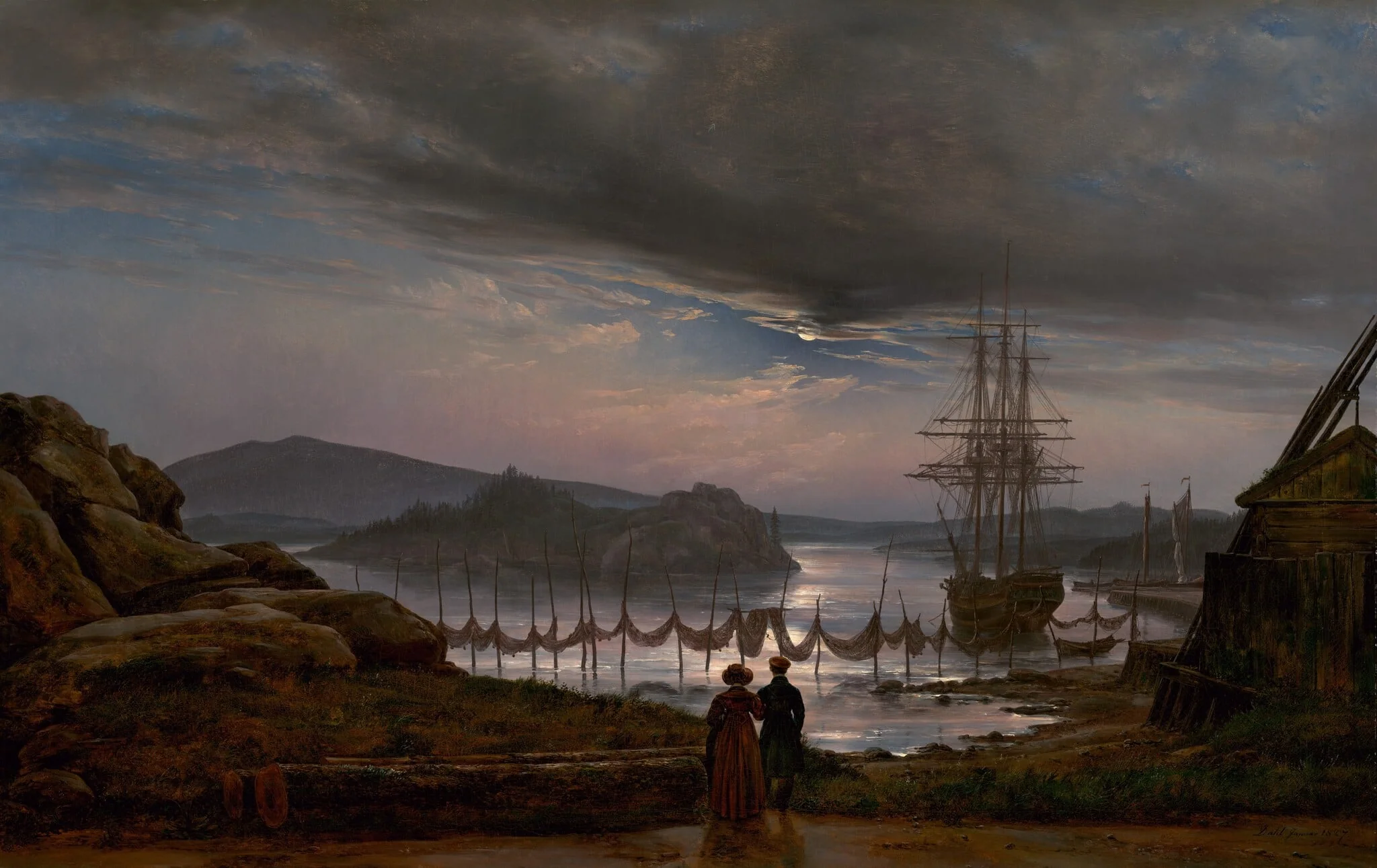
The grammar I have been describing was portable, and that is the second half of the argument. Friedrich did not keep it to himself in Dresden. He shared a house and a habit of looking with Dahl, traded ideas with Carus, and influenced a generation of Scandinavian and German painters who carried the empty composition and the resonant light north and west. Look at View from Vaekero near Christiania, where Dahl turns the Romantic apparatus toward a specific Norwegian shore. The observed detail is sharper than Friedrich would have allowed, the rocks and water studied from life, yet the structure is recognizably the same: a low foreground, a wide reach of water and sky, light doing the heavy work while the human note stays small. Dahl proves the method could survive contact with real topography. It did not need ruins and graveyards. It needed only a painter willing to clear the middle of the picture and trust the light.
Our own holdings give a sense of how broad and durable the movement became once that grammar was loose. Artifact World Gallery now keeps 504 German Romantic works, made by 213 different hands and held across 35 institutions, with dates running from a 1516 outlier at the early edge all the way to canvases of about 1902. That spread is itself an argument. A range of nearly four centuries around a movement conventionally boxed into 1780-1830 tells you that curators and catalogers keep reaching backward and forward to claim a lineage for the Romantic temper, pulling older German painting in as ancestry and later northern landscape in as inheritance. Set that figure against the Met's Heilbrunn account, which places Friedrich himself squarely in the vanguard of the movement and credits his 1805-6 sepia drawings of the Elbe with launching the Romantic motif of the open window, and you see the same instinct at work: a small formal invention, the framed view onto an outside, treated as a turning point worth dating precisely.
The biographies reinforce how local the origins were and how far the reach extended. Friedrich was born in the Pomeranian harbor town of Greifswald and took his main training at the Royal Danish Academy in Copenhagen between 1794 and 1798 before settling in Dresden for the rest of his life, as the National Gallery of Art records. A Baltic childhood and a Danish schoolroom fed into a Saxon studio, and out of that narrow geography came pictures that would shape how the whole of northern Europe imagined nature. Carl Gustav Carus and Joseph Anton Koch came at the same problem from medicine and from the heroic-landscape academies respectively, and their differences are exactly what let us see the break as a deliberate set of choices rather than a single house style.
What the break left behind
It is tempting to file German Romanticism as a beautiful dead end, a poetry of solitude that the harder, brighter painting of the later nineteenth century left behind. The opposite is closer to the truth. The three formal moves I have traced did not die with Friedrich in 1840. The cleared composition, with its small figure and its wide vacancy, becomes the template for a great deal of later landscape and, eventually, for the framed emptiness of modern photography and film. The light treated as event, sourceless and atmospheric, runs straight into Symbolism and the Nordic painting of the 1890s. Even the suppressed surface has a long afterlife, because once a painter has learned to make the hand vanish, the decision to make the hand reappear becomes meaningful, which is part of what gives later, rougher painting its charge.
So the next time you stand before one of these quiet canvases, resist the invitation to read it only as melancholy. Read it as engineering. Find the empty middle and ask what the painter aimed at it. Find the light and ask where it is allowed to come from. Put your face close to the surface and look for the stroke that is not there. The feeling everyone talks about is real, but it is the output of a machine the Germans built on purpose, and the machine is still running every time a picture decides to show you almost nothing and make you lean in.
Sources & further reading
- Romanticism, Art Term — Tate
- Jena Romanticism — Wikipedia
- Caspar David Friedrich, Monk by the Sea — Smarthistory
- German Masters of the Nineteenth Century (full text) — Internet Archive
- Caspar David Friedrich — The Metropolitan Museum of Art, Heilbrunn Timeline of Art History
- Caspar David Friedrich, biographical note — National Gallery of Art
- Caspar David Friedrich, A Walk at Dusk — The J. Paul Getty Museum
- Caspar David Friedrich, Northern Landscape, Spring — National Gallery of Art