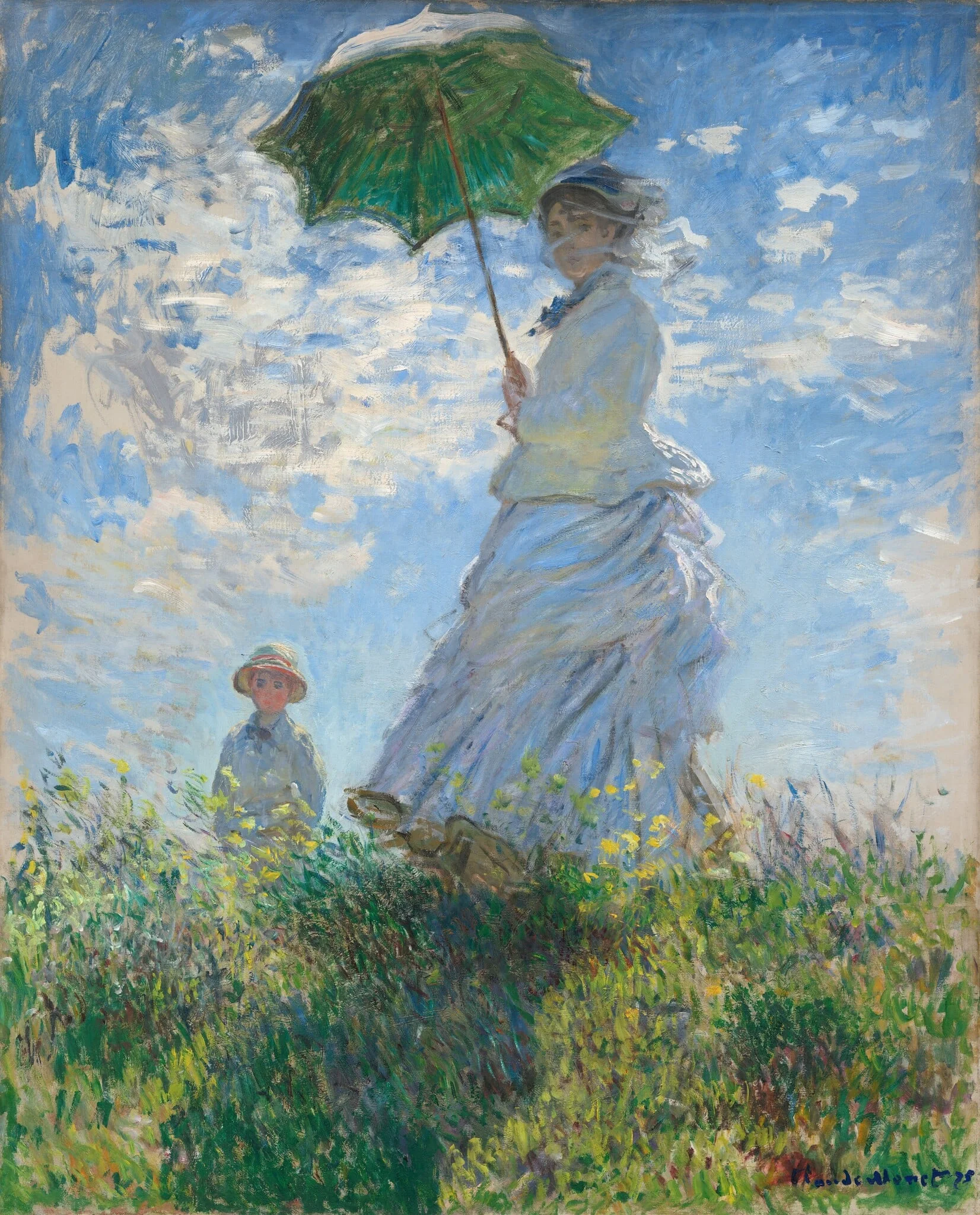
The first Impressionist exhibition opened on 15 April 1874 in the Paris studio of the photographer Nadar. Thirty artists showed 165 works. The critics were not kind. Louis Leroy, writing for the satirical journal Le Charivari, borrowed the word “impressionism” from Claude Monet’s Impression, Sunrise and turned it into a jeer. The painters kept the name. Within a generation, it had become the most influential shift in the history of Western painting.
What had changed was not the subject matter. Monet, Renoir, Degas, Pissarro, Sisley, Morisot, and Caillebotte painted the same world that academic painters had always painted: landscapes, portraits, scenes of city and country life. What had changed was the question they were asking. Academic painters asked what a scene should look like. The Impressionists asked what it actually looked like at a given moment, under a given quality of light.
The break from the salon
The path to that 1874 exhibition ran through years of rejection. The Paris Salon, the official annual exhibition run by the Académie des Beaux-Arts, was the only venue that counted for a painter’s career in nineteenth-century France. Its jury favored history paintings, mythology, and academic technique: smooth surfaces, invisible brushwork, careful finish. Paintings were approved or refused.
Monet, Renoir, and their circle were refused often enough that in 1874 they organized their own show. The decision was not just practical. It was a declaration that they had no interest in the academy’s standards because they were after something the academy could not measure.
What they were after was duration — or rather its opposite. They wanted to catch a moment before it could settle into permanence. Monet set up three canvases at once, painting each for the brief window when the light matched what he had begun. Renoir mixed colors directly on the canvas rather than building up carefully layered glazes. The results looked unfinished to anyone trained on academic painting, which was precisely the point.
Techniques and intentions
The movement produced no shared manifesto. What it produced instead was a set of shared practices that emerged from painting side by side, showing each other’s work, arguing in cafés.
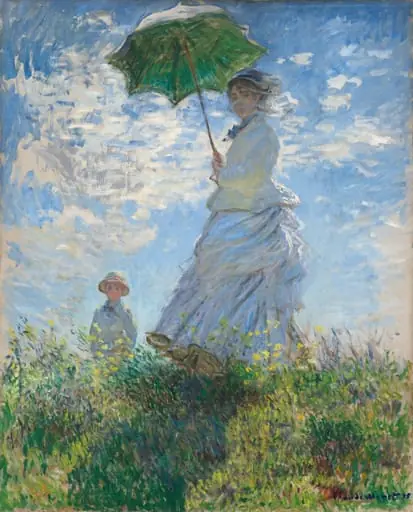
Broken brushwork was the most visible of these practices. Rather than blending colors on the canvas until transitions were invisible, Impressionist painters placed strokes of unmixed color next to each other and let the eye do the mixing. Renoir’s flesh tones are built from adjacent dabs of rose, cream, and ochre. Stand close and they look chaotic. Step back and they resolve into skin.
Outdoor light was another concern. Academic painters worked in studios under controlled northern light. The Impressionists painted outdoors — not just sketching but making finished canvases outside in the field. The technique had a name, plein air painting, but it was less a technique than a commitment: to the actual quality of daylight, which changed with the hour and the season and the weather, and which could not be invented in a studio.
Color shadows followed from this. Academic training taught painters to model shadow in brown or grey, which was how shadow was understood in the studio. Outside, Monet and Pissarro noticed that shadows carried color — blues and violets in winter light, cool greens in the shade of trees. They painted what they saw rather than what the convention said they should see.
The painters and their concerns
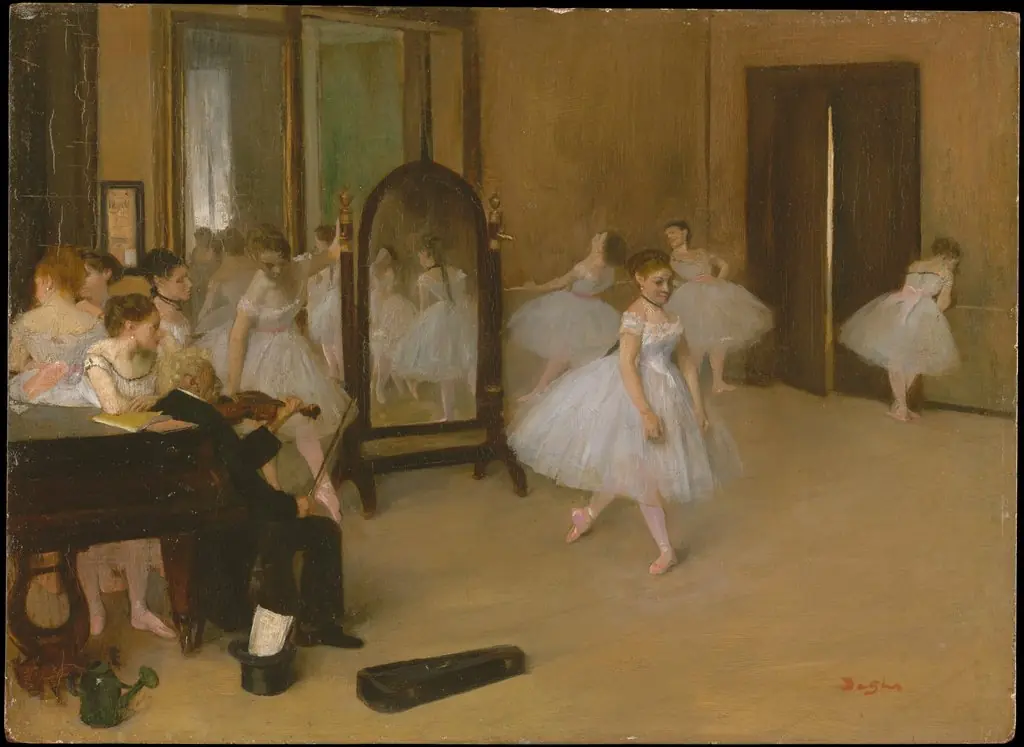
The Impressionists were not a homogeneous group. Edgar Degas, for example, was suspicious of the outdoor program and worked primarily indoors, painting dancers at the Paris Opéra, women bathing, jockeys before a race. His interests were compositional: the odd angles of a figure cut by the edge of the canvas, the spatial tension of bodies arranged in shallow depth. His connection to the group was personal and social as much as visual.
Berthe Morisot was one of the original eight who organized the 1874 exhibition. She painted domestic life, women and children in gardens and interiors, with a directness that male critics frequently attributed to intuition rather than intention. She showed in seven of the eight Impressionist exhibitions, more than any other participant.
Camille Pissarro, the oldest of the core group, was perhaps the most consistently committed to its program. He painted Normandy, Brittany, and the countryside around Pontoise over decades, returning to the same subjects season after season. He was also the most politically engaged, associated with anarchist and socialist circles, and is the only artist to have shown in all eight exhibitions.
Claude Monet’s relationship to the movement he helped found was characteristic: he eventually moved beyond it. His late water garden paintings at Giverny, the large Nymphéas canvases now at the Orangerie in Paris, are less about capturing a moment than about dissolving into sensation altogether. He was painting toward something that had no name yet.
What remained
The Impressionist painters themselves did not agree on what came next. Renoir spent years trying to reconcile his Impressionist habits with a more classical approach to form. Cézanne, who had shown briefly with the group, spent his later career working out how to give structure to sensation — work that fed directly into Cubism. Seurat and Signac took the broken brushwork and systematized it into Pointillism.
The 1874 exhibition had its eight successors, the last in 1886. By then the Impressionists were no longer a unified group, and the most radical of their successors — Gauguin, Van Gogh, Toulouse-Lautrec — were already doing something else entirely.
What the movement left behind was a change in what painting was for. After 1874, a painter could no longer assume that the job was to represent the world in terms that the academy recognized. The job could be to capture light, or sensation, or a quality of attention, or the act of seeing itself. Every movement that followed — Fauvism, Expressionism, Cubism, abstraction — worked in the space that the Impressionists opened. They did not know they were opening it. They thought they were painting the light on the water at Argenteuil.
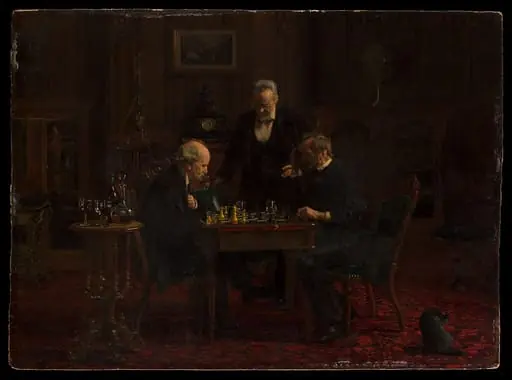
For a closer look at the painter most identified with the movement, see the Claude Monet artist page. For one of the defining American works of the period, see The Chess Players by Thomas Eakins, painted in 1876, the same year as Monet’s second Impressionist exhibition.