Claude Monet could spend entire mornings in his garden at Giverny, pacing the same path until the light shifted just right. He set up three canvases at once, swapping between them as clouds moved across the sky. If you stand in front of Rouen Cathedral’s west façade — not in Rouen itself, but in any of the thirty-plus canvases Monet painted of that façade between 1892 and 1894 — watch how the stone dissolves into brushstrokes that change with the weather. It is not the building you are seeing, but the moment light took shape.
Monet was born in Paris in 1840 and grew up in Normandy, in Le Havre, where his father was a grocer. By his late teens he was already painting the Normandy coast, already interested in the quality of light over water, already resistant to the studio-bound academic tradition that ruled French painting. He moved to Paris, fell in with Pissarro, Renoir, and Bazille, and spent the years before the 1874 Impressionist exhibition working out what he was actually trying to do.
The early work and its concerns
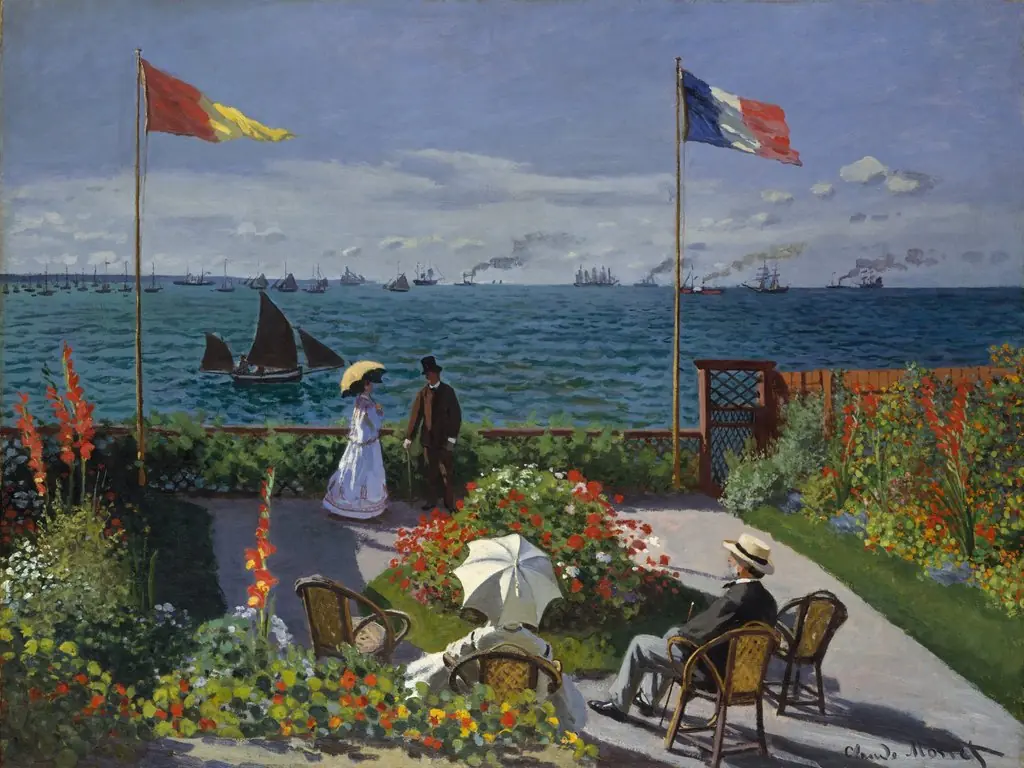
The Garden at Sainte-Adresse, painted in the summer of 1867, shows what Monet could do before the outdoor program was fully developed. The composition is formal — a fence and flagpoles divide the canvas into registers, the figures are placed with care — but the light on the sea is already doing something that academic painting rarely attempted: it is specific to a time of day, to a quality of summer glare, to the particular flatness of the Channel on a bright afternoon.
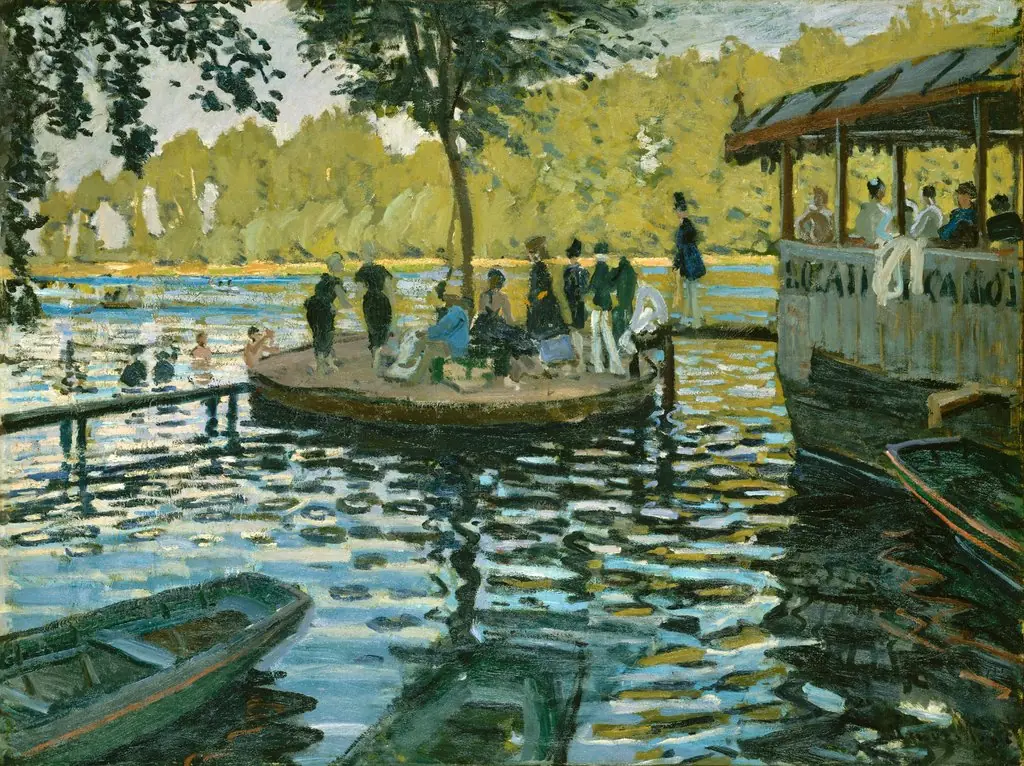
Two years later, at La Grenouillère, a floating café and bathing spot on the Seine outside Paris, Monet worked alongside Renoir on a series of outdoor sketches that look, retrospectively, like the founding documents of Impressionism. La Grenouillère uses broken brushwork to render water in a way that had not been done before: not the smooth, idealizing water of landscape convention, but the actual visual chaos of sunlight broken across ripples.
The Impressionist decade and its aftermath
In the years after 1874, Monet painted with a sustained intensity that was sometimes indistinguishable from anxiety. He worked the Channel coast, the Seine valley, Paris itself. He was chronically short of money, periodically despairing about his work, and unable to stop.
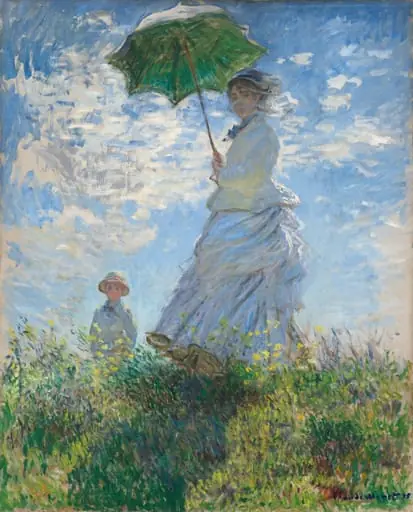
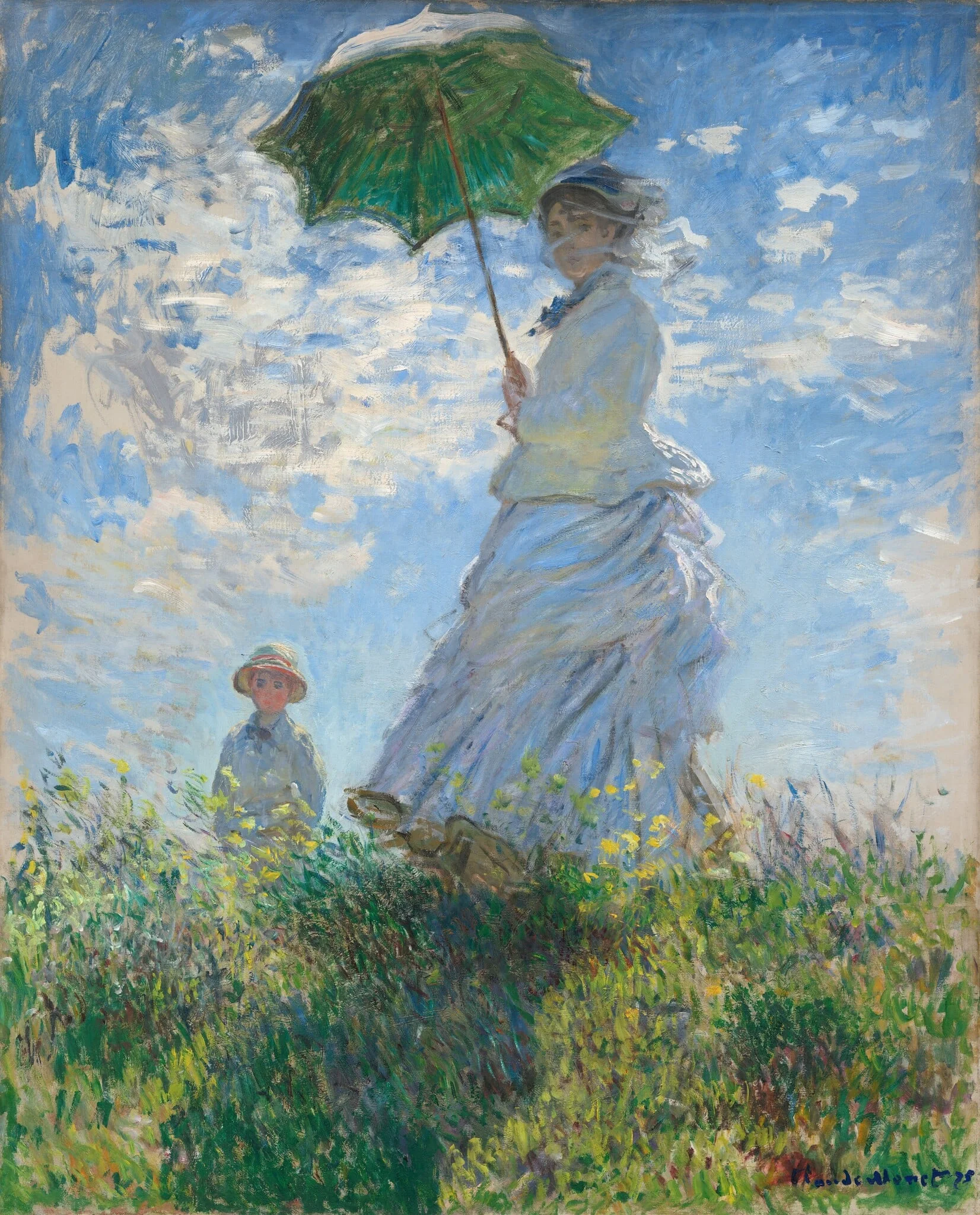
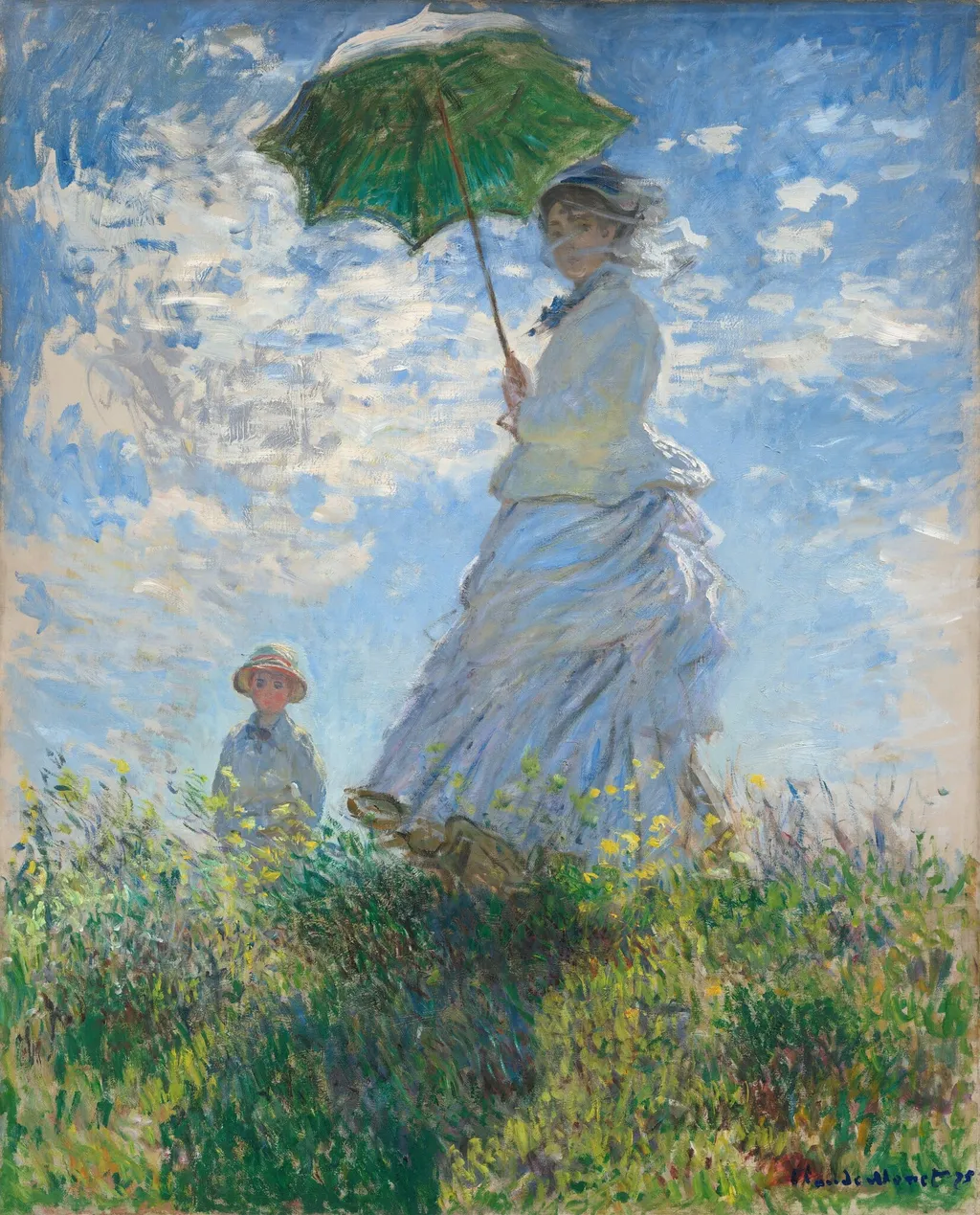
His paintings of that period are characterized by their directness. Woman with a Parasol — Madame Monet and Her Son (1875) is often cited as a characteristic Impressionist work: the figures are summarily rendered, the grass is a field of broken green and yellow strokes, the sky has the quality of actual outdoor light on an overcast summer afternoon. The feeling of air moving through the scene comes not from any single technique but from the cumulative effect of how every element is handled.
Camille Pissarro, Monet’s closest ally in the movement, said of this period that Monet was doing what none of them had dared: trusting the canvas to hold the impression before it cooled. Alfred Sisley and Gustave Caillebotte, working alongside him, were doing related things — Sisley with river floods and snow, Caillebotte with Parisian streets — but Monet’s commitment to the outdoor light, to the specific truth of a specific moment, was the most uncompromising.
The series paintings
The approach that defines Monet’s mature work — painting the same subject repeatedly, at different hours, in different seasons, under different atmospheric conditions — began to take systematic form in the late 1880s. He painted haystacks, then the façade of Rouen Cathedral, then the Thames in London, then the Normandy coastline at Étretat, where the stone arches of the cliffs offered the same kind of monumental subject that dissolved differently in every light.
The logic of the series is not repetition for its own sake. Each canvas asks a sharply limited question: what does this thing look like at seven in the morning, in November, with ground fog? The answer changes the next day. Monet was not painting the subject; he was painting the relationship between the subject and the conditions that made it visible.
This is what made him difficult to work with and occasionally maddening to his dealers. He would not release a series until he had enough canvases to show the full range of conditions. He sometimes destroyed work that did not meet the standard he had set with the better canvases in a series. Durand-Ruel, who championed his work through decades of critical hostility, learned to wait.
Giverny and the late work
Monet bought the house and garden at Giverny in 1890, after years of renting it. He spent the next three decades redesigning the garden and painting almost nothing else. The water garden — the pond, the Japanese bridge, the weeping willows, the water lilies — was both his subject and his studio, a landscape he had designed specifically to paint.
The late Nymphéas canvases, which he worked on through the First World War and into the 1920s, are different from anything he had made before. The horizon is gone. The surface of the water is also the surface of the canvas. Reflections of clouds and sky sit in the same plane as lily pads and submerged stems. The distinction between what is above the water and what is below it becomes uncertain.
Monet worked on these canvases through failing eyesight — he underwent cataract operations in 1923 — and through the grief of the war, which killed several people he had been close to. The large panels he eventually donated to the French state, now installed in the Orangerie in Paris, were intended as a memorial to the war dead, a place where the eye could rest in the continuous movement of light on water.
Whether that intention is legible in the paintings is a question each viewer has to answer alone. What is unambiguous is that Monet, at eighty, was still doing what he had been doing at twenty-five: asking what light actually does, and trying to hold the answer on a canvas before it changed.
For a broader view of the movement Monet helped found, see the Impressionism overview. To explore his work in the collection, visit the Claude Monet artist page and the tile board, which organizes his paintings by their visual affinities with the work of Pissarro, Caillebotte, and Sisley.