Follow the interior as a painting genre across four centuries and you are really watching one room change hands. It starts as a tidy Dutch parlor with a checkerboard floor and a letter half-read by a window. It ends as a cramped Paris sewing room where a mother bends over her needlework and the wallpaper does most of the talking. The argument of this essay is simple and a little stubborn. The interior did not stay still. It traveled, and in transit it shed its old job as a stage for moral anecdote until the room itself, its light and its hush, became the entire subject. What follows tracks that handover work by work, because the change is visible in the paint long before any critic gave it a name.
That journey has a direction, and each move forward strips something away. The Dutch put a story in the room and asked you to read it. The collectors of the next century emptied the story out and filled the walls with their own pictures, turning the interior into an inventory of taste. The Romantics carried it into the studio and made the room a place where a mind sits and works. The Parisians of the 1860s and 1890s threw out the last of the narrative and kept only the light on a wall and a figure too absorbed to notice you. By the end, nothing happens in these rooms, and that absence is the achievement. A genre that began by promising you a glimpse of someone else's life ended by handing you a wall and asking you to feel the silence in front of it.
The Dutch room as a machine for meaning
Begin in the Dutch Republic, where the genre took its modern shape. The scenes of everyday life that we now file under genre painting developed particularly in Holland in the seventeenth century, as the Tate glossary puts it, and the Low Countries held the field almost without a rival into the next century. A working painter in Delft or Leiden could spend a whole career on nothing but rooms: a woman reading a letter, a man at a virginal, a maid pouring milk. The room was the form, and the form sold steadily to a middle class that wanted its own daily life back on the wall. No church commissioned these pictures and no prince required them. They hung in the houses of merchants and notaries, small enough to live with, finished to a polish that flattered the rooms they were bought to decorate.
These rooms were never neutral. A large part of the appeal of a Dutch interior, as Jennifer Meagher writes for the Metropolitan Museum's Heilbrunn Timeline, lay in the chance it gave the viewer to look into a private space otherwise closed to them. You were being let in. Once inside, you were meant to read. A snuffed candle warned of vanitas, an open door promised a moral somewhere past the threshold. The interior worked like a machine for delivering meaning, every object a small lever you were expected to pull. A viewer trained on these conventions did not see a quiet room. They saw a sermon laid out in furniture, and the pleasure of the picture was partly the pleasure of decoding it.
Look at how Vermeer handled the light in his Milkmaid, now in the Rijksmuseum. The whitewashed wall is not blank. It carries a faint nail and its shadow, a scatter of small holes, and a daylight that strikes the bread crust and breaks into hundreds of bright points of paint. Nothing in the room is doing anything except being looked at hard. The woman pours a thin thread of milk and the whole picture seems to hold its breath around that one slow action. Vermeer pushes the anecdote so low that the light itself becomes the subject, half a century before anyone in Paris thought to try the same trick. He keeps the plain virtue of domestic work that a Dutch buyer would expect, but he spends his real attention on optics, on the way a surface eats and throws back the sun.
Pieter de Hooch worked the same Delft rooms and their courtyards. His Dutch Courtyard at the National Gallery of Art sets a handful of figures in a brick-walled yard, the sun warming one wall while a passage leads the eye to a sliver of street beyond. De Hooch loved that recession, the room within the room, the doorway that frames a farther light. He builds depth the way a bricklayer builds a wall, course by patient course, and the figures stay almost incidental to the geometry that holds them in place. Where Vermeer gives you one charged room, de Hooch gives you a sequence of them, each threshold a small promise that the house continues past what you can see. The story barely matters. The architecture is the feeling.
What the Dutch fixed, then, was a grammar. A room seen at a slight angle, a figure caught mid-task and indifferent to you, a light coming low from one side. Every painter who came after inherited that grammar whether they wanted it or not. The history of the interior after Delft is the story of what each generation chose to keep and what it could finally afford to throw away.
The room becomes an inventory of taste
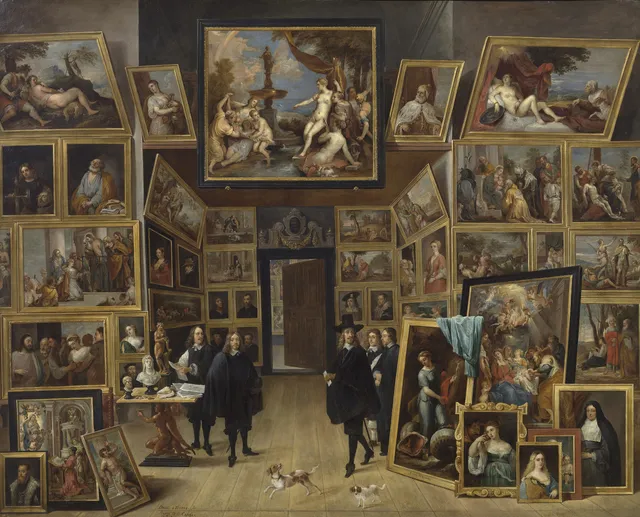
Move south, up the social ladder, and the interior changes employer. In Brussels in the 1650s, David Teniers the Younger painted Archduke Leopold Wilhelm in his Gallery, and the room stops preaching about virtue. It now catalogs property. The Archduke's pictures hang frame to frame, floor to cornice, a wall of Venetian and Flemish masters rendered small but legible, each one a trophy. Teniers was the keeper of that collection, and his canvas doubles as a printed inventory in oil. This is the Baroque interior as a brag, portable proof of what a prince owns. The genre has not changed its medium, only its purpose. The room that once asked you to read a moral now asks you to count the masterpieces and understand whose they are.
A century on, the Dutch took the idea back and made it bourgeois. Adriaan de Lelie painted The Art Gallery of Jan Gildemeester Jansz in the mid-1790s, and the sitter is no archduke but an Amsterdam merchant with a fine eye. Well-dressed visitors stand in a top-lit room talking about the pictures, and the pictures are the real point, a hang you could almost reattribute today. The genre has quietly inverted. The figures who once acted out a lesson now stand around admiring possessions, and the room survives only to show off a collection rather than a meaning. Notice what has happened to the viewer's job. In the Dutch parlor you read the room. In the gallery picture you appraise it, and the painting teaches you to want what the merchant has.
The studio, a room where a mind works
The Romantics carried the interior somewhere stranger, which is to say inward. Léon Cogniet painted The Artist in His Room at the Villa Medici, Rome in 1817, a young Prix de Rome winner alone in his lodging. The room is nearly bare. A bed, a window open to the Roman light and the city it promises. There is no guest, no symbol, no canvas hung to be decoded. The subject is the condition of being a young artist far from home, the charged quiet of ambition in a rented room. The interior has become a self-portrait that leaves most of the self out of the frame. Cogniet trusts the emptiness. He lets the bare walls and the single bright window stand in for everything a more anecdotal painter would have spelled out, the homesickness and the long working hours that the bed and the light only hint at.
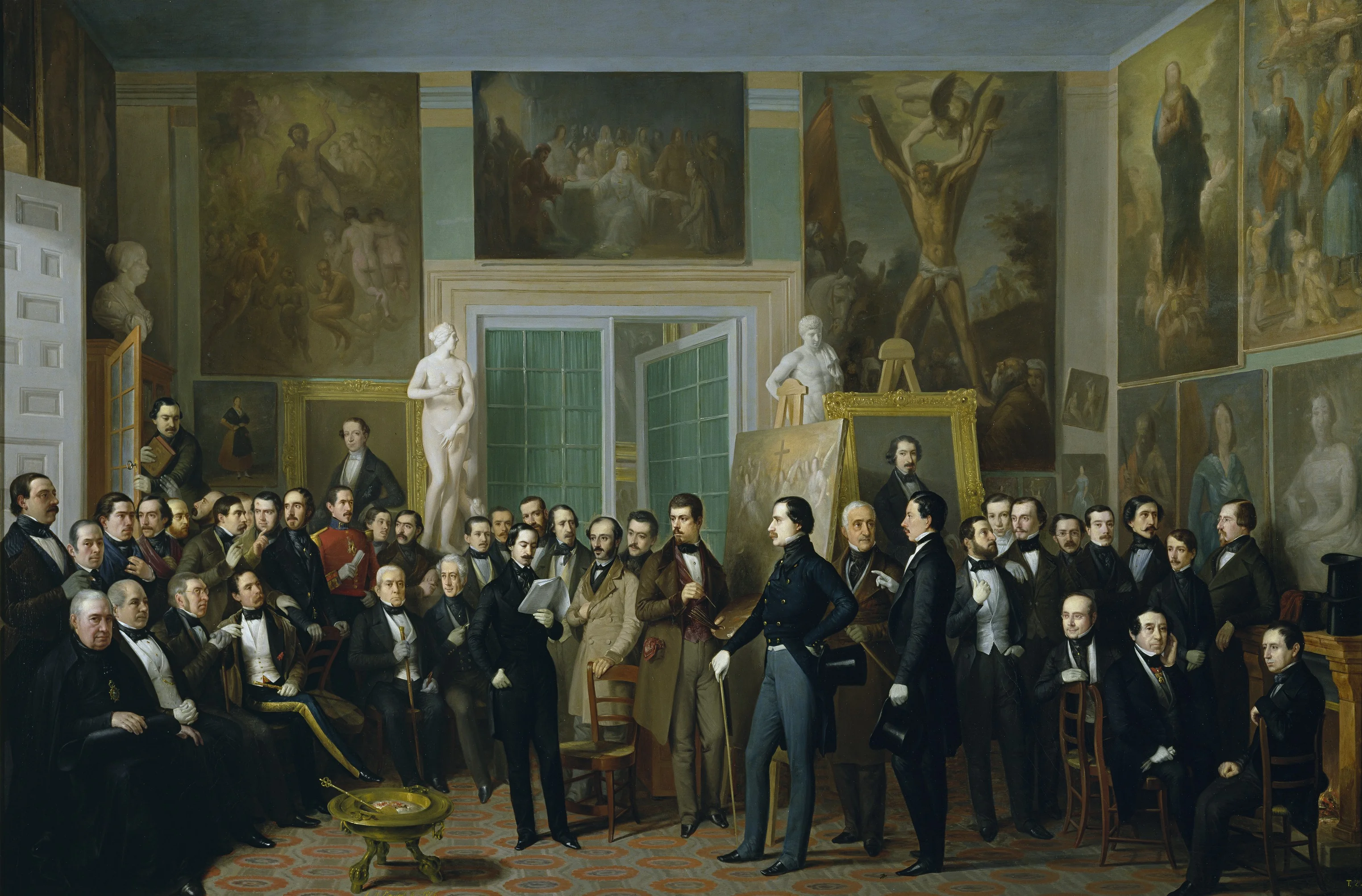
Spain took that studio interior and crowded it back up, but with a new cast. Antonio María Esquivel finished The Contemporary Poets. A Reading of Zorrilla in the Artist's Studio in 1846, and it rewards standing in front of it for a while.
Look at how the room is organized. Esquivel ranks the writers and painters of Madrid in tight rows of chairs across a high studio, the dark frock coats reading as a single mass of black broken by white collars and pale faces all turned one way. At the left the poet José Zorrilla stands and reads, the only figure on his feet, and the seated crowd leans toward him so the whole composition tilts along that axis of attention. Behind and above them the studio wall climbs into shadow, hung with the painter's own canvases and lit by a tall window that drops a cool gray daylight onto the upturned heads. The floor is plain. The furniture is plain. Esquivel spends his finish almost entirely on faces, more than forty of them, each a recognizable likeness, so the room becomes a directory of a literary generation caught in one place at one hour. The interior is doing two jobs at once. It is a working studio with its raking north light, and it is a monument, a group portrait disguised as a casual reading. The genre has learned to hold a crowd without losing the intimacy that made the Dutch parlor work, and the cool light pooling on those forty faces is doing the holding.
Paris, the window, and the vanished story
The last leg of the trip runs through Paris, and it is where the interior finally drops the anecdote for good. In 1867 Claude Monet painted The Cradle - Camille with the Artist's Son Jean. A young mother sits beside a curtained cradle, one hand resting on the fabric, and that is the whole event. No symbol asks to be read. The green of the canopy and the dark of Camille's dress are solved as color problems before they are read as a story. Monet, soon to be the public face of Impressionism, is not telling you what motherhood means. He is showing you a room at one minute with one light in it, and trusting that to carry the picture. The cradle is just a cradle. The tenderness is real, but it arrives through the handling of paint rather than through any prop set down to instruct you.
Édouard Vuillard pushed that trust to its limit. Our holdings alone run to eighty-odd Vuillard interiors, and the small panel Mme Vuillard Sewing by the Window, rue Truffaut is the type specimen. His mother sits at her needlework against the window, and Vuillard nearly dissolves her into the patterned wall behind her, figure and wallpaper built from the same flecked, close-keyed paint. You have to hunt for the line where a person stops and her room begins. This is the interior at the far end of its road from Delft. The room is no longer a container for a figure. It is the same substance as the figure, and the only story left is the quiet of a woman who has done this same work every day for thirty years. Vuillard painted his mother's apartments over and over, the same lamps and cluttered tables, until the rooms read less like places than like states of mind, warm and a little airless.
Works discussed in this article
What the gallery's own rooms reveal
Set our own shelves against that history and the spread confirms the route. Across Artifact World Gallery the interior runs to 2,696 works by roughly 1,200 artists, held in 121 venues and reaching from rooms painted around the year 1000 to canvases finished in the last few years. That thousand-year span is not evenly filled. It thins to almost nothing before the Dutch, swells hard in the seventeenth century and again across the nineteenth, and the single most-represented hand in the whole set is Vuillard, whose near-compulsive painting of his mother's apartments shows how completely the genre had turned inward by 1900. A category that began as a Dutch specialty, as the survey histories record, ends up concentrated in one painter who worked the same few rooms for a lifetime. The numbers tell the same story the paintings do. The interior is a young genre wearing an old name, thin everywhere until a market in the Low Countries gave painters a reason to make rooms the whole job, and thickest exactly where the room stopped illustrating a life and started being one.
There is a second figure worth pausing on. These rooms are scattered across 121 institutions, which means no single museum owns the genre's story. A category this dispersed got that way because its market kept moving, from a tight Dutch trade in cabinet pictures to a diffuse nineteenth-century one where regional museums and academies bought living painters. The interior's history is also a history of who paid for it, and that economic shift is written into the sheer breadth of the shelf. The genre survives because it stayed cheap to make and easy to live with, a room you could buy and hang inside your own.
So the room kept moving, and it never went back. You can stand in front of a Vuillard panel and still feel the Delft parlor underneath it, the same northern light falling on the same domestic quiet. But the letter has been read and set down, the moral has been forgotten, and what remains is a person and the wall behind her laid in with one breath of paint. The interior traveled all that way to find that wall. It is still there, holding its light, waiting for the next painter to walk in.
Sources & further reading
- Genre painting — Tate
- Genre Painting in Northern Europe — The Metropolitan Museum of Art
- The Milkmaid — Rijksmuseum
- A Dutch Courtyard — National Gallery of Art
- Interior with a Young Couple — The Metropolitan Museum of Art
- Genre painting — Wikipedia
- Johannes Vermeer — Smarthistory
- The Masters of Past Time: Criticism on the old Flemish & Dutch Painters — Internet Archive