Artwork
The Cradle - Camille with the Artist's Son Jean
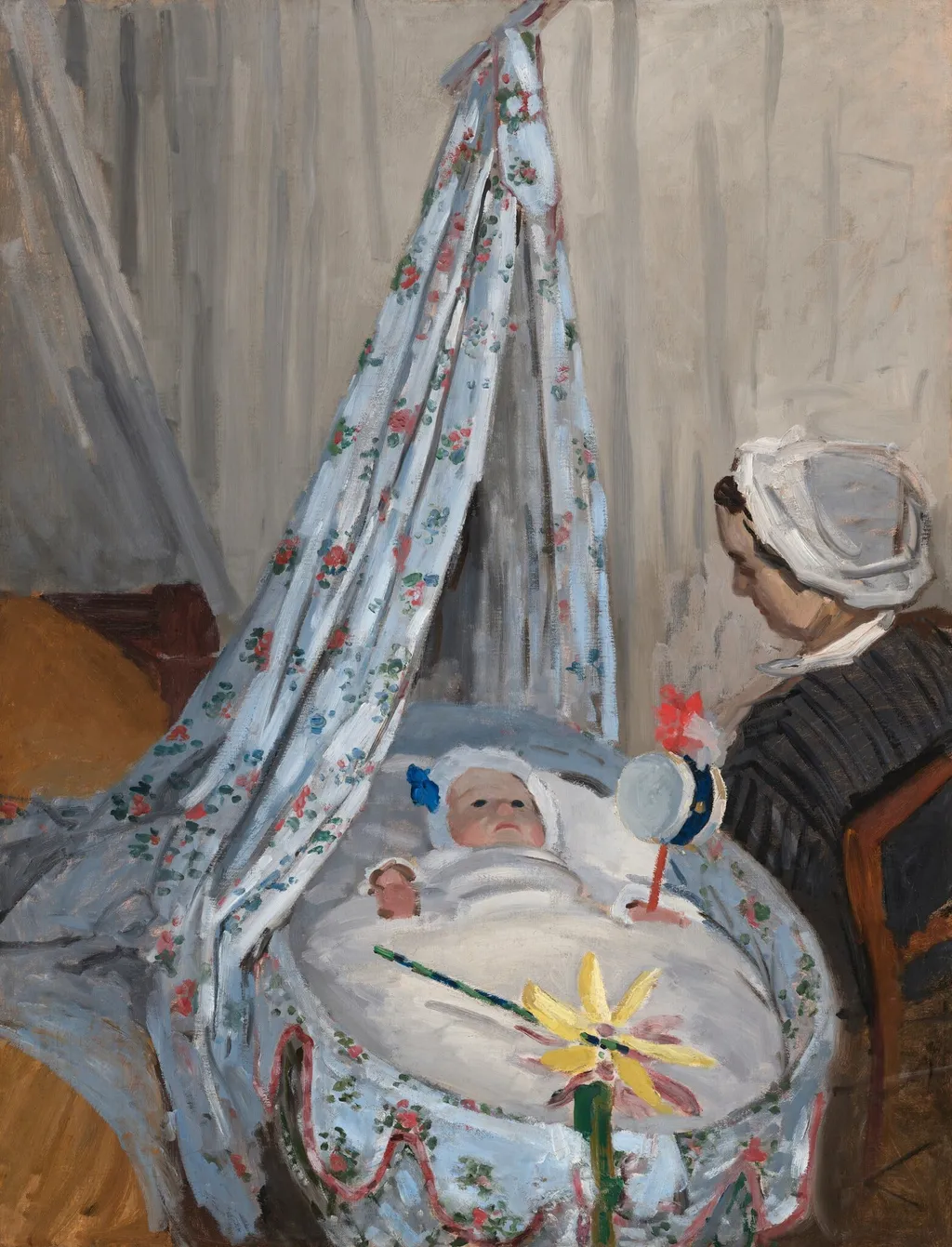
The Cradle - Camille with the Artist's Son Jean is an oil painting by the Impressionist artist Claude Monet. It dates from 1867 and is held in the collection of the National Gallery of Art.
About this work
History & Provenance
Notable exhibition history includes a 1918 showing in Bremen, where it was listed in the catalogue as lent by Frau Meta Schütte from her private collection.
Claude Monet painted The Cradle – Camille with the Artist’s Son Jean in 1867, depicting his wife Camille Doncieux holding their infant son Jean; the work was created for personal display rather than commission. Its early ownership passed from Dr. Georges de Bellio to the Donop de Monchy family, then through sales to von Tschudi, Boussod, Valadon et Cie, Galerie Caspari, and Mrs. Meta Schütte by 1918. The painting remained in the Schütte family until circa 1948, was sold to E.J. van Wisselingh and Co., then to Wildenstein, Arnold Kirkeby, the Friedlands, Knoedler, and finally to Paul Mellon in 1965, who gifted it to the National Gallery of Art in 1983.
The painting is held at the National Gallery of Art in Washington, D.C., where it was accessioned in 1983 as a gift from Paul Mellon. Its presence in the museum's collection is confirmed by its current location and inventory status. Prior to this final donation, the work passed through several prominent private collections, including those of Dr. Georges de Bellio, Mrs. Meta Schütte, and Arnold Kirkeby.
Notable exhibition history includes a 1918 showing in Bremen, where it was listed in the catalogue as lent by Frau Meta Schütte from her private collection. The artwork, measuring 116.2 by 88.8 cm, depicts Camille Doncieux and Jean Monet. Its journey to the National Gallery involved sales through major dealers such as Wildenstein and Co. and M. Knoedler & Co., culminating in the 1983 gift that secured its place in the public trust.
Context
Painted in 1867, The Cradle portrays Camille Doncieux cradling her son Jean and serves as an early example of Monet’s intimate domestic subjects that prefigure Impressionist concerns with light and familial tenderness. Its provenance, traced through the de Bellio collection, private exhibitions in Bremen, and a series of sales documented from 1907 to 1983, illustrates the work’s circulation among collectors before its acquisition by the National Gallery of Art. Scholarly attention emphasizes the painting’s significance for understanding Monet’s early portraiture and his relationship with Camille, as well as its role in the broader narrative of Impressionist art history.
Overview
The Cradle, painted by Claude Monet in 1867, depicts his wife, Camille Doncieux, seated beside the sleeping infant Jean in a white wicker crib. The composition focuses on the intimate domestic moment, with Camille gazing intently at her child while her body is angled toward the viewer. Monet employs loose, rapid brushstrokes characteristic of early Impressionism to render the scene, particularly in the background and the folds of Camille's striped dress, which contrasts with the sharper definition of the crib and the child's hand.
Natural light enters from a window on the right, illuminating the lace on Camille's sleeve and the baby's fist, creating a soft interplay of shadow and illumination. This work marks a significant departure from Monet's earlier landscapes and seascapes, signaling his exploration of domestic interior subjects during a period of personal hardship and financial struggle. It stands as one of the few paintings from this era where Monet prioritized the human figure within a private setting, foreshadowing his later interest in capturing fleeting moments of daily life.
The painting remains a key example of how Impressionist techniques were applied to genre scenes, emphasizing the emotional resonance of the subject over detailed realism.
Subject & Meaning
The painting centers on Camille Doncieux, dressed in a striped garment, as she gently leans over her sleeping baby. Her expression conveys a sense of serene weariness, characteristic of new motherhood. The infant, Jean, rests in a white crib, his tiny fist visible. The scene emphasizes the quiet bond and protective gaze within a private family setting.
Technique & Style
Monet utilized oil on canvas, employing loose brushstrokes that contribute to the painting's overall softness. While the background elements are rendered with a blurred effect, the artist brought Camille's face and the crib into sharper focus. This selective clarity draws the viewer's attention to the central figures, enhancing the sense of intimacy and immediate presence.
Own this work as a print
Artist & collection
Artist
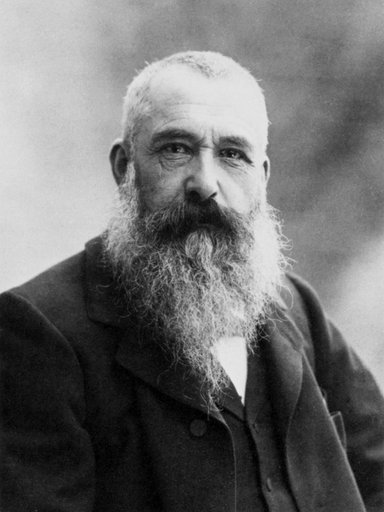
Oscar-Claude Monet was a French painter and founder of Impressionism who is seen as a key precursor to modernism, especially in his attempts to paint nature as he perceived it.




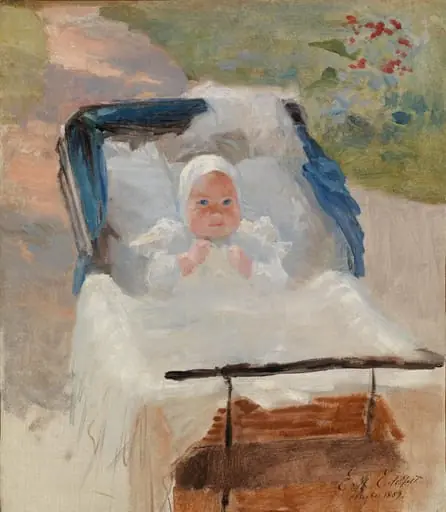 Taiteilijan poika Erik lastenvaunuissa
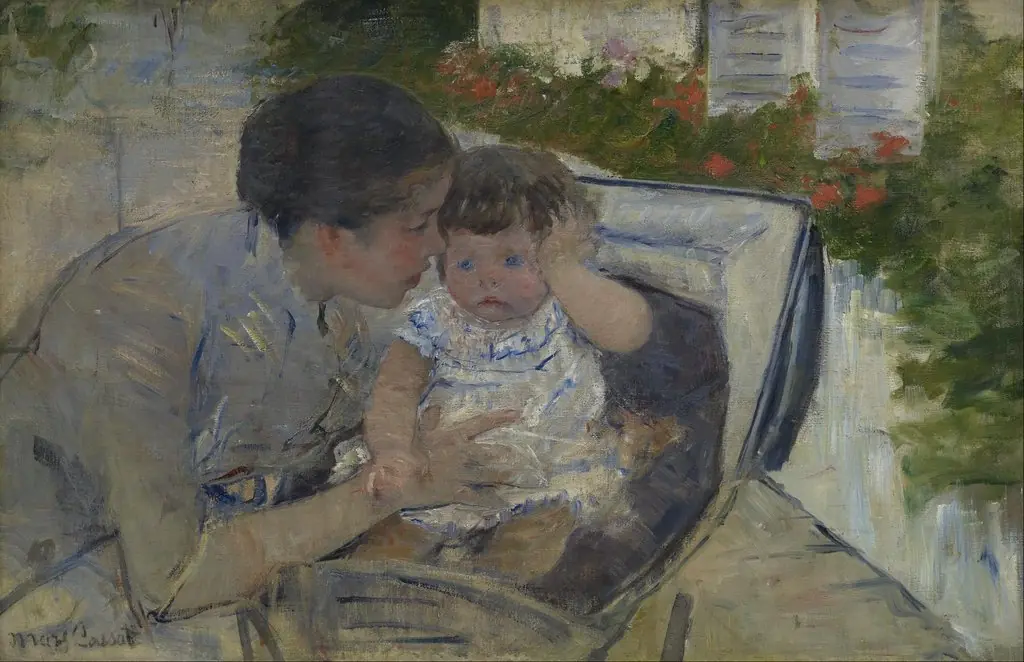 Susan Comforting the Baby
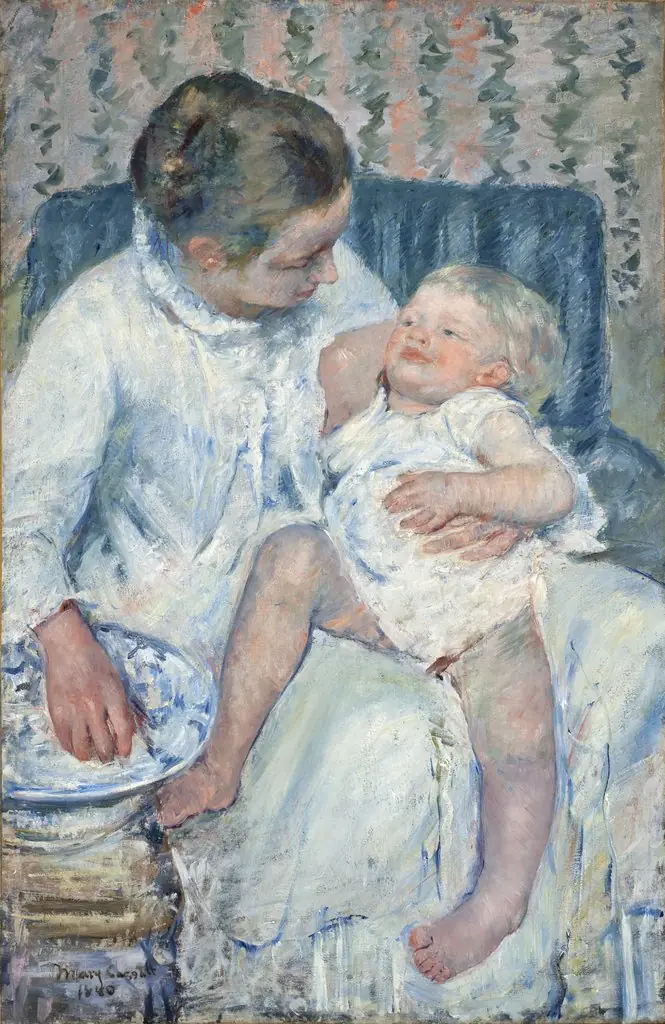 A Child's Bath
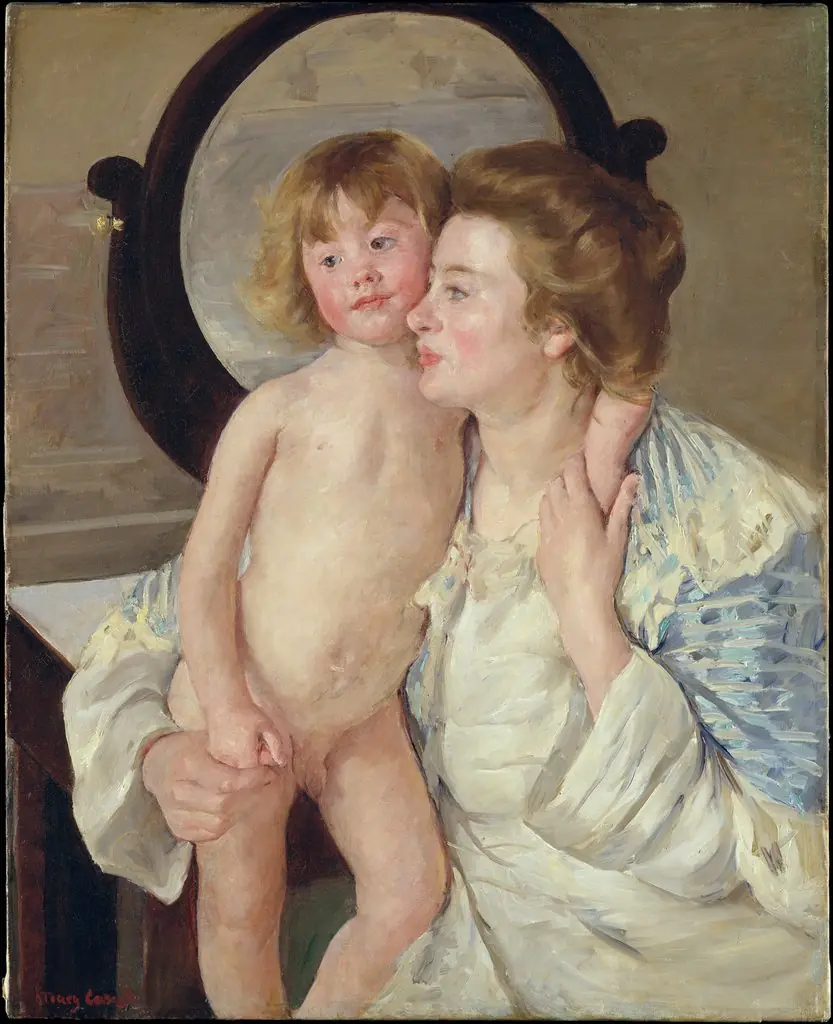 Mother and Child (The Oval Mirror)
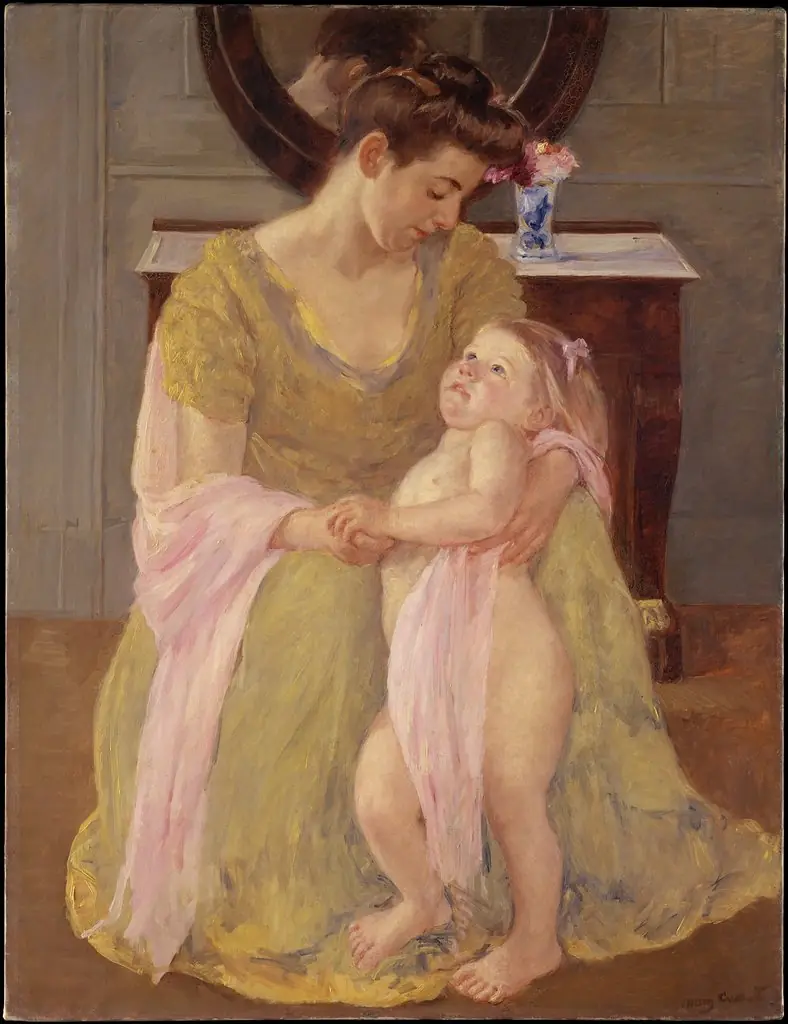 Mother and Child with a Rose Scarf
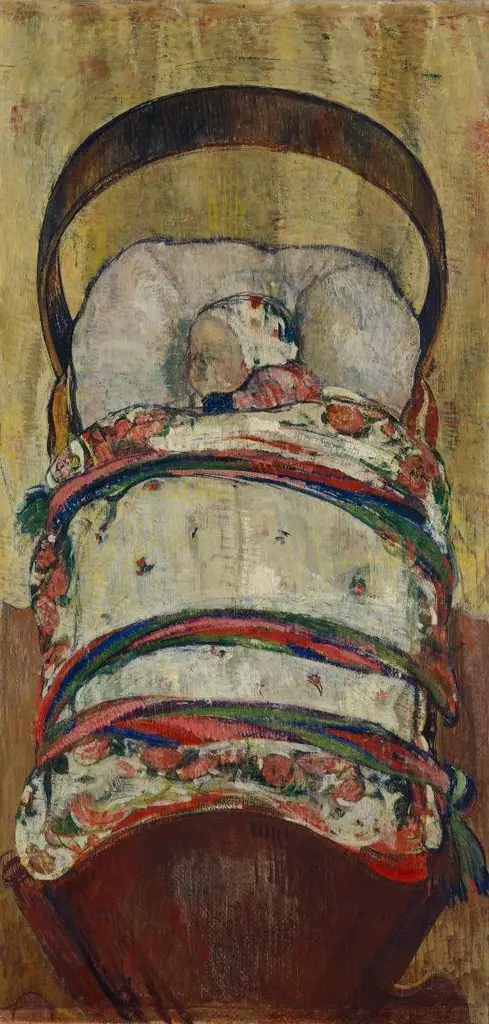 Walliser Wiege
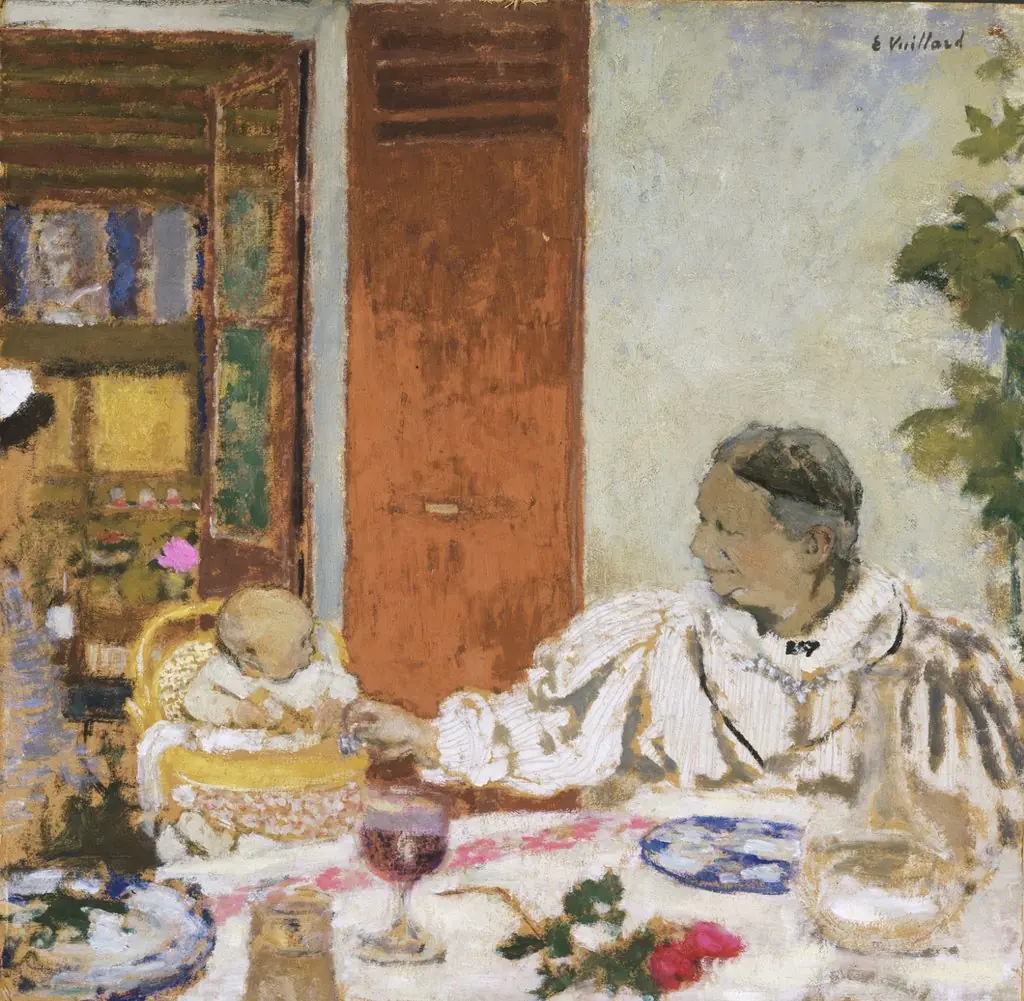 The Meal
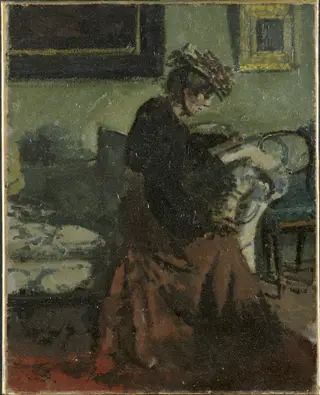 Easter Monday-Hélène Daurmont
 Caresse Maternelle
 Omakuva vuodelta 1890
 Intérieur avec femme en rouge de dos
- Luncheon (Annette and Her Grandmother)