Artwork
The Contemporary Poets. A Reading of Zorrilla in the Artist's Studio
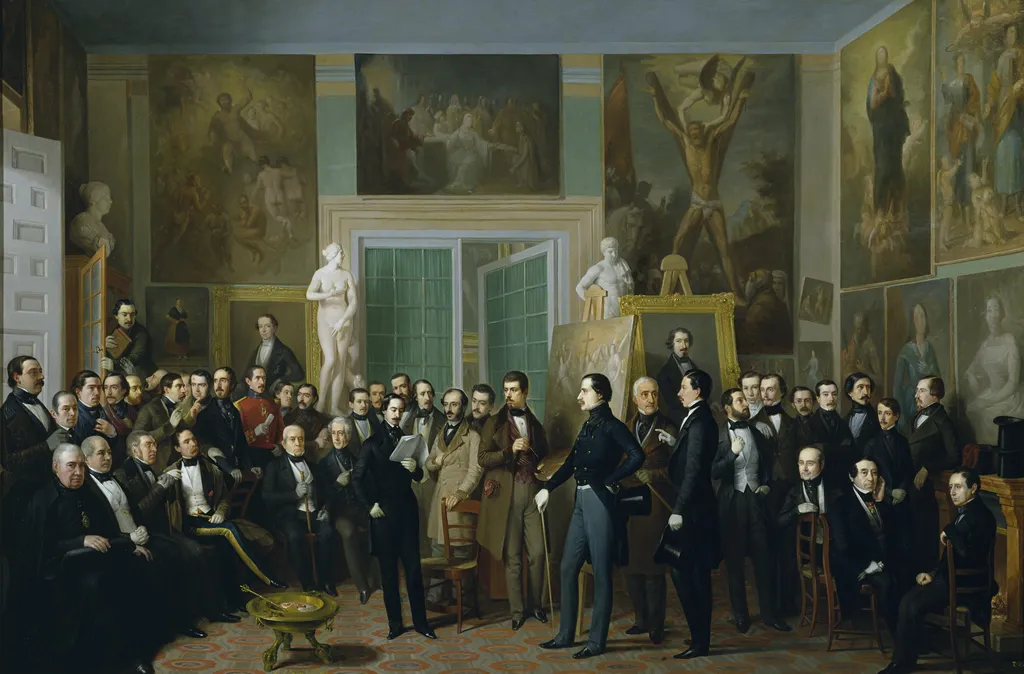
The Contemporary Poets. A Reading of Zorrilla in the Artist's Studio is an oil painting by the Romanticist artist Antonio María Esquivel. It dates from 1846 and is held in the collection of the Museo del Prado.
About this work
José Zorrilla reads aloud to an invented gathering of forty-four figures crowded into Antonio María Esquivel's Madrid studio. Painted in 1846, the canvas sets the living beside the dead: José de Espronceda, gone four years earlier, appears only as a portrait within the portrait. The large surface records the literary elite of Isabel II's reign.
Subject & Meaning
Zorrilla’s reading evokes his celebrated recitation at José de Espronceda’s funeral, a moment considered the manifesto of Spanish Romanticism.
The painting depicts a fictional gathering of Spanish Romantic poets and artists in Antonio María Esquivel's studio, centered on José Zorrilla reading a poem aloud. Iconographically, it functions as a collective portrait or 'iconographic mosaic of the Elizabethan Parnassus', assembling the leading literary and artistic figures of the era. Symbolically, the work represents Esquivel's gratitude toward the Liceo Artístico y Literario, which funded his eye treatment after he lost his sight and attempted suicide.
Zorrilla’s reading evokes his celebrated recitation at José de Espronceda’s funeral, a moment considered the manifesto of Spanish Romanticism. The composition, modeled after Flemish Baroque cabinet paintings, and the detailed studio decor emphasize the intellectual community and collaborative spirit of Madrid’s Romantic circle. Thus, the painting stands as a testament to artistic solidarity and the defining ethos of Spanish Romanticism.
Technique & Style
Executed in oil on canvas, the painting measures 144 by 217 cm. Esquivel employed a meticulous handling characteristic of Spanish Romantic portraiture, carefully articulating the likenesses of dozens of writers and artists. The composition adopts the schema of a Flemish Baroque cabinet, with figures arranged in a crowded yet orderly grouping around two central protagonists: José Zorrilla reading aloud and the artist himself at his easel, palette and brush in hand. A large window provides lateral illumination, casting soft, even light across the studio interior.
The walls are densely hung with paintings, some by Esquivel and others from his collection, lending the scene the character of a private gallery. This detailed rendering of the studio environment, combined with the collective portrait format, creates a staged but documentary-like record of Madrid's literary circle.
History & Provenance
Antonio María Esquivel painted the work in 1846 as a gesture of gratitude to the fellow poets and artists who had raised funds for his eye surgery after a near-fatal illness and suicide attempt. It was first exhibited that same year at the annual exhibition of the Real Academia de Bellas Artes de San Fernando in Madrid. Initially held by the Spanish Ministerio de Fomento, the painting was transferred by royal order on 17 April 1866 to the Museo de la Trinidad.
After that museum closed in 1872, it entered the Museo del Prado. In 1896 the Prado loaned it to the Museo de Arte Moderno (later the Museo Español de Arte Contemporáneo), and it finally returned to the Prado in 1971.
The painting is held at the Museo del Prado in Madrid, Spain. It was first exhibited in 1846 at the annual exhibition of the Real Academia de San Fernando. Subsequently, it was housed in the Ministerio de Fomento before being transferred to the Museo de la Trinidad by Royal Order on 17 April 1866.
Following the dissolution of that museum in 1872, it entered the Museo del Prado. In 1896 it was relocated to the Museo de Arte Moderno (later the Museo Español de Arte Contemporáneo) and eventually returned to the Prado in 1971. No specific inventory or accession number is recorded in the sources.
Context
The painting is considered Esquivel’s most celebrated work and a capital piece of Spanish Romanticism, widely regarded as the most important graphic testimony of mid-19th-century Madrid’s intellectual world. Conceived as an iconographic mosaic of the Isabelline Parnassus, it depicts leading poets and artists associated with the Liceo Artístico y Literario. Art historians note it as the first known painting of a gathering of intellectuals in an artist’s studio, predating Gustave Courbet’s The Painter’s Studio by nearly a decade.
First exhibited in 1846 at the Real Academia de San Fernando, the work immediately became a landmark of Spanish Romanticism and remains a key document of the period’s literary and artistic circles.
Legacy
The painting is regarded as Esquivel's most celebrated work and a key monument of Spanish Romanticism. It is considered the foremost graphic record of Madrid's intellectual circle of the era. Notably, it pioneered the depiction of a gathering of intellectuals in an artist's studio, predating Gustave Courbet's 'The Artist's Studio' by nearly a decade.
Housed in the Museo del Prado after various institutional transfers, it continues to be studied as a comprehensive portrait of the Romantic literary and artistic scene.
Overview
Antonio María Esquivel's "The Contemporary Poets. A Reading of Zorrilla in the Artist's Studio," completed in 1846, is a significant oil painting measuring 144 by 217 cm. Now housed at the Museo del Prado, this work presents a fictional assembly of Spain's leading literary figures within the artist's own studio. It captures a pivotal moment in Spanish intellectual life, serving as a visual record of the cultural landscape during the reign of Isabel II.
Own this work as a print
Artist & collection
Artist
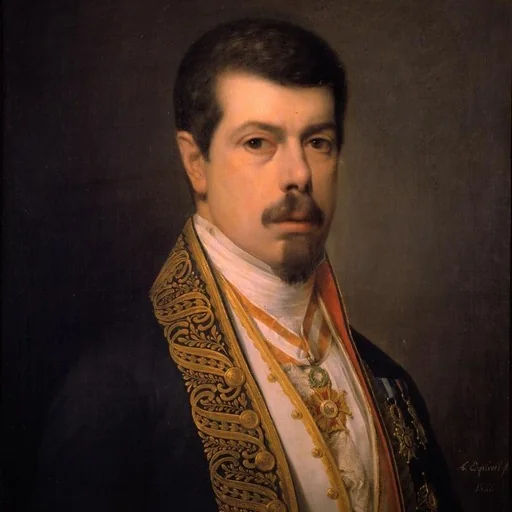
Antonio María Esquivel y Suárez de Urbina (8 March 1806 – 9 April 1857) was a Spanish painter in the Romantic style who specialized in portraits.

- The Sculpture Gallery of the Felix Meritis Society
 The Members of the Hamburg Artist's Club
 The Chamber of Deputies Received at the Palais-Royal by the Duke of Orleans
 Den grundlovgivende forsamling
 The Congress of Paris
 Triumvirate Assuming Power in the Name of the Prince of Orange, 21 November 1813
 One of the Rooms in the Royal Collection of Paintings at Christiansborg Palace
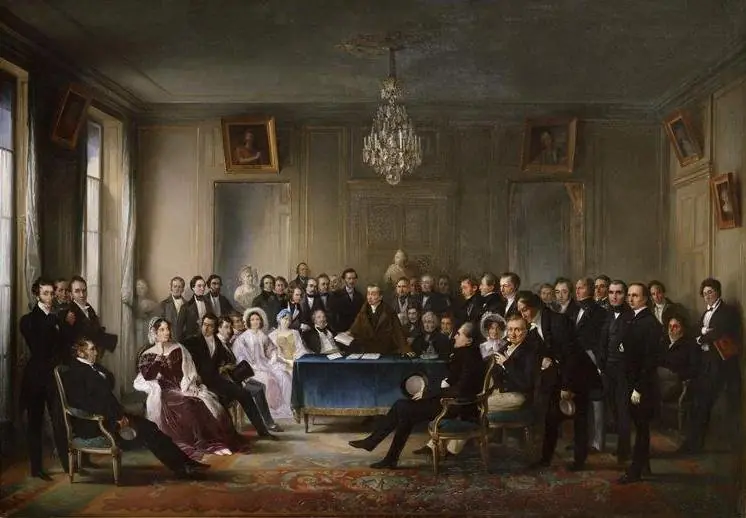 Andrieux faisant une lecture dans le foyer de la Comédie Française
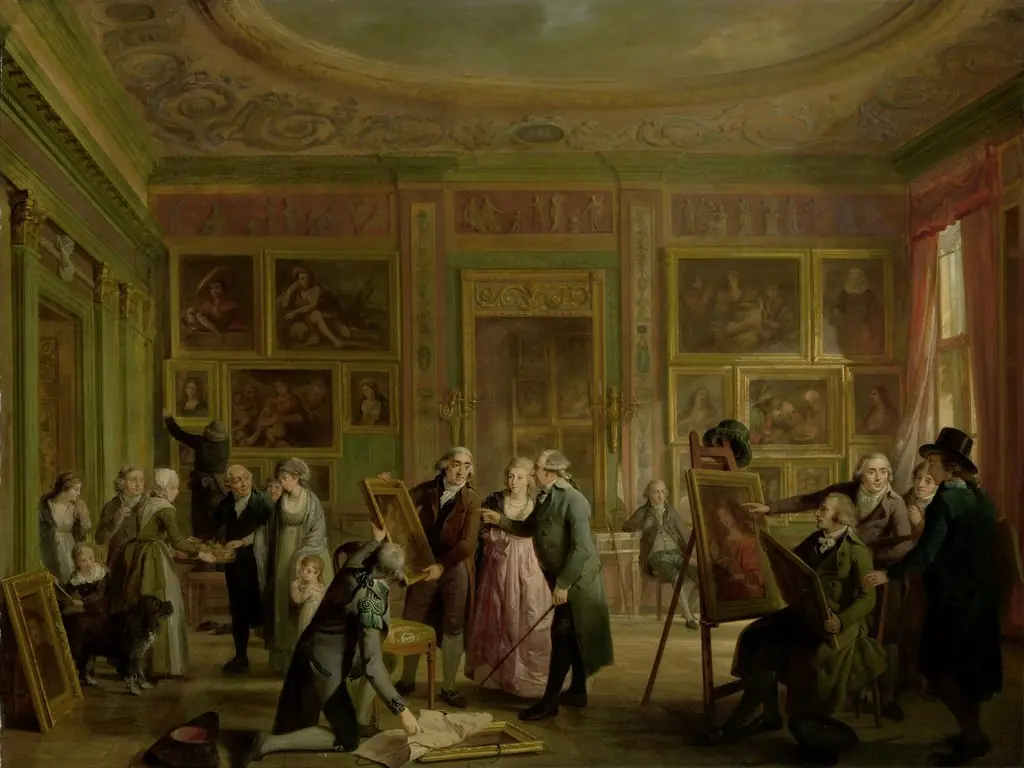 The Art Gallery of Josephus Augustinus Brentano
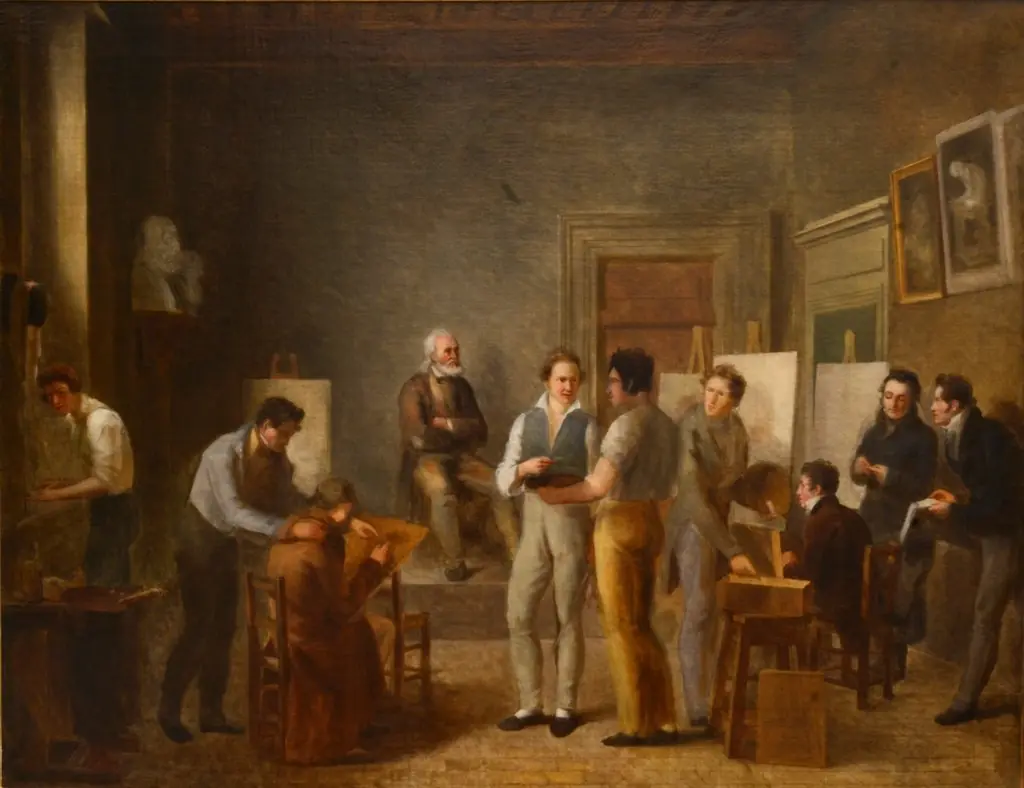 La Classe de peinture à l’école de dessin de Lyon by Jean-Marie Jacomin
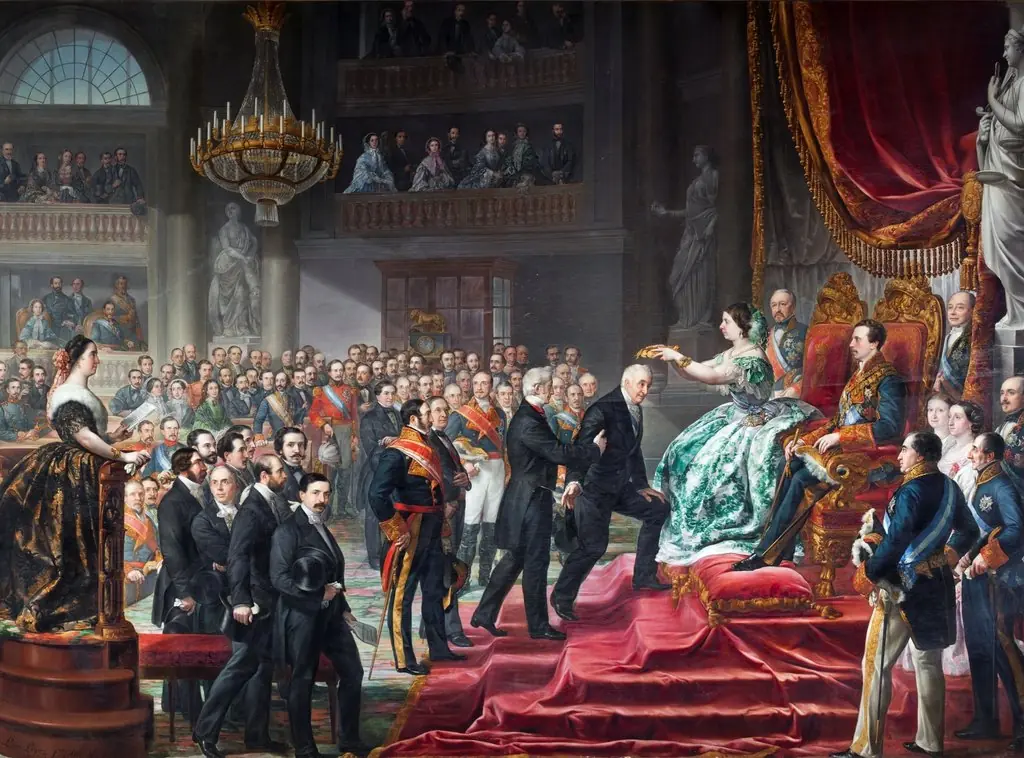 The Coronation of the Quintana
 The Leaders of the Irish Confederation in Council