The picture as instrument, not rehearsal
The panels we now file under the maniera greca, the so-called Italo-Byzantine manner, have spent centuries being misread as a waiting room. Vasari treated the gold grounds and the stiff frontal saints as a clumsy Greek interruption, a holding pattern before Giotto arrived to make figures breathe. That story flatters the Renaissance and tells us almost nothing about the pictures themselves. My argument is narrower and, I think, closer to the evidence. These were working instruments of devotion, built to be read and used by people who needed an image they could trust as a reliable point of contact with a holy person. Naturalism was never a target they failed to hit. Presence was the thing they were engineered to deliver, and they delivered it well enough to stay in production for half a millennium.
Read that way, every feature usually marked down as a defect turns into a decision. The flat gold behind a Madonna is not an empty sky a painter could not yet render; it is a non-place that lifts the figure out of ordinary time and ordinary weather. A blessing hand frozen in one position is not wooden; it is legible at a glance to a congregation that already knew the code. To recover what these pictures meant to their first viewers, we have to stop grading them against a future they were not trying to invent, and start asking a blunter question: what did a thirteenth-century worshipper in Pisa, or a fifteenth-century merchant in Venetian Crete, actually do when standing in front of one? The answer is not aesthetic appreciation. It is transaction.
A Greek manner, named before the Renaissance needed it
Italians gave the style a name early, and the name matters. They called it the maniera greca, the Greek manner, and that label is a small landmark in its own right: it is among the first post-classical European terms for an artistic style at all, as the standard account of the term records. To name a style is to recognize it as a choice rather than the only way to paint, and Italians were doing that while the manner was still dominant, which it remained across Italian painting until the close of the thirteenth century. Then Cimabue and, after him, Giotto began pulling Florentine painting toward weight and worldly space, and Vasari, writing centuries later, repaid the older manner by dismissing it as a clumsy Greek thing the Florentines had to overcome.
What Vasari treated as backwardness was in fact transmission. The forms came from Byzantium, from a culture that had thought longer and harder than the Latin West about what a sacred image is for and what it is permitted to do. The conventions an Italian patron bought into were not provincial fumbling. They were an imported theology of the image, carried on panels, and the patrons knew it.
Gold, and the year the icons arrived
The gold ground is the feature everyone remembers, and it has a date attached. Burnished gold leaf behind the figures became the usual setting for Italo-Byzantine icon-style panels from the thirteenth century onward, and the push came from a catastrophe: the sack of Constantinople in 1204 sent Byzantine icons west in quantity, where Italian workshops studied them and absorbed the format, as the history of the gold-ground technique makes plain. Gold was expensive, which mattered to the donor, but its meaning was not only cost. Under candlelight it moves. A panel that reads as a flat slab by day becomes, in a dim church lit by flame, a shifting and breathing surface, the figure seeming to advance and recede as the light walks across the leaf. The ground was chosen for what it did in the room it was made for.
There was a hard economics under the shimmer. Gold leaf was gold, weighed and paid for, and a contract could specify how much of it a panel would carry the way it specified the blue of the Virgin's mantle. A donor who paid for a gold ground was buying visible expenditure, an offering whose cost was legible to everyone who knelt before it. The brightness was devotion and display at once, and the painter's job was to make the metal do spiritual work as well as social work, to read as heaven and as generosity in the same glance.
The paint itself was tempera, pigment bound in a water-soluble emulsion of egg yolk, in the technical sense the term still carries. Tempera dries fast and will not blend wet into wet the way oil does, so the Italo-Byzantine painter built flesh and drapery in hatched layers over a green underpaint, modeling by accumulation rather than by smearing. The result is a face built from line and incremental shadow, exactly the kind of clear, edge-conscious form a viewer could read across a nave. The material and the message agree. A medium that resists softness produced an image that wanted to be unmistakable.
Close looking: Daddi's Saint Paul and his worshippers
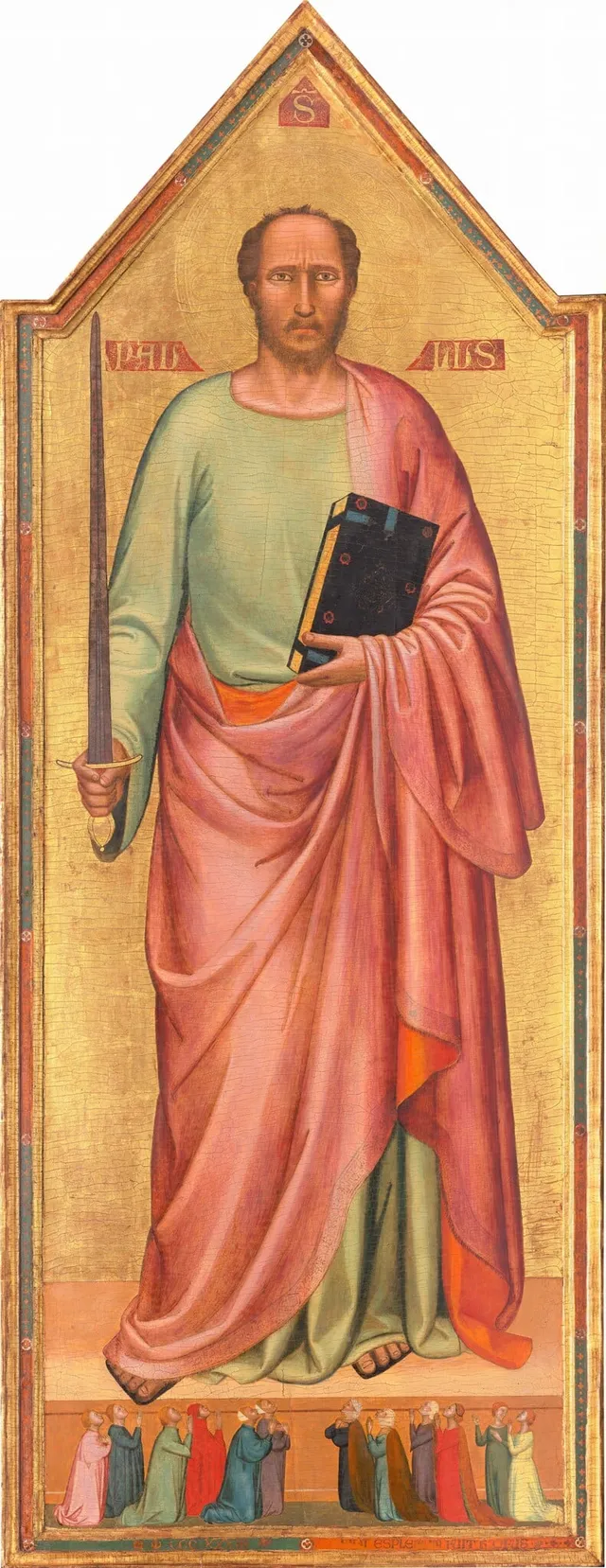
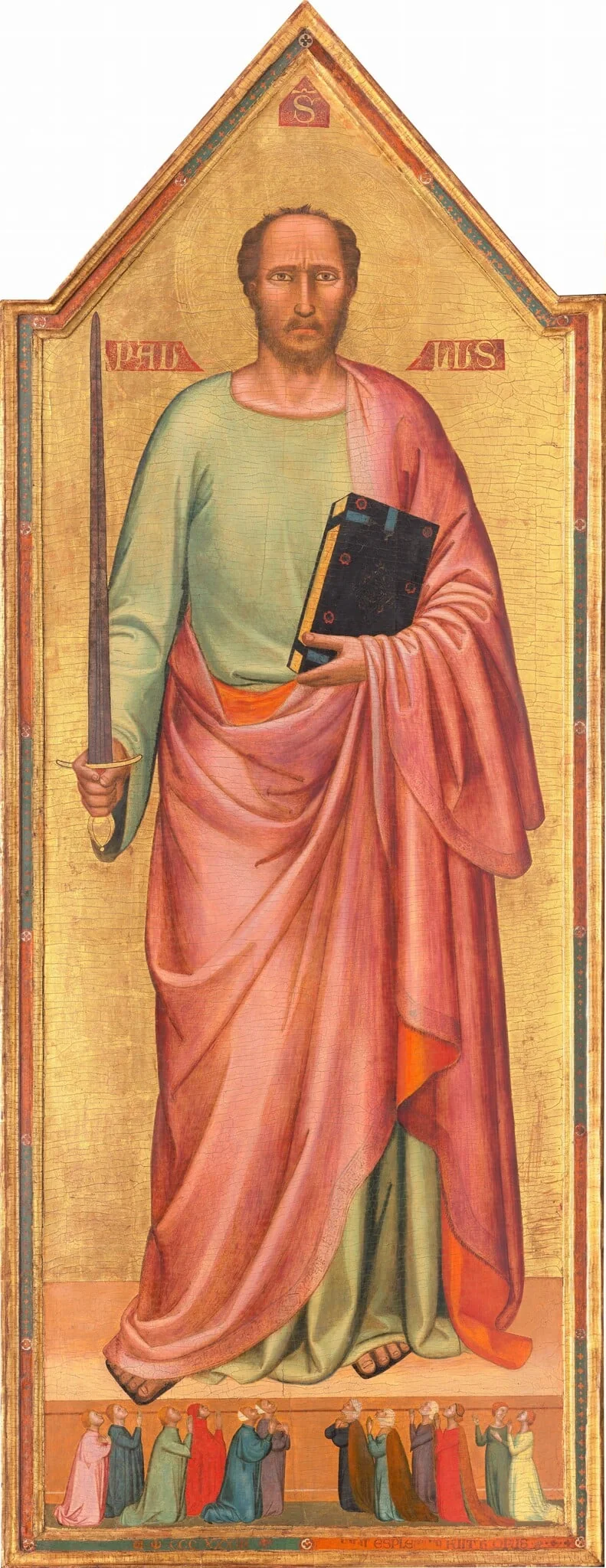
Look at Saint Paul and a Group of Worshippers by Bernardo Daddi. Paul stands gold-backed and frontal, monumental, the sword of his martyrdom held upright and the book of his letters in the other hand, his halo a hard incised disc that catches the light before his face does. At his feet, on a far smaller scale, kneels the cluster of worshippers the title names, lined up in profile, hands raised or pressed together, looking up. The size difference is the whole point. This is not a painter who could not yet draw two figures the same height. It is a painter using scale as grammar: the saint is large because he is powerful, the donors are small because they are supplicants, and the empty register of gold between their heads and his shoulders is the measured distance a prayer has to travel.
Daddi works at the late, Florentine edge of the manner, where the Greek conventions are softening under Giotto's influence, and you can feel the negotiation in the panel. Paul has a little more bodily presence than a strict icon would grant, a hint of weight under the robe. Yet the deep structure stays Byzantine. The donors are not portraits in any modern sense; they are a posture, the visible record of an act of devotion frozen so it can keep being performed. A first viewer would not have asked whether the likeness was accurate. They would have read the panel as a contract made visible: these people have placed themselves under this apostle's protection, and the gold certifies that the protection is real.
What a worshipper actually did with it
The first viewers did not hang these panels as art. They lit candles in front of them, kissed them, swore vows to them, carried them in procession, and credited them with healings. The image was treated as a channel, and the conventions were what made the channel trustworthy. Frontality put the saint face to face with the worshipper, available for direct address. Inscriptions named the figure so there could be no doubt who was being petitioned. The fixed iconographic attributes, Paul's sword, a martyr's palm, an archangel's scales, told an often-illiterate viewer instantly which power they were standing before.
Pictures in this manner also taught and certified. Bonaventura Berlinghieri's Saint Francis altarpiece of 1235, made for San Francesco in Pescia, was painted in tempera on wood in the maniera greca and ranks among the earliest narrative depictions of Francis, according to the record of Berlinghieri's work. Francis had died only nine years earlier. The panel set his standing image flanked by small scenes of his miracles, and for the friars and townspeople in front of it the format did legal as well as devotional work: it asserted that the man they remembered was a saint, with the gold ground as the visible stamp of that claim. The manner was a technology for making holiness official.
Scholarship on the Byzantine side of this exchange has spent decades reconstructing exactly that social life of the image, most influentially in Robin Cormack's study of how icons functioned inside the society that made them. The Italian panels inherited the function along with the format. When we treat an Italo-Byzantine Madonna as a half-formed Renaissance picture, we miss that it was a fully formed object of a different kind, complete on its own terms and doing precisely what it was commissioned to do.
In our own holdings
The reach of the manner shows up clearly once you count. Artifact World Gallery holds 217 Italo-Byzantine works spread across 39 venues and made by 87 named hands, the earliest dating to roughly 1225 and the latest as late as 1753. That last figure is the surprise, and it is the whole story in one number. A style that conventional accounts retire at the end of the thirteenth century is, in our corpus, still being painted more than four hundred years after Giotto supposedly buried it. The manner did not die when Florence moved on. It went elsewhere and kept working.
Counted across our holdings, the chronology refuses the neat handoff that the textbook narrative wants. If the manner were merely a stage that ended when Giotto opened up the picture plane, the dates would bunch in the thirteenth century and trail off. They do not. They thin, then persist, then resurface, because the demand the manner served never closed. Wherever an image was still asked to stand in for a holy person rather than to depict a scene, the gold-ground panel remained the correct answer, and a painter could be commissioned to make one in 1400 or 1600 with no sense of working in a dead language.
Inside that span you can watch the Florentine and Sienese workshops bend the Greek manner without breaking it. Orcagna hardens it into a stern, hieratic monumentality after the plague years. Don Silvestro dei Gherarducci, a Camaldolese monk and manuscript illuminator, brings a miniaturist's precision to a panel like his Crucifix, where the shaped cross itself is the icon and the gold around Christ's body is the field he hangs against rather than a landscape he hangs in. Lippo Vanni keeps the enthroned, symmetrical hierarchy alive in his Madonna and Child Enthroned with Saints Peter and Paul and Angels, the Virgin centered and frontal, the flanking saints turned slightly inward to point the eye back to her. And Gherardo Starnina carries the tradition toward its tender late form in the Madonna of Humility, a type that seats the Virgin on the ground rather than a throne, softening the icon's distance without surrendering its gold.
Works discussed in this article
An anonymous panel like Saint Michael and the Dragon shows how durable the iconographic code was even when the painter's name dropped away. A first viewer needed no caption. Wings, armor, a lance driven down into the writhing dragon, and the scales of judgment somewhere to hand: the attributes carry the entire meaning, and the gold removes the combat from any earthly battlefield to the permanent present where the archangel always wins. The picture is a promise about cosmic order, stated in a vocabulary the parish already spoke.
The inheritance: Siena, and the long survival
Two things happened to the manner after the thirteenth century, and our span from 1225 to 1753 holds both. The first is absorption. In Tuscany the Greek manner was not discarded so much as digested. Duccio di Buoninsegna, founder of the Sienese school, took the formalized Byzantine inheritance and gave it a lyrical, gravely spiritual inflection while his early work stayed strongly indebted to Byzantine iconography. Cimabue, the most dramatic of the painters working under contemporary Byzantine influence, became the hinge through which older antique qualities re-entered Italian painting just before his pupil Giotto. The gold-ground panel they all worked in did not vanish at Siena either; it persisted into the Renaissance there, still glittering behind figures generations after Florence had moved toward modeled space.
The second thing is migration. The manner sailed east to the Venetian colonies, above all to Crete, where workshops kept the icon tradition alive long after Italy had reframed it as history. Nikolaos Tzafouris, a Cretan master, painted his Christ Bearing the Cross in exactly this hybrid world, fusing Byzantine icon structure with motifs learned from Italian painting for a market that wanted both. Works like his, and the later madonneri who followed, are why our latest dated example lands in the eighteenth century. The Greek manner outlived the Renaissance that supposedly replaced it, because in the places that still used images the way the thirteenth century had, it never stopped being the right tool.
In Tzafouris's Christ Bearing the Cross the seam between the two traditions is visible in the handling itself. The face of Christ keeps the Byzantine icon's long nose and small mouth, the features drawn rather than modeled, the sorrow held in line instead of in the soft shadow an Italian contemporary would have reached for. But the cross presses forward at an angle that wants a little real space behind it, and the soldiers crowding the edge borrow the fuller, rounder bodies of Italian narrative painting. A Cretan workshop was selling to two markets at once, Greek Orthodox buyers who wanted an icon and Venetian buyers who wanted a picture, and the panel quietly satisfies both. The gold ground is the part that did not have to compromise.
Stand a final time in front of Daddi's Paul, with the donors kneeling small in their gold. The modern eye wants to call the panel stiff and move on to Giotto. The first viewer knelt where the painted donors kneel and joined a conversation the picture was holding open. That is the thing the survey misses and the manner never forgot. These were not images of saints. They were the places where you went to find one, and for five centuries across our corpus, people kept going.
Sources & further reading
- Italo-Byzantine — Wikipedia
- Gold ground — Wikipedia
- Tempera (art term) — Tate
- Bonaventura Berlinghieri — Wikipedia
- Italian Painting of the Later Middle Ages — The Metropolitan Museum of Art
- Cimabue — Smarthistory
- Madonna and Child on a Curved Throne (Byzantine 13th Century) — National Gallery of Art
- The Shimmer of Gold: Giovanni di Paolo in Renaissance Siena — The J. Paul Getty Museum
- Writing in Gold: Byzantine Society and Its Icons — Internet Archive