Artwork
Saint Paul and a Group of Worshippers
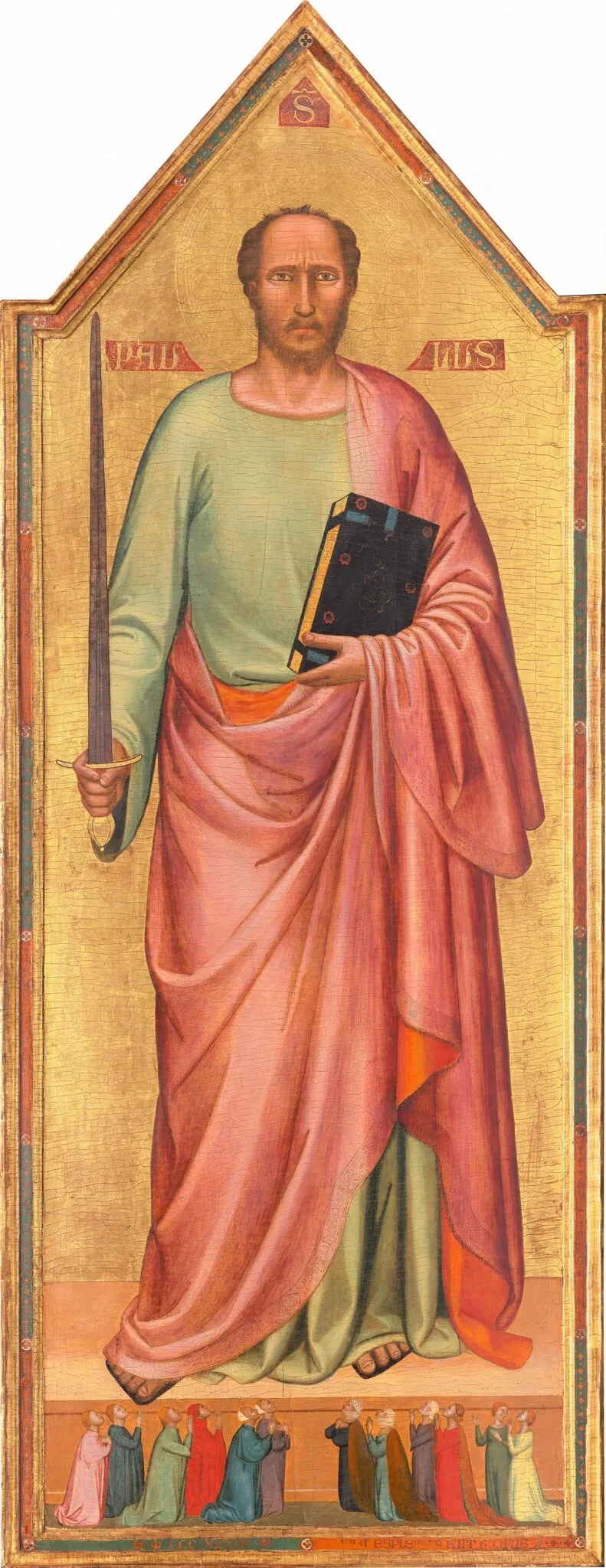
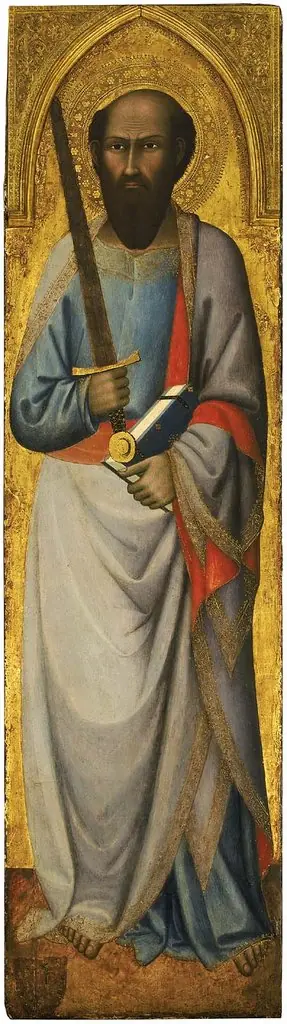
Saint Paul and a Group of Worshippers is a tempera painting by the Italo Byzantine artist Bernardo Daddi. It dates from 1333 and is held in the collection of the Andrew W. Mellon collection.
- Inscription
- Inscribed:above the saint's halo: S[ANCTUS]; above the saint's shoulders: PAU LUS; on the lower frame below the worshippers: [ANNO DOMI]NI.MCCCXXXIII M...II.ESPLETUM FUIT H[O]C OPUS (In the year of the Lord 1333... this work was finished) [1]
About this work
The gold ground, incised halo, and archaic format suggest it once hung against a pillar, probably in San Paolino, commissioned by a lay confraternity.
Twelve small Florentines, six men and six women, kneel in two rows beneath a towering Saint Paul, their faces calm as the saint stares forward with rigid, frontal intensity. Bernardo Daddi painted the narrow panel in 1333, a Latin inscription on the lower frame recording the year. The gold ground, incised halo, and archaic format suggest it once hung against a pillar, probably in San Paolino, commissioned by a lay confraternity.
Subject & Meaning
The painting depicts Saint Paul the Apostle, identifiable by his traditional attributes: a sword, signifying his martyrdom by beheading, and a book, representing his New Testament epistles. He also wears a turban, a common convention for biblical figures in medieval Tuscan art. Surrounding Paul is a group of worshippers shown in attitudes of prayer and respect, indicating the veneration of the saint.
The work’s religious genre and its focus on Paul as the main subject suggest a devotional function, likely intended to inspire viewers to honor Paul’s teachings and martyrdom. The iconography reinforces Paul’s role as apostle, teacher, and martyr, embodying the Christian ideals of faith and sacrifice.
History & Provenance
The work is dated to 1333, and is attributed to Bernardo Daddi. Its early provenance is uncertain: earlier claims that it came from the Florentine monastery of San Felice in Piazza lack documented evidence, while a later hypothesis, based on an old photograph annotation, suggests a possible origin at the Ospedale di San Paolo or the church of San Paolino in Florence. The known ownership chain begins with Elia Volpi (1858–1938) of Florence by the early 1900s.
Volpi sold it through the American Art Galleries, New York, in November 1916. It was then held by Bourgeois Galleries, New York, before being purchased by Duveen Brothers, Inc. in January 1920. Duveen sold it on 15 December 1936 to The A. W. Mellon Educational and Charitable Trust, Pittsburgh, which gifted it to the National Gallery of Art, Washington, in 1937. No specific commission is documented in the sources.
The painting is held in the collection of the National Gallery of Art, Washington, D.C., as part of the Andrew W. Mellon Collection. It entered the museum in 1937 as a gift from The A. W. Mellon Educational and Charitable Trust. No accession number is specified in the sources, and exhibition history is not recorded in the available documentation.
Overview
Bernardo Daddi's Saint Paul and a Group of Worshippers, painted in tempera on panel in 1333, presents the imposing figure of Saint Paul towering over a kneeling assembly of twelve supplicants. The painting's narrow, elongated format, confirmed by a Latin inscription on its lower frame, suggests its original placement within a specific architectural context. This work exemplifies Daddi's distinctive approach to devotional imagery, blending traditional elements with his refined artistic sensibility.
Technique & Style
Daddi deliberately incorporated archaizing elements into this 1333 work, diverging from more current Florentine trends. The halo features hand-incised patterns rather than the fashionable punched designs of the era, and the rigid posture of the saint, along with the pointed arch, recalls 13th-century artistic conventions. Despite these conservative choices, Daddi's characteristic lyrical style is evident in the soft, flowing drapery of Paul's mantle and the subtly rendered faces of the kneeling figures.
Context
The panel's distinctive tall and slender proportions indicate it was designed to be positioned against a church pillar, likely within the Florentine church of San Paolino, where Daddi was known to have worked. The twelve worshippers depicted suggest the painting was commissioned by a lay confraternity, possibly the Compagnia di San Paolo, as a focal point for their communal prayer and veneration.

Artist & collection
Artist
Bernardo Daddi (c. 1280 – 1348) was an early Italian Renaissance painter and the leading painter of Florence of his generation. He was one of the artists who contributed to the revolutionary art of the Renaissance,…