Walk into the National Gallery of Art in Washington expecting a parade of famous names and you will miss what the building is actually for. The collection is best read as an archive of method. Every wall is a record of a physical decision: what the ground was made of, how thin the paint was floated, whether a black was a hole or a surface, how fast the brush moved before the oil set. The Gallery hangs styles next to one another, but the real subject underneath the labels is technique. This essay takes a single position and carries it work by work: at this museum you can reconstruct how a style was made, because the makers left the evidence in the handling, and the institution preserves that evidence at a fidelity most catalogues flatten away.
That claim is not sentimental. It is structural. The Gallery was assembled in the twentieth century by collectors who bought finished objects rather than commissioning new ones, so the holdings are unusually weighted toward demonstration pieces, the works artists used to prove a method worked. Stand in front of a David and a Monet on the same afternoon and you are looking at two opposed theories of what paint is supposed to do. One hides the hand and pretends to be enamel. The other makes the hand the entire content. The building keeps both arguments alive in the same marble rooms, and that is the through-line worth following.
The house is the first exhibit
Material and method are the museum's own origin story, not only its contents. The Gallery was privately established for the American people in 1937 by a joint resolution of Congress, after Andrew W. Mellon offered his collection and the funds to house it (Wikipedia). Mellon, who had served as Secretary of the Treasury, conceived and paid for the project but did not live to see it open. He and his architect, John Russell Pope, both died in August 1937, two months after excavation began (National Gallery of Art). The men who specified the marble never stood inside it.
Pope's neoclassical West Building was, at the time of its construction, the largest marble structure in the world. That is a fact about method as much as scale. The pink Tennessee marble was graded by tone so the courses darken toward the base and lighten toward the cornice, a slow optical correction worked into the stone itself, the same kind of thinking a painter applies to a ground. Decades later the institution chose the opposite material logic. I. M. Pei's East Building, completed in 1978 and opened on June 1 of that year by President Jimmy Carter, answered Pope's symmetrical masonry with sharp triangular geometry and a knife-edge corner that visitors have worn smooth by touching it. The campus argues with itself, classicism against modernism, in two registers of the same instinct to build deliberately.
The public verdict came fast. After the March 17, 1941 dedication, the building opened to visitors the next day and drew 798,156 of them through June 30, an average of 7,529 a day in its first months (Smithsonian Annual Report, 1941). A nation at the edge of war queued to look at paint.
Reading the ground: Bierstadt's manufactured light
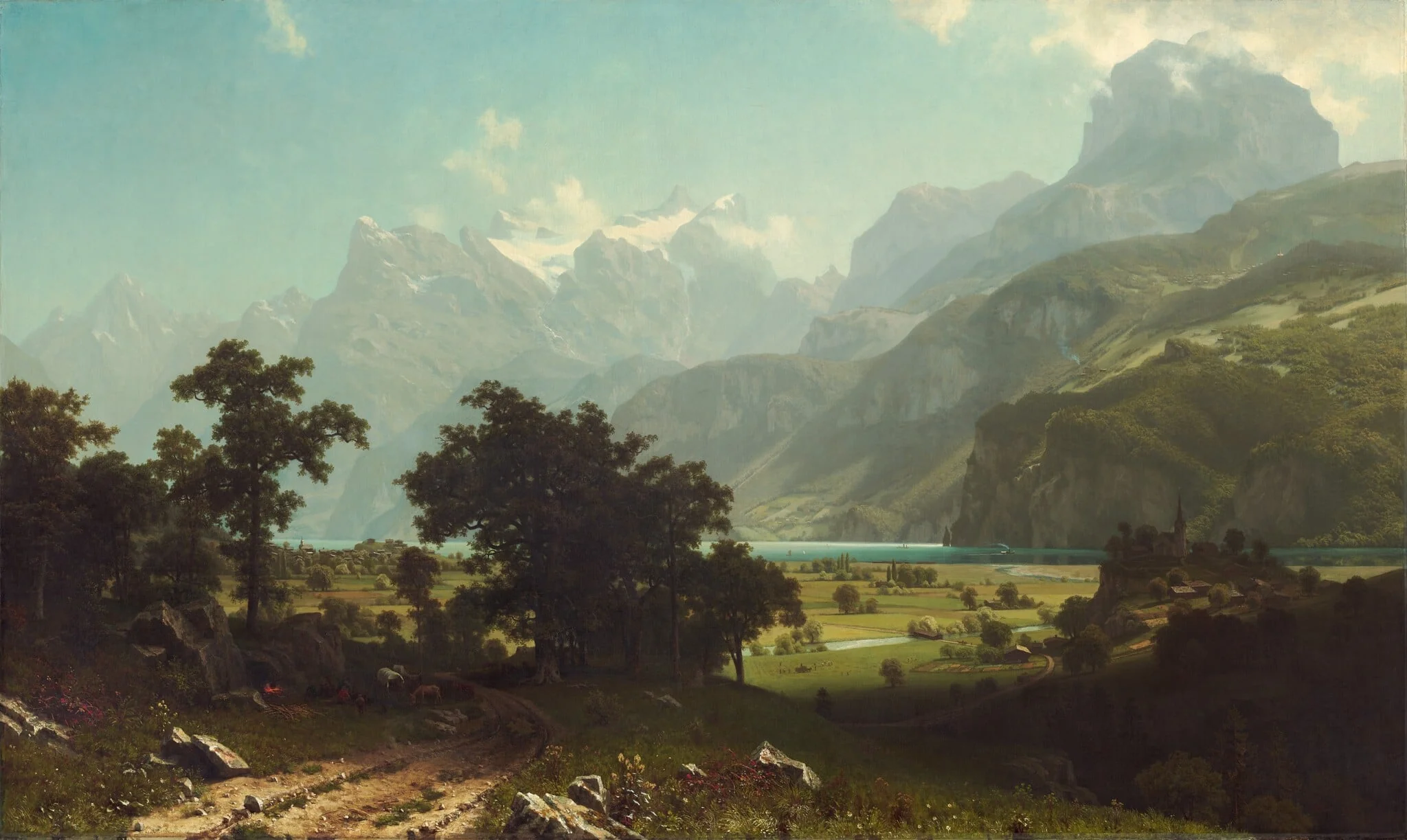
Start with the hero, because it shows how openly a method can be staged. Albert Bierstadt built his reputation on light that looks delivered from offstage, and Lake Lucerne lets you watch the machinery. Look at how the picture is layered front to back. The foreground rocks and the small figures at the water's edge are drawn with a tight, dry brush, every edge crisp enough to feel close. Behind them the lake goes glassy and the touch loosens. By the time the eye reaches the far peaks, Bierstadt has thinned his paint into pale, smoky films so the mountains seem to recede into vapor rather than distance. The transition is not atmospheric accident. It is a sequence of decisions about how much pigment to carry on the brush at each plane.
The light is the giveaway. A break in the sky drops a wide bar of illumination across the middle of the water, and the contrast is pushed past anything a single moment outdoors would give you. Bierstadt worked from oil sketches made on site, then composed the large canvas in the studio, where he could raise the drama to a pitch the field never offered. That is the method behind the Hudson River style: plein-air observation refined into theatrical assembly. He glazes the bright water in thin translucent layers over a luminous underpaint, so the surface seems lit from within rather than from above. A canvas built at this scale asks to be read the way you watch a stage, from a fixed distance with the room gone dim, and Bierstadt composes for exactly that viewing. The eye is led in along the lit water, stalled at the bright bar in the middle distance, then released up the dissolving peaks. You are not looking at a lake. You are looking at a carefully engineered argument that American nature was operatic, and the engineering is visible the moment you stop reading the subject and start reading the paint.
The enamel and the smear: two theories of the surface
Hang two of the Gallery's portraits side by side in your mind and the opposed methods snap into focus. The Emperor Napoleon in His Study at the Tuileries by Jacques-Louis David is the neoclassical ideal of surface taken to its limit. David sanded his transitions until the brush vanishes. The skin has the polish of porcelain, the gold thread on the uniform is built up in fine ridges that catch real light, and the candles guttering low in the background are not loose at all; they are described down to the wax. The method serves the politics. A face with no visible hand reads as fact, not opinion, and David wanted the worn, late-night Emperor to read as documented truth.
Now set Jean Honoré Fragonard against him. Young Girl Reading is the opposite wager. Fragonard left the speed in. The lemon-yellow dress is laid down in broad confident strokes, and the ruff at the wrist and collar is flicked on in thick, abbreviated dabs that read as lace only from across the room. Up close they are frank smears of loaded paint. The girl's profile is steadied and finished, but the costume around it is almost shorthand, painted at a pace that the David method would consider unfinished. Fragonard is betting that conviction reads as truth too, just a different truth, the truth of a thing seen quickly and felt. The Gallery holding both pictures means you can test the two bets against each other without moving far.
Constable's broken green and the road to optical mixing
The method that would eventually produce Impressionism is already half-built in Wivenhoe Park, Essex. John Constable refused the single flat green that academic landscape used for grass. He chopped it. The meadow is a field of separate touches, some bluish, some near-yellow, with flecks of light scumbled across the top that he and his critics called the snow, the small white highlights that make wet English fields glitter. He is letting the eye blend the colors instead of pre-mixing them on the palette, which is the same optical principle the next generation in France would systematize. The cattle, the water, the low spreading sky over flat Essex country are all observed, but the radical part is the surface, granular and alive, refusing to settle into the smooth varnish of the period. Get close and the meadow stops being a meadow. It becomes a worked surface of greens that were never blended, dragged wet over a warmer underlayer so a little of the ground keeps showing through. Step back and the field reassembles, greener and more humid than any single tube of paint could be.
It is worth saying plainly that this is the bridge. The English landscape painters worked out broken color as a way to record weather, and the French took the method and aimed it at the whole visible world. The Gallery lets you stand at the hinge.
Manet's flat black and Monet's dissolved edge
The break itself is in the room too. Edouard Manet is usually praised for subject, but his method is the scandal. The Dead Toreador lays the figure flat against a near-empty floor, foreshortened so steeply that the body seems pressed up toward the picture plane. The black of the costume is the key. Manet refuses to model it with the gradual brown-to-black shading the tradition demanded. He paints black as a broad, almost unbroken plane, a shape rather than a volume, and lets a few sharp highlights stand for the whole anatomy of folds. The figure reads as a silhouette first and a man second. Look at how little he gives you. There is the body, the costume, a stripe of light on the floor, and almost nothing else. The economy is the point. Everything that does not serve the silhouette has been cut. That flatness, the decision to treat the canvas as a surface to be designed rather than a window to be carved, is the technical opening that the Impressionists walk through.
And then there is Claude Monet. Woman with a Parasol - Madame Monet and Her Son is the method at full speed. Monet painted it outdoors and fast, from a low viewpoint so Camille and the boy stand against open sky. The grass is struck in with quick diagonal strokes that lean in the direction of the wind. The veil and dress are streaked, not drawn, and the green underside of the parasol throws a band of reflected color onto her face that an academic painter would have corrected away. Look at the edges. Nothing is outlined. The figure is held together by patches of light and shadow that only resolve at a distance, the broken touch Constable hinted at now driven all the way to dissolution. She is barely a person. The face is a few strokes under the hat brim, the features left for the viewer to supply, and the whole figure could be undone by a thumb while the paint was still wet. That risk is the subject as much as the wind is. The content is the speed of the looking.
Works discussed in this article
What the archive lets you count
The reason this museum rewards a method-first reading is sheer range. Across our records, Artifact World Gallery maps 36,526 works to the National Gallery of Art, made by 4,077 artists, with dated examples running from roughly 1001 to about 1950. That span of nearly a thousand years, held in a single American institution founded only in 1937, is the practical condition for the argument. You can put a Venetian Titian and his glaze-built flesh in the same afternoon as a Corot whose silvery tonal method points straight at Impressionism, and the technical lineage stops being a textbook diagram and becomes something you can see. The numbers carry the point. A holding that runs from medieval panels to mid-century canvases, gathered in a few decades rather than inherited over centuries, is a collection put together to show how one solution to a painting problem hands off to the next. The Gallery did not grow this collection slowly over centuries the way the older European museums did. It bought it, deliberately, as a teaching instrument.
The acquisitions confirm the priority. Leonardo da Vinci's Ginevra de' Benci, painted around 1474 to 1478, is the only painting by Leonardo in the Western Hemisphere, and the Gallery acquired it in 1967 from the Princely Collections of Liechtenstein (National Gallery of Art). It is prized for the name, but it earns its place here for the method, the smoked transitions and the juniper worked in behind the sitter with the patience of a manuscript illuminator. A museum that pays that price for that surface is telling you what it values.
The American method, kept honest
The collection does not stop at European polish, and that is part of the argument. George Bellows's boxing picture Both Members of This Club, painted in 1909, hangs here as a key work of the Ashcan circle (Smarthistory). Its method is the inverse of David's. Bellows worked wet and rough, dragging slabs of pale paint across the fighters' bodies so the violence is in the brush as much as the subject. The movement took its name from a Bellows drawing of three vagrants going through an ash can (Tate), and the speed of that drawing survives in the paint. Set it near the Bierstadt and you have the two American answers in one building: the manufactured sublime and the unvarnished street.
This is the payoff of reading the Gallery for method rather than fame. The labels group works by Romanticism, by Impressionism, by school and decade. But the deeper organization, the one the collectors actually bought into, is technical. Each room is a set of solved problems: how to make distance, how to make black, how to make light look like it is happening now instead of having happened. A style is a recurring answer to one of those problems, repeated until it hardens into a look.
So go back to the Bierstadt and look one more time at where the foreground paint goes dry and the far mountains go thin. That single gradient, repeated and varied across a thousand years of works in one museum, is the whole story of how a style gets made. Not in the choice of subject. In the loaded brush, and in the decision of exactly how much to put on it before the next stroke.
Sources & further reading
- National Gallery of Art — Wikipedia
- Our History — National Gallery of Art
- Annual Report of the Board of Regents, 1941 — Internet Archive (Smithsonian Institution)
- Ginevra de' Benci (obverse) — National Gallery of Art
- Rijksmuseum announces list of Vermeer paintings — Rijksmuseum
- Bellows, Both Members of This Club — Smarthistory
- Ashcan School — Tate