Walk into the Cleveland Museum of Art collection expecting beauty and you will get it. You will also miss most of what the building holds. The pictures on these walls were not made to be looked at in respectful silence by strangers a century or three later. They were made to be read by the people who first owned them, or paid for them, or knelt in front of them, and those first viewers read fluently. A studio scene told a collector he belonged to a cultured class. A boxing canvas told a 1909 New Yorker which side of a cultural fight the painter had taken. A fisherman in a Japanese hanging scroll told an educated viewer to admire withdrawal from worldly ambition. None of those messages came with a label. The label was the shared knowledge each first owner carried into the room. The argument of this essay is simple and a little stubborn: the Cleveland collection rewards the viewer who stops asking whether a picture is lovely and starts asking what it was telling the first person to stand in front of it.
That question has a civic edge here, because of how the museum came to exist. It was set up as a trust in 1913 out of the endowments of three Cleveland businessmen, Hinman Hurlbut, John Huntington, and Horace Kelley, and its white marble building opened to the public on June 6, 1916 (Wikipedia). The institution still charges nothing for general admission. So an iconography that once belonged to patrons, courts, and private cabinets now belongs, for the price of walking through a door, to anyone. Artifact World Gallery holds 19,107 Cleveland works by 2,854 artists, spanning roughly the year 1000 to 1972, against the museum's own count of more than 61,000 objects. That is a wide slice for a single institution, and it is unusually deep in two directions at once: medieval Europe at one end, the long maturity of East Asian painting at the other. Even our portion of the holdings reaches across nine centuries and three continents, and almost every object in it was, at the moment of its making, a message somebody was meant to decode.
A trust built so that strangers could read
The founders' decision to make admission free was not sentimental. It was a wager that ordinary Clevelanders could learn to look. The museum started teaching almost immediately. By its February 1917 issue, the institution's own periodical, the Bulletin of the Cleveland Museum of Art, was already printing reports and acquisition notes meant to walk a lay audience through what the new galleries contained (Internet Archive). A bulletin is a small thing, but the gesture behind it is large. It assumes the visitor wants to understand and can be helped to. That impulse, to explain rather than merely display, is the thread I want to follow. The works below were built on assumptions their first viewers shared and we have largely lost. Recover the assumption and the picture snaps back into focus.
The studio as a flattering mirror
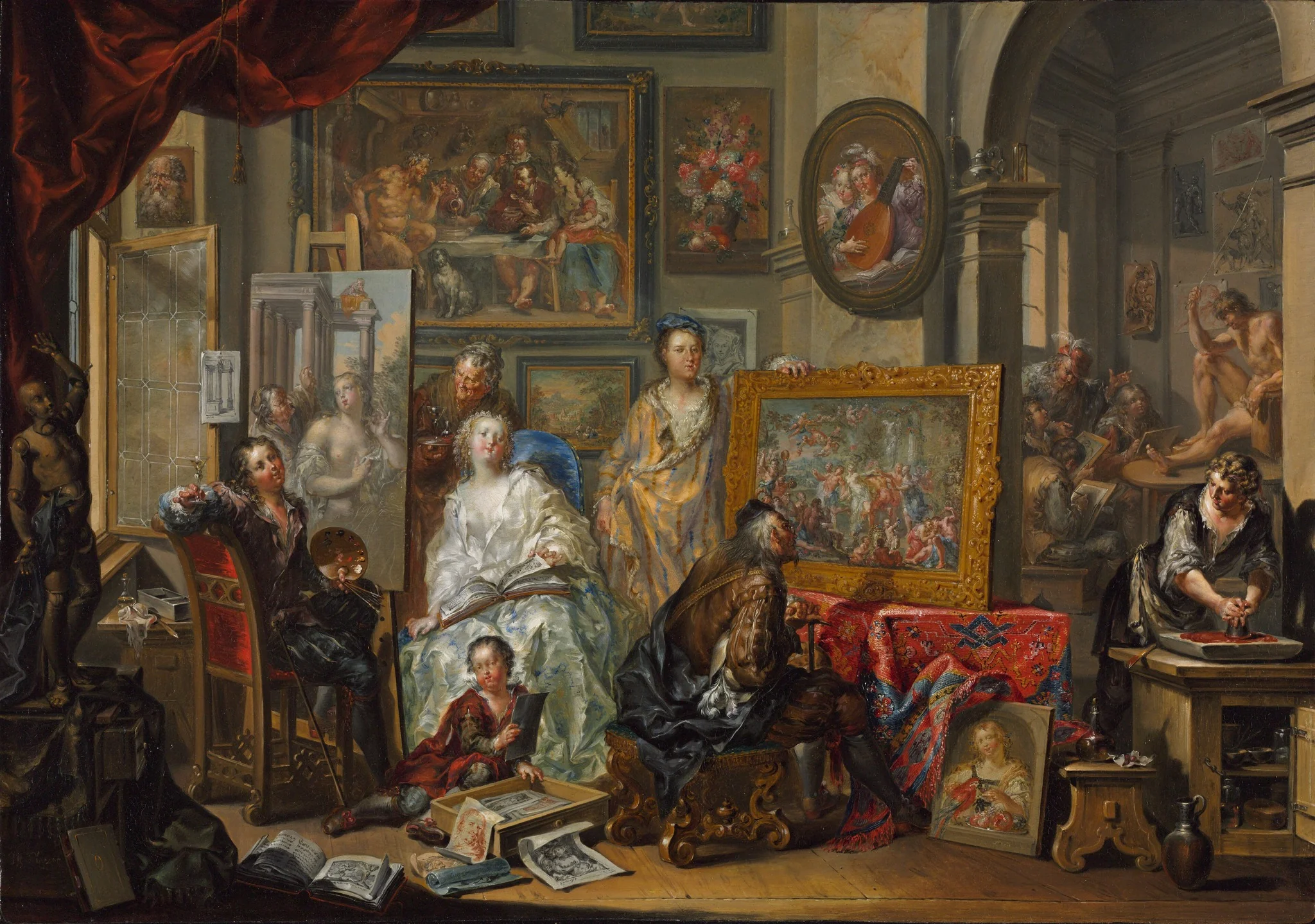
Start with the picture that sits closest to the theme, The Artist's Studio by Johann Georg Platzer, an Austrian who painted small, jewel-bright cabinet pieces on copper in the second quarter of the eighteenth century. The support matters. Copper takes paint like enamel, so Platzer's reds and golds glint rather than glow, and the surface holds a crowd of tiny figures in sharp focus all the way to the back of the room. There is no atmospheric softening, no falling-off into haze. Every figure in the deep space is rendered with the same hard clarity as the ones at the front, which is part of how the picture insists that everything in it is worth your inspection.
Look at what he packs in. The studio is not a quiet garret with one easel. It is a stuffed theater of connoisseurship: finished canvases stacked and tilted against the walls, sculpture and plaster casts on the shelves, instruments and portfolios scattered across the foreground, figures bent over a print held up to the window light. The painter is there, but he is almost a supporting player among the patrons and visitors who handle the objects and appraise them. The composition tips its contents toward us so nothing is hidden, the way a dealer fans goods across a counter. That tilt is the tell. This is a picture about the act of collecting, made for a collector, and it flatters him by showing his appetite as cultivation. To its first owner, hanging in a paneled room beside the very kind of objects it depicts, the panel said something precise and pleasant: that to surround yourself with art was to live among learning, taste, and good company. The studio is a mirror, and the buyer is the most flattered figure in it, the one standing outside the frame and seeing his own habits returned to him as virtue.
A picture that keeps a man outside the door
Move from a European cabinet to an American barn and the stakes of reading a picture get heavier. The Power of Music by William Sidney Mount, painted in 1847 on Long Island, looks at first like a genial scene of country life. A white fiddler plays inside an open barn for two other white men, while just outside the door a Black man stands alone, hat off, head inclined, plainly listening. He has set down a jug and an axe, the tools that mark him as labor rather than leisure. The whole meaning lives in that doorframe.
Mount's first viewers, in the decade before the Civil War, did not need the iconography explained. They saw a man the music had reached and the room had not, included by sound and excluded by the threshold, his dignity and his exclusion stated in the same composition. The picture argues without a caption. Sympathy and segregation are drawn into one image, and a Northern audience could take from it whatever its conscience allowed, which is exactly why it sold and circulated as a print. Note that Mount has given the listener the most attentive face in the picture. The men inside are easy in their pleasure; the man outside is concentrated, almost reverent. This is iconography doing political work in plain clothes. To call the canvas charming is to refuse the reading its own period gave it. The barn door is not a quaint detail. It is the subject.
The new iconography of the city
By 1909 the symbols had changed, and a young painter in New York set out to forge new ones. Stag at Sharkey's by George Bellows shows two boxers locked at the center of a private athletic club, where men could fight for money by being made temporary members to skirt the law. The two bodies fuse into a single straining wedge of muscle, lit hard from above, while the ringside crowd dissolves into a smear of leering faces in the dark. Bellows paints fast and thick, the highlights dragged on in a few loaded strokes, the canvas left rough where the light hits a shoulder or a jaw. The violence is in the handling as much as the subject. You can almost feel the painter racing to fix a thing that will not hold still.
What did this mean to its first viewers? Everything, and it depended on which viewer. To the genteel taste that still wanted American art to look like polite landscape, the canvas was an affront, a celebration of brutal, low, immigrant-tinged spectacle. To Bellows and his circle it was a claim: that the real iconography of modern America was the crowd, the body, the wager, the electric light, not the marble nymph. Bellows is everywhere in our holdings, with over two hundred works attached to his name, and that volume is itself a record of how thoroughly the museum world came to accept the case he was making. The work that read in 1909 as an affront now reads as a cornerstone. The picture reads now as energy. It read then as a side taken in an argument about what art was allowed to depict, and the side it took won.
Reading withdrawal: the scholar by the water
Cleveland's strength has never been only Western, and its Asian galleries demand a different literacy. Fishing in Springtime by Ike no Taiga, an eighteenth-century master of the Japanese literati style, looks to an untrained eye like a soft landscape with a small figure in a boat. The brushwork is loose and wet, the hills built from blotted, breathing strokes rather than firm outlines, and the figure is tiny against the expanse of water and air. To an educated viewer of Taiga's own day, that fisherman was a fixed moral type, the scholar who has turned his back on rank and office to live simply by the water. The fishing is not recreation. It is a philosophical position, an emblem of integrity through withdrawal that Japanese and Chinese viewers had been reading for centuries. The smallness of the figure is the point: a man who has made himself minor on purpose, dwarfed by a world he no longer competes in.
This is where Cleveland's collecting history pays off for the argument. The museum has actively built its Asian holdings in concert with peers, including a joint acquisition with The Metropolitan Museum of Art of a large group of eighteenth-century Chinese color woodblock prints from Suzhou, each institution taking more than a hundred sheets (The Metropolitan Museum of Art). Those prints, like Taiga's scroll, were dense with legible symbols for their first buyers: auspicious flowers, learned allusions, signs of status and wish. A free museum that hangs them beside a Mount and a Bellows is making a quiet claim that the literacy required to read a Suzhou print is the same human skill required to read a barn door on Long Island. Two institutions splitting a single hoard is also a reminder that this kind of looking is taught and passed along, not born in anyone.
Works discussed in this article
Weather, sheep, and the comfort of the familiar
Two landscapes in our Cleveland holdings show iconography at its quietest, where the message is reassurance. Point Judith, Rhode Island by Martin Johnson Heade belongs to the American luminist habit of treating coastal weather as a state of feeling. The low horizon, the long raking light, the stillness held a moment before it breaks, all told a mid-century American audience that their own quiet shorelines carried a sublime worth attention, no Alps required. Heade gives most of the canvas to sky and lets the land lie flat and thin beneath it, so the weather becomes the real subject and the coast a stage for it. The picture is a piece of national self-regard, gentle but real.
Beside it set Landscape with a Peasant and His Flock by the Belgian animal painter Eugène Verboeckhoven, whose sheep are rendered with the same loving finish a portraitist gives a sitter's face. Each fleece is worked up wool by wool, each animal given a slightly different turn of the head, so the flock reads as a gathering of individuals rather than a mass. To a nineteenth-century bourgeois buyer watching the countryside empty into factory towns, that flock was a purchase of nostalgia, a small framed promise that rural order still existed and could hang over the dining table. The iconography here is not allegory. It is mood as merchandise, and it sold because the longing was sincere.
Portraits, virtue, and a bronze that argues with itself
Two more threads round out the case. The enamel painter Henry Bone, with several works under his name in our holdings, made portrait miniatures meant to be held, gifted, and kept close, objects whose entire meaning was intimacy and loyalty rather than public display. A miniature is read in the hand, often in private, and its smallness is a kind of vow. At the opposite scale, the neoclassicism of Jacques-Louis David turned the Roman past into a lesson in civic virtue for viewers living through revolution, where a sober profile or a raised arm carried an argument about duty to the state. Different sizes, opposite settings, one principle. The first viewer was always meant to take something away.
The collection's most famous test of reading is not a painting at all. In 2004 the museum acquired the Cleveland Apollo, the only known life-size bronze of the Apollo Sauroktonos, or lizard-slayer, a type traditionally linked to Praxiteles and dated to about 350 BC (Getty). The figure shows the god as a slender adolescent, leaning, relaxed, about to kill a small lizard on a tree trunk. Nothing about the pose looks like an act of violence, which is much of why it puzzles. Ancient viewers argued over what the gesture meant, oracular, cultic, or simply a study of a god caught in a moment of idle, lethal grace. The picture of reading I have been pressing holds even here: the meaning was contested in antiquity, not lost on us. A free museum simply hands that old argument to a new public and trusts the public to take it up.
What free admission really gives away
Return to the founders' wager. They built a trust that gives art away for free, and what it gives away is not only access to objects. It is access to the act of reading them. Every work named here was once private property in the fullest sense, decoded by a narrow circle who shared the painter's assumptions: a collector who knew that a crowded studio flattered him, a Northern buyer who understood what a man kept outside a barn door signified, an educated reader who saw a fisherman and thought of integrity. The museum takes that private literacy and makes it municipal. The Cleveland collection is best understood not as a warehouse of beauty but as a teaching room where the public learns to ask the question its first owners answered without thinking.
So the next time you stand in front of one of these works, resist the urge to decide whether you like it. Ask instead who it was talking to, and what it expected that person to already know. The honesty of the place is that it lets you fail at this, then try again tomorrow for free. That is the real inheritance the trust left, available to anyone willing to look twice.
Sources & further reading
- Cleveland Museum of Art — Wikipedia
- Cleveland and the Met Jointly Acquire Suzhou Woodblock Prints — The Metropolitan Museum of Art
- Conservation and Analysis of the Cleveland Apollo (Artistry in Bronze) — Getty
- Bulletin of the Cleveland Museum of Art, February 1917 (Vol. 4, No. 2) — Internet Archive
- Praxiteles, Apollo Sauroktonos (Lizard-Slayer) — Smarthistory
- Winslow Homer, Breezing Up (A Fair Wind): provenance and loan history — National Gallery of Art