Realism: The formal break, composition, light, the handling of paint
Realism, the mid-century movement is almost always introduced by its subjects: stone-breakers, peasants at a funeral, a provincial woman trying on a new bonnet. The story goes that painting suddenly looked at ordinary life and found it worthy of a large canvas. That account is true and incomplete. The deeper rupture was not what these painters chose to depict but how they built the picture once they had chosen it. The argument of this essay is simple and, I think, underweighted: Realism's revolution lives in its grammar, in composition, in the behavior of light, and above all in the visible handling of paint. Change the subject and you have a new anecdote. Change the construction and you have a new way of seeing.
Hold that thesis against the conventional timeline. As Tate's glossary notes, the term was coined by the novelist Champfleury in the 1840s and found its painter in his friend Gustave Courbet. The label, then, began as a literary battle cry and only afterward hardened into a way of handling the brush. What I want to track is that second step. A funeral scene painted with academic finish, smooth modelling and a clear hierarchy of light, would still have been Romanticism wearing peasant clothes. Realism became Realism when the surface stopped pretending to be a window and started behaving like worked matter. The peasants matter. The trowelled paint matters more, because the trowel is the place where the new attitude becomes physical fact rather than slogan.
What broke, and against what
Realism emerged in France in the 1840s as a reaction against Romanticism, and its chief practitioners were Courbet, Jean-François Millet, Honoré Daumier, and Jean-Baptiste-Camille Corot, as the standard survey of the movement records. Romanticism organized a canvas around feeling: a diagonal surge of bodies, a storm of chiaroscuro, a focal hero lit like an actor while the margins fell into expressive gloom. Light was rhetoric. It told you where to look and how to feel. The academic machine that Romanticism shared with Neoclassicism prized a finished surface in which the marks of the brush were polished away, so the eye slid over the paint and into the illusion without friction. The picture was meant to evaporate. A good academic finish was one you forgot you were looking at.
The Realists attacked all three at once. They flattened the compositional hierarchy, so a row of figures might stretch across the canvas with no single hero and no obliging spotlight. They let daylight fall evenly and indifferently, the way it actually falls in a courtyard or a kitchen, refusing to dramatize. And they left the paint legible. You can see the loaded knife, the dragged stroke, the place where a dark was scumbled over a light. The Met's account of nineteenth-century French Realism puts the program plainly: Courbet rejected the idealized classicism of the academy and the exotic themes of Romanticism in favor of direct observation of the modern world. Direct observation has a texture. It looks like the world examined, not the world arranged. And once you let the texture show, you have admitted the painter into the picture as a worker with a tool, which is precisely what the academy wanted hidden.
Scale was the provocation that made the formal break impossible to ignore. Courbet created a sensation at the Salon of 1850-51 by painting scenes from his native Ornans on the enormous canvases previously reserved for kings, saints, and battles. Smarthistory's reading of A Burial at Ornans makes the point that the offense was not the funeral but the format: a provincial burial granted the dimensions of heroic history painting, with the mourners ranged in a long frieze and no climax to guide the eye. The composition itself was the insult. A history painting taught you to feel. Courbet's frieze just stood there, wide and democratic, and let you look. Spread the same scene across a small cabinet picture and the scandal evaporates; it is the heroic acreage, given to people who had never earned it in paint, that turns a funeral into a manifesto.
Close looking: Eakins, The Chess Players
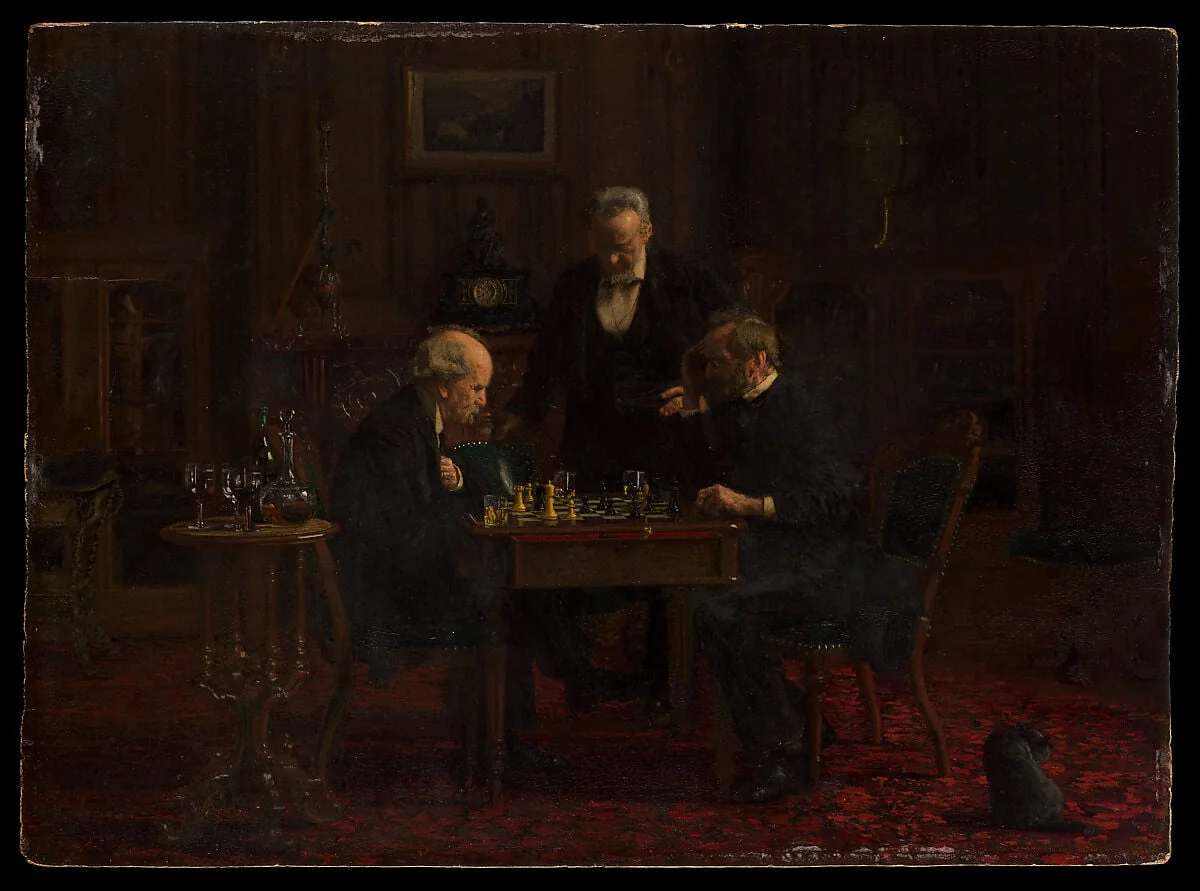
Cross the Atlantic and the formal logic travels with the idea. Look hard at The Chess Players by Thomas Eakins. Three men occupy a warm, brown interior: two seated at a small table over the board, a third standing and leaning in to watch. There is no drama in the staging. Nobody gestures for our benefit. The composition is built around the low triangle of the table and the bent backs of the players, and the light comes from a single warm source at the left that grazes the bald head of one man and catches the white of a shirt cuff, then dies quietly into the dim red of the room behind.
Notice what Eakins does with attention. The faces are the most worked passages in the picture, modelled with a patient, almost anatomical density of small strokes, while the carpet and the shadowed shelves dissolve into broad, thin films of brown. He is not flattering anyone. The standing figure's hand rests on the chair back, and the knuckles are described with the same unsentimental care as the chess pieces. The board tilts very slightly up toward us, just enough to lay the pieces out for inspection without breaking the calm of the room. This is Realism's light at work: not a spotlight that ranks the men by importance, but ordinary lamplight that happens to find the foreheads bent in thought. The subject is concentration. The means is restraint, and the restraint is the content.
Spend longer with the picture and the discipline tightens. Eakins withholds every cheap cue an academic painter would reach for. There is no gleaming highlight invented to lead the eye, no convenient shaft of light cutting a path to a face, no background detail enlisted to comment on the scene. The wood of the table, the worn leather, the slack folds of the older men's coats all sit at roughly the same pitch of brown, so the room reads as one continuous, dim substance out of which only the heads and hands rise. That evenness is a decision, not an accident of the lamp. It says that nothing here is more important than anything else, that the painter has refused to rank his sitters, and that the quiet of two men thinking is sufficient subject without help. The picture earns its stillness by giving up the tools that would have made it loud.
Set this beside The Dead Toreador by Édouard Manet, and you see the same break taken to a colder extreme. Manet fells his matador onto a near-empty floor and tips the ground plane up behind him so the body reads almost as a flat silhouette against bare paint. The black of the jacket is one confident, unbroken shape. The light is frontal and shadowless, the kind that erases the modelling academies spent years teaching. Where Eakins keeps the room warm and inhabited, Manet strips it to a dead man, a sash of pink, and the assertion that a painting is a surface with paint on it. Both men refuse the Romantic theater of light. One does it tenderly, the other with a bluntness that would scandalize the Salon.
Works discussed in this article
The handling of paint as argument
If composition and light set the stage, the handling of paint is where Realism makes its case at close range. Academic technique treated the brushstroke as a means to be hidden. The Realists treated it as evidence. A passage of palette-knife work in a Courbet rock face says, in effect, that this picture was made by a hand moving material across a surface, and that the maker is not ashamed of the labor. That candor about process is itself a kind of honesty, a formal echo of the movement's insistence on observed fact over inherited ideal. The texture tells the truth about the painting the way the subject tells the truth about the world. A viewer who steps close is no longer offered an illusion to fall into; he is shown the thing the illusion is made of, and asked to accept the made thing as enough.
Consider The New Bonnet by Francis William Edmonds, an American genre scene that carries the Realist temper into a modest domestic key. A woman holds up her new hat; an older relative looks on with a flicker of disapproval; the room is described down to the crockery on the shelf and the grain of the plank floor. The light is even, household light, with no halo for the heroine of the small drama. Edmonds keeps his surfaces tighter than Courbet ever would, but the impulse is shared: dignify the ordinary by looking at it steadily, and let the description do the work that allegory used to do. The bonnet is a whole social world rendered in a few square feet of paint, a quiet argument over thrift and vanity staged entirely through observed objects rather than through a moralizing gesture.
The handling question also explains why the boundary between Realism and what followed is so porous. Claude Monet's Woman with a Parasol is usually filed under Impressionism, and rightly, but its DNA is Realist. Monet has kept the ordinary subject, his wife and son on a breezy slope, and pushed the visible stroke further than Courbet dared, until the grass is a flurry of separate marks and the veil snaps sideways in the wind. The Realists made the brushstroke admissible. The Impressionists then let it run the whole picture. Look at the two side by side and the lineage is a matter of degree, not of kind: one movement said the paint may show, the next said the paint is the subject. Madame Monet's face, half-shadowed under the parasol, is barely a face at all, a few soft smears that the eye assembles; the same refusal to over-finish that made Courbet's mourners scandalous has here become a method for catching a passing minute of weather.
How wide the net was cast
The canonical authorities place Realism tightly: a French movement of the 1840s and 1850s, a Champfleury coinage, a Courbet face. Our own catalog tells a looser, more interesting story about how the word actually gets used. Artifact World Gallery holds 23,625 works filed under Realism, spread across 162 venues and made by 3,970 distinct hands, with dates running from roughly 1682 to 1974. That span is the surprise. It begins almost a century and a half before Champfleury wrote the word and ends well into the twentieth century. What it records is not a dating error but a fact about reception: cataloguers and curators apply Realism as a descriptive mode, an attitude toward observation and surface, far beyond the narrow French moment that the textbooks fence off.
That breadth confirms the thesis from the data side. If Realism were only a subject matter, a roster of peasants and burials, it could not stretch across three centuries and 3,970 artists without losing all meaning. It stretches because what holds it together is formal: the even light, the deflated hierarchy, the honest handling. Those traits recur in a Dutch-descended interior of the late seventeenth century and in a sober American portrait of the 1930s, which is why both can sit under the same banner without strain. The corpus is, in effect, a very large experiment, and it keeps returning the same answer about what makes a picture read as real.
The 162 venues are worth dwelling on too. A term born in a single Paris quarrel now organizes works held across more than a hundred and sixty separate collections, which means the curatorial profession as a whole has ratified the loose usage. No central authority decided that a Boston genre scene and a French rock face belong together. Many keepers, working independently, reached for the same word because the pictures behave the same way under the eye. When a category survives that much distributed, unsupervised tagging and still coheres, the thing holding it together is unlikely to be the accident of a French decade. It is the grammar.
The landscape painters complicate the picture in a productive way. Albert Bierstadt's Lake Lucerne and Autumn - On the Hudson River by Jasper Francis Cropsey are observed with a topographer's patience, every ridge and reflection set down from study, yet their light is frankly theatrical, a Romantic glow banked behind the mountains. They show that observation and drama were not always at war. The American landscapists kept the Realist's eye for fact while holding onto Romanticism's appetite for sublime light, which is exactly the hybrid the French hardliners were trying to purge. The category is wide enough to hold the quarrel inside itself.
Why the formal reading matters now
It is easy to praise Realism for its politics, its sympathy for labor, its democratic eye. That praise is deserved and it is also where most accounts stop. The trouble with stopping there is that it makes Realism sound like good journalism, valuable for its content and indifferent to its form. The painters would have hated that. Courbet did not pick a fight with the Salon over what a funeral meant; he picked it over how big a funeral was allowed to be and how plainly it could be painted. The radicalism was in the trowel and the format, in the decision to let daylight fall without favoritism and to leave the stroke where the hand had put it.
Read the movement this way and a great deal of later painting clicks into place. The flatness Manet hands to the next generation, the autonomous brushwork Monet inherits, the patient secular attention Eakins brings to three men over a chessboard, all of it descends from a single decision taken around 1850: that a painting could tell the truth about the world only by first telling the truth about itself. The subjects were the occasion. The handling was the revolution. The next time a wall label tells you Realism simply discovered ordinary life, walk up close to the canvas instead and watch the paint admit how it was made.
Sources & further reading
- Realism, Art Terms — Tate
- Realism (art movement) — Wikipedia
- Nineteenth-Century French Realism — The Met, Heilbrunn Timeline of Art History
- Gustave Courbet, A Burial at Ornans — Smarthistory
- Gustave Courbet (1819-1877) — The Met, Heilbrunn Timeline of Art History
- The Painter's Studio — Wikipedia
- Le réalisme (Champfleury, 1857) — Internet Archive, Getty Research Institute scan