The river is the spine, not the subject
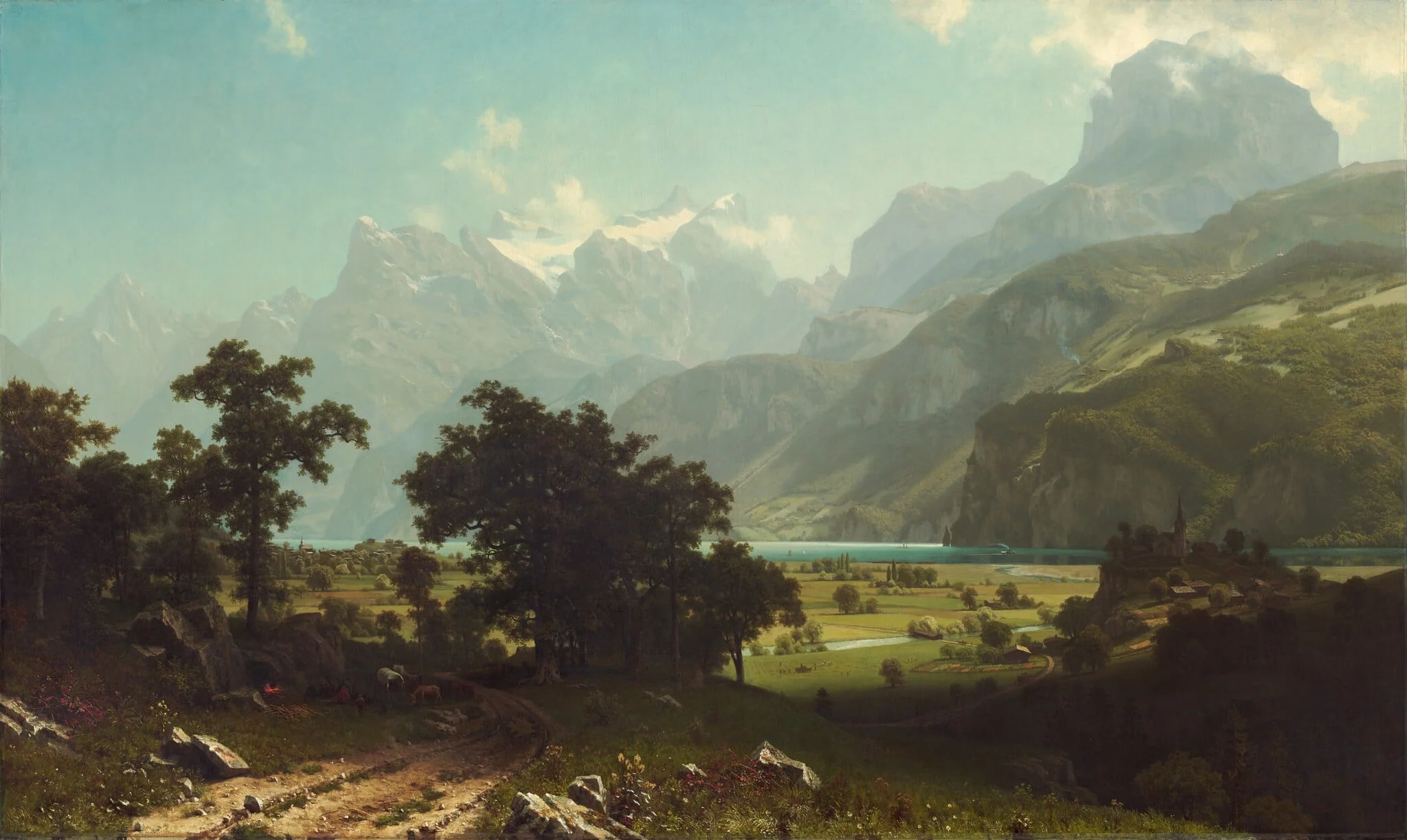
The river as a subject in painting is rarely about water for its own sake. A painter who runs a river through a canvas is reaching for something water happens to provide: a line that carries the eye from the foreground into the far distance, a mirror that doubles the sky, a seam that divides a wild bank from a settled one, a road for trade. Look closely at any serious landscape built around moving water and you find the river doing structural labor. It is the spine the rest of the picture hangs on. This essay makes a small bet, which is that you can learn to read a whole subject by reading one work slowly, and that the work worth slowing down over here is Albert Bierstadt's Lake Lucerne.
My claim is narrow and, I think, defensible. In landscape painting the river is less a thing depicted than a tool for managing a viewer's passage into depth, and for deciding whether a scene is being reported or argued. Bierstadt does not paint Lake Lucerne to inventory a Swiss lake. He uses its water to stage a confrontation between two registers of nature, the theatrical and the observed, and the negotiation between those registers is the whole drama of nineteenth-century landscape. Get one canvas right and the rest of the subject opens. The collection bears this out across centuries, but the argument is won or lost at the level of a single surface.
Looking at Lake Lucerne
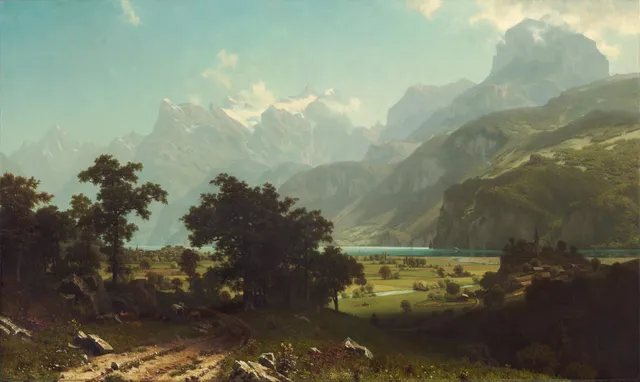
Stand in front of Lake Lucerne and notice first what Bierstadt refuses to let you do. He will not let your eye rest in the foreground. The near shore is busy, broken with rock and scrub, with a scatter of small figures who exist mainly to be small, and that bustle pushes you outward across the water almost at once. The lake itself is painted nearly flat, a pale sheet that holds the reflected mountains without quite committing to them. Then the far range rises, and Bierstadt switches handling entirely. The peaks are built up in cooler, harder light, their edges crisp where the water was soft. The lake is the hinge. On the near side the paint is loose and incidental. On the far side it tightens into spectacle.
That shift is the argument. Bierstadt trained in Düsseldorf, and you can read the German schooling in the way light is staged rather than simply observed, a shaft breaking across the middle distance to nominate one stretch of mountain as the subject and leave the rest in reserve. The water earns its place precisely because it is the one passive element. It does nothing but receive. Every active decision in the picture, the placement of the figures, the cut of the light, is measured against the lake's stillness. Take the water out and the composition has no fulcrum. The peaks would simply pile up at the back of the canvas with nothing to balance them.
Walk your eye back to the foreground a second time and the economy becomes clear. Bierstadt spends almost no descriptive care on the near rocks. They are blocked in with a few broad strokes, enough to read as rock and no more, because their only job is to be near. The figures are smaller than they have any naturalistic right to be, and that exaggeration is deliberate. It inflates the distance across the water and makes the far peaks read as colossal. The lake measures that exaggeration for us. Because its surface is calm and continuous, the eye can gauge how far it has traveled by the time it reaches the base of the mountains. A choppier handling would have broken that ruler. Bierstadt needs the water glassy so the scale can do its work.
Bierstadt belongs to a generation the Metropolitan Museum dates to roughly 1850, the moment a circle of New York landscape painters cohered around the example of Thomas Cole and acquired the name Hudson River School (Met, Heilbrunn Timeline). Our own holdings show how wide the water motif runs once you stop treating it as decoration. Artifact World Gallery holds 477 River works by 228 artists across 56 venues, spanning roughly 1114 to 1960. That eight-century reach is the useful fact. It means the river was a working problem for painters long before and long after the American school made it a national one, and a single canvas can only be understood as one answer among hundreds.
The river as a line you can read
If Lake Lucerne uses still water as a passive hinge, Thomas Cole turns a river into the picture's central sentence. His View from Mount Holyoke after a Thunderstorm is known by a plainer name, The Oxbow, taken from the thing the eye actually fixes on, the great looping bend of the Connecticut River. Cole splits the canvas on a diagonal (Smarthistory). To the left a storm is still tearing at a dark wilderness of blasted trees and churned cloud, a slope that refuses cultivation. To the right the sky clears over a tamed valley of fields and farm smoke, and the river loops calmly through it. The oxbow is the pivot between the two. Cole even tucks a small self-portrait at the lower edge, an easel and a painter turning back toward us, as if to insist that the choice between wilderness and settlement is being made by a human hand, his.
This is the river as argument in its plainest form. Cole was not neutral about what the bend meant. He worried, across his short career, that American expansion would erase the very wildness that made the country worth painting, and the calm civilized water on the right is shadowed by the storm it has just survived. The river organizes the moral content the way it organizes the space. Read the water and you have read the picture's politics. The bend simply sits there, doing two jobs at once.
Look at how the paint changes across the divide. On the storm side Cole works wet and dark, the foliage knotted, the brush almost agitated, so the wilderness feels physically rougher than the valley. On the cleared side the strokes lie down flat and the color warms. The river is the only element that crosses the boundary intact, the same silver thread reading through both halves, and that continuity is the quiet claim of the picture. Whatever the country decides, the water keeps running. Cole gives the bend a near-symbolic clarity by lifting his viewpoint high onto the mountain, so the oxbow reads almost like a letter drawn on the floor of the valley, a shape you could trace with a finger.
Survey against invention
Cole's followers inherited the river as both motif and method. Jasper Francis Cropsey built a career on it. His Autumn - On the Hudson River floods an entire valley in the red and gold of an American October, the river a bright ribbon threading miles of woodland toward a hazy horizon. His Valley of Wyoming does similar work in a Pennsylvania river plain, the water leading the eye through a landscape already heavy with the memory of a colonial massacre. The generation wrote its theory down too. Asher B. Durand, Cole's closest heir, published his Letters on Landscape Painting in the journal The Crayon in 1855, instructing younger painters to go directly to nature and to study the specific truth of a place rather than invent a generic one (Internet Archive). The river made a perfect teacher for that program because it would not hold a generic shape. It bent where the land told it to bend.
You can measure how new Durand's demand was against the older habit it displaced. Thomas Doughty, a senior figure, painted his Fanciful Landscape, as the title admits, from imagination. Its water is a composed convenience, a calm reflective foreground set down where the design wanted calm, not where a survey would have put it. Doughty is not failing at anything. He is working under different rules, the eighteenth-century studio convention in which a river is a compositional given, a polite mirror to anchor the lower third. Set his invented water beside Cole's surveyed oxbow and you watch the American school's whole reform in miniature, the river migrating from a thing the painter arranges to a thing the painter obeys.
The river before the Americans
None of this began in New York. Dutch painters had made the river a specialty two centuries earlier, and our eight-hundred-year span reaches back to take them in. Their rivers are rarely sublime. They are working water, weatherbound and busy, ferries and barges under the low light of a country built at sea level. Aert van der Neer pushed that ordinary water somewhere stranger. His moonlit view of the New Amstel River, now in the Getty, turns the river into a black mirror for a low moon (The J. Paul Getty Museum). The whole tonal drama rests on water's willingness to carry a light it does not own. Look at the surface and you see how little actual moon there is in the sky and how much of it lives in the river instead, a cold smear of silver laid into near-black paint.
The Dutch lesson was structural, and the Americans inherited it whether they knew the source or not. A horizon set two-thirds of the way down the canvas, with water filling the strip below, was enough to build a serious picture on. The river gave the lower third something to do besides sit there. It caught the sky and tied the near bank to the far one. Hold that Dutch economy next to the Hudson oxbow and the contrast has nothing to do with skill. The question is what the water is asked to mean. The Dutch want the river true to a working day and a particular weather. Cole wants it to carry a nation's argument with itself. Same motif, opposite burdens. Before a painter decides how to render the water, he has already decided what the water is for.
The river dissolves
The motif's last great move was to stop being a structure at all. When Alfred Sisley painted The Bridge at Villeneuve-la-Garenne, the Seine near Paris is no longer a line drawing the eye to a distant truth. It is a field of broken color, the bridge's stone reflected in short separate strokes that refuse to settle into a clean mirror. The river has become an excuse to study light on a moving surface. Paul Cézanne carried that further at Médan, where his Banks of the Seine, now in Washington, shows how completely he had absorbed Impressionism's modulated touch before bending it toward something more architectural (National Gallery of Art). In both, the water stops organizing depth and starts dissolving it. The river that Cole used to lead you confidently into the distance now keeps you at the surface, looking at paint.
Get close to Sisley's bridge and the water stops being water at all. It is a lattice of separate touches, blue laid against rose, neither blended into the other, each one a record of a single decision made fast in front of the motif. From across a room the strokes resolve into a reflection. Up close they stay stubbornly themselves. That is the whole Impressionist wager played out on a river's surface, the bet that a viewer's eye will do the mixing the painter declined to do. The Seine was the perfect place to test it because flowing water never offers the same reflection twice, so a painter who wanted to copy it exactly was beaten before he started. Sisley stopped trying to copy and started transcribing light.
That is exactly why one work can teach the subject. Lake Lucerne sits on the hinge of this history. Bierstadt's still water still believes in depth, in the long pull from a busy foreground to a staged horizon, and it still wants to overwhelm. But the loose, almost careless handling of his near shore is already the loose handling Sisley would make into a whole method. Read his lake closely and you are reading both directions at once, back toward Cole's surveyed river and forward toward the dissolving one. The seam between his soft foreground and his hard peaks is the seam between two centuries.
In our holdings
The pattern is easy to test against the archive. Across the 477 River works in the collection you can watch the motif change jobs, from Dutch ferry-road to Impressionist surface, with the American moral diagonal sitting between them. Pull a handful and the through-line holds. The water is never decorative. It is always doing the composition's heavy lifting, whether as a passive mirror, a moral pivot, a working road, or a broken field of light. Here is what to look for when you compare them yourself.
- A road and a livelihood. The Dutch estuary as working infrastructure, water flat and useful under a high sky.
- A moral diagonal. The bend that divides storm-wracked wilderness from cultivated valley, as in Cole.
- A measured recession. Still water staged to pull the eye into theatrical alpine depth, as in Bierstadt.
- A broken surface. Reflection refused, water turned into separate strokes of light, as in Sisley and Cézanne.
Works discussed in this article
A verdict from the waterline
My own conclusion, after looking, is that the river is the most honest test a landscape painter faces, because water cannot be faked into holding still. It will obey the design or it will expose it. Bierstadt's lake obeys, barely, and the strain of that obedience is visible in the seam between his loose foreground and his hard theatrical peaks. Stand close enough to read that seam and you are watching the nineteenth century decide what a landscape was for. Then walk to the next canvas with a river in it, a moonlit Amstel, a Hudson bend, a flickering stretch of the Seine, and you will find the same decision being made again, in different paint, with the water once more doing the work nobody thinks to thank it for.
Sources & further reading
- The Hudson River School — The Metropolitan Museum of Art, Heilbrunn Timeline of Art History
- Thomas Cole, The Oxbow — Smarthistory
- Paul Cézanne, Banks of the Seine at Médan — National Gallery of Art
- Asher B. Durand, Letters on Landscape Painting, Letter 1 (The Crayon, 1855) — Internet Archive
- The Oxbow (View from Mount Holyoke) — Wikipedia
- Hudson River school — Tate
- Aert van der Neer, Moonlit Landscape with a View of the New Amstel River — The J. Paul Getty Museum