To stand in front of a Song dynasty landscape is to watch a disciplined generation of painters pick a fight with the century that taught them to hold a brush. The quarrel was not really about technique. It was about what a mountain is for. The Tang masters and their immediate heirs had treated landscape as a setting, a gilded backdrop where emperors fled and immortals took their ease. The Song painters refused that premise. They pushed the human story to the bottom of the picture, sometimes off it entirely, and let the mountain itself carry the moral weight a Tang painter would have reserved for a sovereign.
Here is the argument this essay defends. Song landscape reads as a sustained rebuttal of an old idea, the Tang conviction that nature was ornament. Where the Tang gilded, the Song built. Where the Tang narrated, the Song observed. The towering central peak of the early eleventh century is a counter-proposal, made in ink rather than mineral color, that structure in the visible world matters more than spectacle. And because every good argument outlives the people who start it, the Song position was itself revised and partly overturned by the dynasty's own second act in the south, then re-litigated for six more centuries by painters who kept copying the originals to work out what they had meant.
The stakes were philosophical. This was the age of a Neo-Confucian revival, when thinkers held that the patterned coherence running through water and stone, the li or underlying principle of things, could be read by a patient eye. A landscape that merely dressed a wall could not carry that idea. A landscape built like an argument could.
What the Tang left behind
The predecessor was not crude. Tang court painting had perfected a blue-and-green manner, qinglü, in which mountains were laid down in fine outline and filled with azurite and malachite, the rock faces shelving up in decorative scallops as bright as cloisonné. You can see what that tradition looked like, preserved and recopied long after the dynasty fell, in Emperor Xuanzong's Flight to Shu, a Southern Song hanging scroll in our archive that remembers a Tang composition. The peaks rise in jagged mineral-green spires, packed edge to edge, closer to coral than to geology, and threaded through the passes is the imperial party, tiny riders winding away from the An Lushan rebellion. The painting is gorgeous, and it is honest about its priorities. The mountains are there to frame the emperor's misfortune. They are scenery in the theatrical sense, a painted flat standing behind the actors.
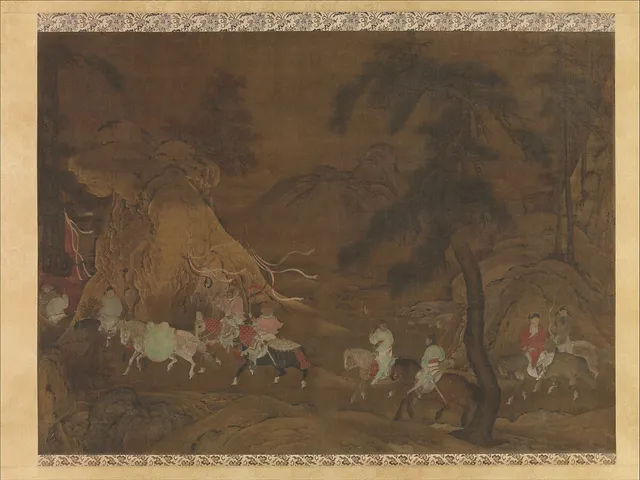
That is the position the Song generation set out to dismantle. Their complaint, reconstructed from what they painted and from the treatises they left behind, was that the blue-green manner flattered the surface of the world and ignored its build. Mineral color sat on top of the silk like enamel. It described a mountain's costume, never its bones. The beauty was not in dispute. The priorities were. A manner this lovely could still be, in the Song view, a manner that had stopped looking hard at the thing in front of it.
The mountain becomes the argument
What replaced it, in the decades after the dynasty's founding in 960, was the most ambitious landscape painting China had yet produced. The Met describes the early Northern Song as the flowering of one of the supreme artistic expressions of Chinese civilization, monumental landscape, and the word monumental is precise rather than promotional (the Met's essay on the period). Fan Kuan's Travelers by Streams and Mountains, a hanging scroll standing close to seven feet tall, makes the case in one image: a sheer wall of rock fills the upper two-thirds of the silk, a thin ribbon of waterfall drops down its right flank, and at the base, almost lost, a mule train of travelers crosses a road (Smarthistory reads it against Neo-Confucian thought). The proportion is the polemic. The men are ants. The mountain is the whole of the world, and the viewer's eye is meant to climb it.
Notice how differently that picture asks to be read. The Tang blue-green scroll spreads its incident sideways and keeps the eye moving along the surface, from one bright peak to the next. Fan Kuan sends the eye up. Foreground boulders give way to a gulf of mist where the temple roofs hide, and above it stands the unbroken cliff. The composition is vertical because the claim is hierarchical. Stone outranks man, and the painting makes you feel that order in your neck as you look. The reading even has a tempo. You enter low, among the boulders and the half-seen roofs, you lose the path in the band of mist, and then the cliff arrives all at once with nowhere further up to go. A Tang scroll lets the eye stroll. Fan Kuan makes it ascend, and an ascent has a summit that humbles whoever reaches it.
The medium carried the message. These painters worked in shan shui, literally mountain-water, the art of building a world from brush and ink rather than the court's mineral pigments (the term itself encodes the subject). Monochrome was a choice with an edge to it. Stripped of azurite, a mountain had to convince through structure alone, through the weight of its ink-washed mass and the texture strokes, cun, that modeled bare stone into something you could believe held its own shadows. Where the Tang painter reached for green, the Song painter reached for a drier brush and a harder look. The restraint was not poverty. It was a discipline that left nowhere to hide a weak passage of drawing.
Guo Xi and the long view
No one set out this program more fully than Guo Xi, the court painter whose treatise on landscape, dictated to his son and read for centuries afterward, described how a mountain should be seen from close at hand, from a height looking in, and across a level distance. His Early Spring, dated 1072 and held in Taipei, is the textbook case of the dissolving, breathing mountain, its rock faces twisting upward like slow smoke. The picture in our own archive shows the quieter side of his method, and in some ways the more radical one.
Guo Xi's argument ran past the edge of the silk. In the essay his son compiled, he proposed that a well-made landscape could stand in for the mountains themselves, that a busy official with no hope of retiring to the wilderness might hang a painting and travel in it with his eyes. A picture, by this logic, was a usable model of the world. That is a working painter's version of the Neo-Confucian claim that principle is legible in things. If the order of nature is real and can be read, then a painter who catches it has done more than decorate a room. He has supplied an instrument for contemplation.
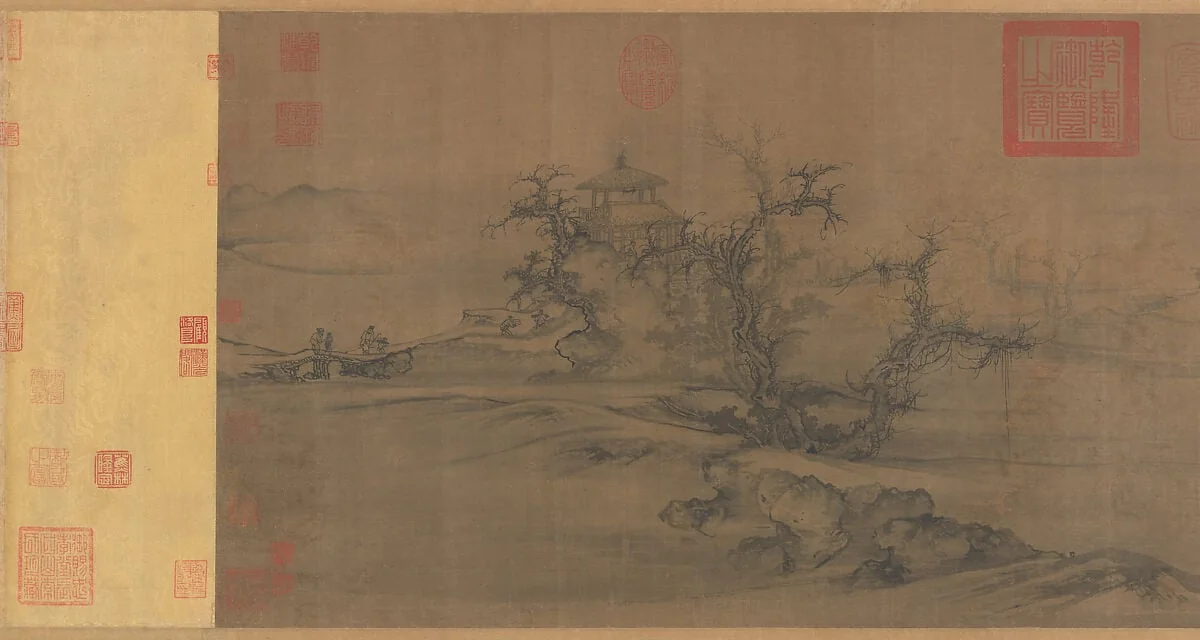
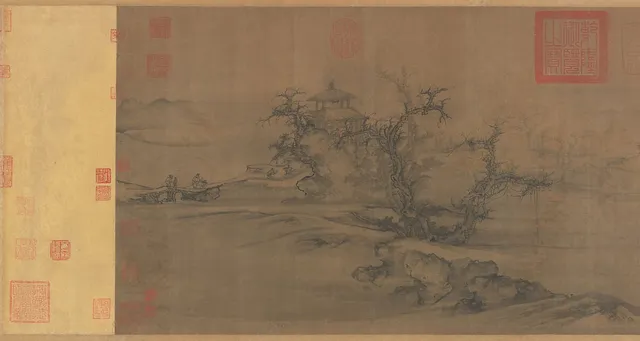
His Old Trees, Level Distance is a handscroll rather than a towering hanging scroll, and it argues by subtraction. Read it from right to left, the way the hand unrolls it. A cluster of bare old trees stands in the foreground, their branches drawn in the crab-claw manner Guo Xi favored, hooked and brittle, reaching into empty air. The ground they grip is a low spit of rock and a few worn boulders. Then the land simply gives way. Beyond the trees the river valley opens into a wide, pale recession, water and sky fusing into one washed silver, a thin range of hills floating at the far edge with almost no ink to hold it down. Two small figures meet on the near bank, and a hut sits among the reeds, but they are incidents, not the subject. This is the level-distance formula the Met names, tall foreground trees set against a wide river valley (the museum's catalogue entry for the scroll), and what it stages is not a place so much as a way of looking, the slow pull of the eye from the close and tactile toward the far and dissolving. The Tang painter filled the silk. Guo Xi empties most of it and trusts the void to finish the work. The emptiness is the most active part of the picture, the place where the viewer is asked to keep supplying what the brush deliberately withheld.
What the archive holds
The wager paid out over a remarkably long span. Artifact World Gallery holds 259 Song dynasty landscapes, the work of 99 separate hands gathered from six museum collections, with dates that run from roughly the year 1000 to 1788. That range is the most telling figure in the set. A movement that flourished and fell with a dynasty by 1279 is represented here by paintings made five and six hundred years afterward, because the Song manner became the standard every serious Chinese landscapist had to answer to. The corpus is less a snapshot of two centuries than the transcript of a very long conversation.
Cluster the dates and a pattern shows. The earliest works sit near the movement's own lifetime. The bulk arrive much later, in the centuries when collectors and academies had canonized the Song masters and copying them was how a painter earned a place in the lineage. A date near 1788 on a Song-manner landscape is not a forgery and was never meant to deceive anyone. It is a citation, a painter naming his source in the only language his medium had. The eleventh century kept generating new work long after its own painters were dust.
Ninety-nine artists across six collections is its own kind of evidence. The Song landscape was never the property of one workshop or one city. It was a shared language, copied and dispersed widely enough that a survey today can pull it from half a dozen separate museum holdings without strain. A style that survives that much copying, in that many hands, across that many institutions, was carrying something its imitators thought worth the labor of getting right.
A handful of those works carry the whole argument between them, from the Tang-style foil at one end to the late copies that kept the debate alive at the other.
Works discussed in this article
The southern turn, and the first revision
The first painter to revise the Song program was the Song itself. When the Jin armies took the north in 1127 and the court fled south to Hangzhou, the Southern Song landscape that grew up there quietly gave up the totalizing peak. The great synthesizers of the southern academy, Ma Yuan and Xia Gui, pushed the composition into a single corner, a foreground bluff, a slice of mist, and left the rest of the silk open. Later critics named it the one-corner style. It kept the Song commitment to ink and structure and let go of the Song appetite for the complete cosmic view. Intimacy took the place of grandeur. A mood took the place of a system.
You can feel that softer, more lyrical landscape arriving early in Zhao Lingrang, an aristocrat-painter of the late Northern Song whose River Village in Autumn Dawn trades the cliff for the marsh. Low banks, misted willows, ducks on still water, a level world with no peak to climb. Zhao was after atmosphere and season rather than the moral architecture of a Fan Kuan, and in reaching for it he pointed toward nearly everything the south would later make its own. The drama here is weather, not stone. The picture asks to be felt at eye level, the way you feel a damp morning, rather than craned up at like a verdict.
Two more works in the archive mark the other inheritance the Southern Song carried forward, the careful drawing of figures inside the landscape rather than beneath it. An untitled scroll after Li Gonglin, the Northern Song master of plain-line figure drawing, and another after Liu Songnian, an academician of the southern court, both keep human incident legible without letting it swallow the setting. They are a reminder that the Song argument was never a simple expulsion of the figure. It was a re-ranking. The person could stay, so long as the person knew its place in the order of things.
The argument, revisited
Then the argument was had again, and again. Because the Song originals had become canonical, later dynasties painted their way back into them, partly as homage and partly as a continued debate over what the eleventh century had gotten right. The archive's reach to 1788 is populated by exactly these returns. Liu Yu, a seventeenth-century painter working under the Qing, titled a handscroll Traveling Amid Streams and Mountains, borrowing the very phrasing of Fan Kuan's most famous picture. The gesture is a thesis in itself. Six hundred years on, a painter announces his subject by quoting the Song, then sets out to test whether the old monumental claim still holds when a later brush makes it.
Even the storytelling tradition the Song supposedly demoted kept answering back. Ma Hezhi, a twelfth-century court painter, illustrated classic poems with landscapes that put the human narrative front and center again, fluttering and openly literary. The Song had not killed the narrative landscape. It had forced it to compete with a rival that took the land seriously, and the competition ran on for centuries after both sides should have been exhausted.
The simplest proof that the Song won its argument is that the argument refused to close. A Tang court painter rendered a mountain so an emperor would have somewhere to flee. A Song painter rendered a mountain so that a viewer five centuries later would feel pressed to climb it, and then to paint his own. Old Trees, Level Distance still does this. Unroll it and your eye is dragged past the brittle branches into that silver distance, hunting for the far hills, supplying with your own attention the order the painter only suggested. The Tang gave you a picture to admire. The Song handed you a problem to keep solving.
Sources & further reading
- The Northern Song Dynasty (960-1127) — The Met, Heilbrunn Timeline of Art History
- Guo Xi, Old Trees, Level Distance (catalogue entry) — The Met
- Neo-Confucianism and Fan Kuan, Travelers by Streams and Mountains — Smarthistory
- Shan shui — Wikipedia
- Early Spring (painting) — Wikipedia
- An Essay on Landscape Painting (Guo Xi, 1935 English edition) — Internet Archive
- Chinese, Southern Song Dynasty (period author) — National Gallery of Art
- Song (Chinese culture, style, period), AAT 300018427 — Getty, Art & Architecture Thesaurus