Artist
Edward Lear
United Kingdom of Great Britain and Ireland
Edward Lear is an United Kingdom of Great Britain and Ireland Impressionism artist. 60 works are cataloged here, principally at National Gallery of Art.
Edward Lear (12 May 1812 – 29 January 1888) was an English artist, illustrator, musician, author and poet, who is known mostly for his literary nonsense in poetry and prose and especially his limericks, a form he popularised but which term he never used. His principal areas of work as an artist were threefold: as a draughtsman employed to make illustrations of birds and animals, making coloured drawings during his journeys (which he reworked later, sometimes as plates for his travel books) and as a minor illustrator of Alfred, Lord Tennyson's poems. As an author, he is known principally for his popular nonsense collections of poems, songs, short stories, botanical drawings, recipes and alphabets. He also composed and published twelve musical settings of Tennyson's poetry.
Overview
Edward Lear (12 May 1812-29 January 1888) was an English artist, illustrator, musician, author and poet whose multifaceted career spanned natural history illustration, landscape painting, musical composition, and the creation of literary nonsense. Though he achieved early recognition as one of the foremost ornithological draughtsmen of the nineteenth century, his posthumous fame rests chiefly on his nonsense verse, particularly his limericks and poems such as 'The Owl and the Pussy-Cat,' which helped popularise a form he never actually named. Working across media and genres, Lear produced thousands of watercolours and oils alike, published travel books based on extensive Mediterranean and Asian journeys, and composed the only musical settings of Alfred, Lord Tennyson's poetry that the poet ever approved. His work as a bird artist, undertaken primarily in his teens and twenties, was pioneering in its reliance on living rather than specimen-based observation, while his later landscapes captured the intense light and colour of southern Europe and the Levant with a distinctive immediacy that has attracted renewed scholarly and critical attention.
Biography & dates
Lear was born in Holloway, North London, on 12 May 1812, the penultimate of twenty-one children of Jeremiah Lear, a stockbroker, and Ann Clark Skerrett. The family's circumstances deteriorated sharply after Jeremiah's speculative losses in 1816 in the economic aftermath of the Napoleonic Wars. When Lear was about four, he left the family home, Bowmans Lodge, to live with his eldest sister Ann, twenty-one years his senior, who raised him and remained his closest companion until her death when he was nearly fifty. His childhood was marked by significant health difficulties. From around age six, he suffered epileptic seizures, and he also developed bronchitis, asthma, and, in later years, partial blindness. He experienced his first seizure at a fair near Highgate with his father, an event that caused him lasting shame and led him to withdraw from company whenever he sensed an episode approaching. By about age seven, he showed signs of depression, which he termed 'the Morbids,' and which recurred throughout his life. Lear began drawing professionally by age sixteen, and in June 1830 commenced work on Illustrations of the Family of Psittacidae, or Parrots, published in November of that year when he was nineteen. This established his reputation as an ornithological illustrator of the first rank. From 1832 to 1836, he worked for Edward Smith-Stanley, 13th Earl of Derby, at Knowsley Hall near Liverpool, drawing the animals in Derby's private menagerie; he also taught Elizabeth Gould during this period and collaborated with her husband John Gould. He was elected to the Linnean Society of London. As his eyesight deteriorated, making the fine detail of lithographic plates increasingly difficult, Lear shifted his focus to landscape painting and travel. Between 1842 and 1847, he travelled extensively through Italy, from Lazio and Rome south through Abruzzo, Molise, Apulia, Basilicata, Calabria, and Sicily, gathering material for his Illustrated Excursions in Italy and later travel books. In 1846, he published A Book of Nonsense under the pseudonym Derry Down Derry, and in the same year gave drawing lessons to Queen Victoria. He met Alfred Tennyson and William Holman Hunt in subsequent years. From 1855 to 1864, with brief interruptions, Lear lived on the island of Corfu, then under Ukase of the Ionian Islands under British protection. From this base, he travelled into Ottoman Balkan territories, including Albania, Vardar Macedonia, and Greece, in 1848-49. He toured India and briefly Ceylon in 1873-75. From 1871 until his death, he resided in Sanremo, Italy, first at Villa Emily and from 1881 at Villa Tennyson. Between 1878 and 1883, he spent summers on Monte Generoso, on the border between Swiss Ticino and Italian Lombardy. He died in Sanremo on 29 January 1888 and was buried at the Cimitero Monumentale della Foce.
Style & movement
Lear's artistic practice developed through three principal phases, each with distinct technical and stylistic characteristics. His early work as an ornithological draughtsman was distinguished by direct observation from living birds rather than from skins or specimens, a methodological advance that set him apart from contemporaries and earned comparison with John James Audubon. The precision and vitality of these plates, produced in his teens and early twenties, reflect both his acute visual attention and the demands of scientific illustration in an era of expanding natural historical knowledge.
The deterioration of his eyesight forced a transition to landscape, where he developed a manner marked by strong sunlight and intense colour contrasts. Working initially in coloured wash during his travels, he would later rework these on-the-spot drawings into oil paintings, watercolours, and prints for his travel books. This studio reworking introduced a degree of formal composition that sometimes sat in tension with the immediacy of the original sketches, yet his best landscapes preserve a distinctive sense of place and atmospheric condition. His Italian, Balkan, and Indian subjects share a preoccupation with topographical specificity and the effects of Mediterranean and sub-tropical light.
As a writer, Lear's nonsense verse operates through strict formal patterning, the limerick's anapestic rhythm and AABBA rhyme scheme providing the container for absurd content, punning, and unexpected resolution. His nonsense songs, stories, and alphabets extend this principle across genres, combining linguistic play with a sometimes melancholic undercurrent that has suggested to critics affinities with surrealism and 'Pataphysics. The musical settings of Tennyson's poetry, of which he published twelve, were the only ones Tennyson approved, suggesting a consonance of sensibility between the two men that transcended their different media.
Major works
Lear's major works span illustration, travel literature, poetry, and music. Illustrations of the Family of Psittacidae, or Parrots (1830) remains a landmark of ornithological art, produced when he was nineteen and establishing his reputation. His work for the Earl of Derby at Knowsley Hall resulted in Gleanings from the Menagerie at Knowsley Hall (1846). The travel books that emerged from his extensive journeys include Views in Rome and its Environs (1841), Illustrated Excursions in Italy (1846), Journal of a Landscape Painter in Greece and Albania (1851), Journal of a Landscape Painter in Southern Calabria (1852), and Journal of a Landscape Painter in Corsica (1870). His Indian journey yielded watercolours later published as Impossible Picturesqueness: Edward Lear's Indian Watercolours, 1873-1875. In nonsense literature, A Book of Nonsense (1846) was followed by Nonsense Songs and Stories (1871), More Nonsense Songs, Pictures (1872), and Laughable Lyrics (1877). His most famous single poem, 'The Owl and the Pussy-Cat,' appeared in 1867, written for the children of his patron the Earl of Derby. The History of the Seven Families of the Lake Pipple-Popple (1865) was his first nonsense story. Nonsense Botany (1888) and various nonsense alphabets extended his work in the genre. His posthumously published illustrated edition of Tennyson's Poems (1889) realised, if partially, his lifelong ambition to illustrate the poet's work. His oil painting The Plains of Lombardy from Monte Generoso is held by the Ashmolean Museum in Oxford. His works are represented in numerous major collections including the Tate, the British Museum, the National Portrait Gallery, the Art Institute of Chicago, the National Gallery of Art, and the Yale Center for British Art, which hosted a major retrospective in 2000-2001.
Influences & students
Lear's early development as an ornithological illustrator was shaped by the demands of scientific accuracy and the emerging conventions of natural history publication in early nineteenth-century Britain. His employment by the Zoological Society and the Earl of Derby placed him within networks of aristocratic patronage and scientific enquiry that determined both his subjects and his methods. The comparison with John James Audubon, made by contemporaries, situates him within an international tradition of bird illustration, though his working from life rather than specimen constituted a distinct methodological choice.
His collaboration with John Gould and instruction of Elizabeth Gould connected him to the most prominent ornithological publishing enterprise of the era. The Goulds' prolific output for the natural history market provided a context for Lear's own early work, even as his eyesight forced him toward different subjects and scales.
In his later life, his acquaintance with Alfred Tennyson and William Holman Hunt placed him in contact with major figures of Victorian poetry and Pre-Raphaelite painting, though his own artistic trajectory remained largely independent of these movements. Tennyson's approval of Lear's musical settings of his poetry indicates a rare instance of mutual regard between the poet and a composer. There is no record of formal pupils or a studio following; his influence operated through publication and example rather than through teaching or the formation of a school.
Legacy
Lear's posthumous reputation has undergone significant shifts in emphasis. Celebrated in his lifetime primarily as an artist and travel writer, with his nonsense verse circulating as popular entertainment, he came to be remembered in the twentieth century chiefly as a writer of children's literature and nonsense poetry. This narrowing of reputation has been challenged by more recent scholarship and exhibition practice, which have reasserted the significance of his visual art, particularly the landscapes and natural history illustrations. The Yale Center for British Art's exhibition 'Edward Lear and the Art of Travel' (September 2000, January 2001), curated by Scott Wilcox and Eva Bowerman, represented a major institutional effort to restore critical attention to his pictorial work. Modern scholarly editions of his travel journals, letters, and visual works, including those edited by Vivian Noakes, Ray Murphy, Peter Quennell, and Vidya Dehejia, have made his oeuvre more accessible to researchers. His nonsense works have been translated into numerous languages, including German by H.C. Artmann and Hans Magnus Enzensberger, and into French, where translators have grappled with the formal constraints of the limerick. In scientific nomenclature, Lear's macaw (Anodorhynchus leari) commemorates his contribution to ornithological illustration. The continued circulation of his limericks, songs, and stories, their identification by surrealists and practitioners of 'Pataphysics as anticipatory of their own practices, and登入, and their persistent presence in children's literature, attest to a cultural afterlife that extends across high and popular forms. His work is held in major museum collections worldwide, and the scholarly and popular publication of his multifaceted output continues.
Works by Edward Lear
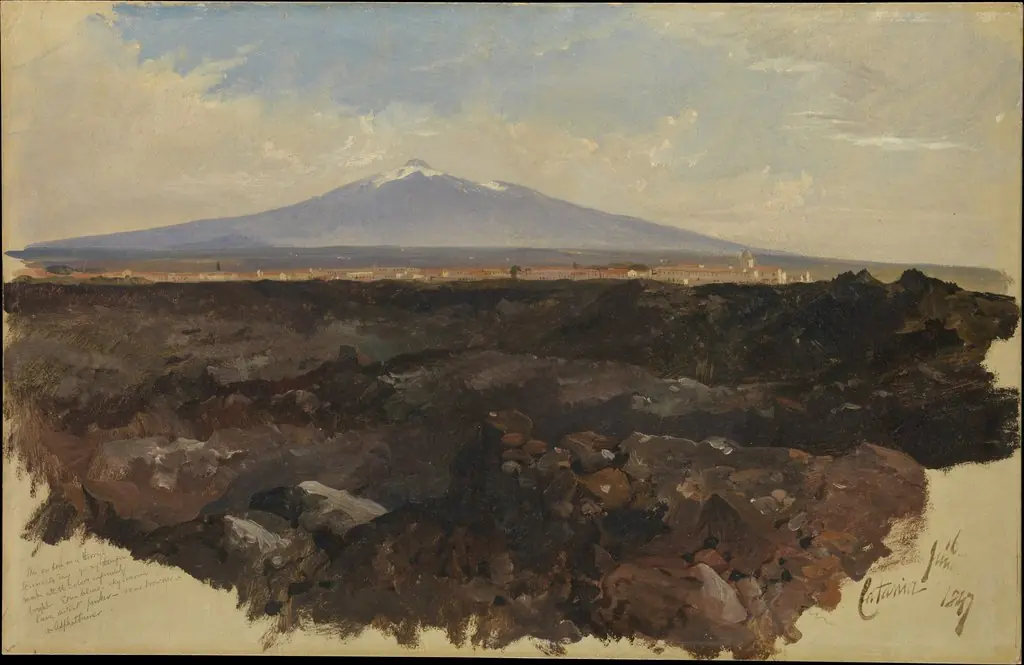 Catania and Mount Etna
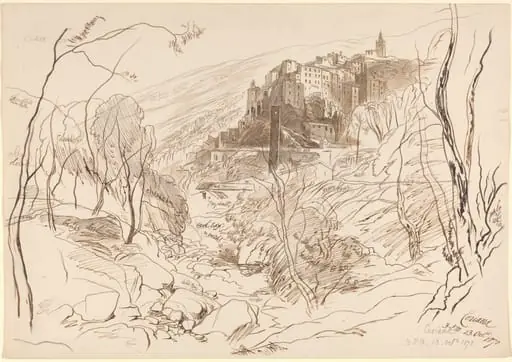 View of Ceriana
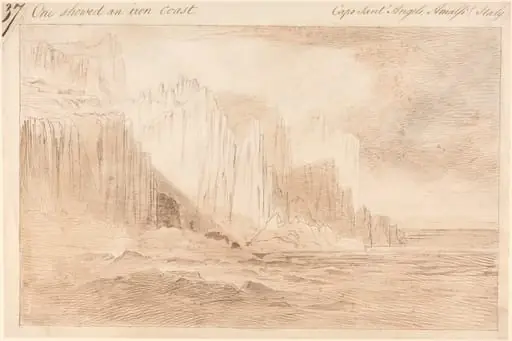 Capo Sant'Angelo, Amalfi
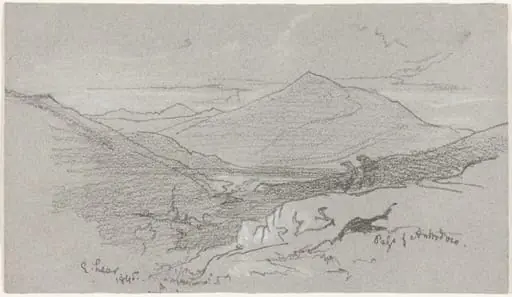 Mountainous View from Antrodoco
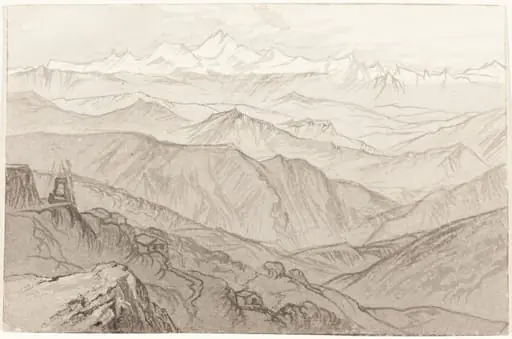 Mount Kinchinjunga (All Things Fair)
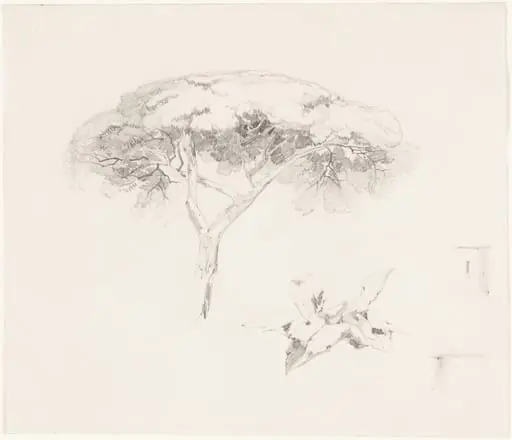 Umbrella Pine and Other Studies
![Sketches in Italy [recto]](https://artifactworldgallery.com/img/edward-lear--sketches-in-italy-recto--976e8557435634e9-w320.webp) Sketches in Italy [recto]
Sketches in Italy [recto]![A Sailing Ship [verso]](https://artifactworldgallery.com/img/edward-lear--a-sailing-ship-verso--c9eebd6783d42a3d-w320.webp) A Sailing Ship [verso]
A Sailing Ship [verso]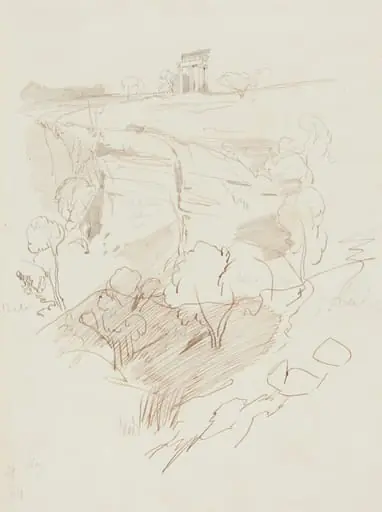 Ruined Temple on a Hill
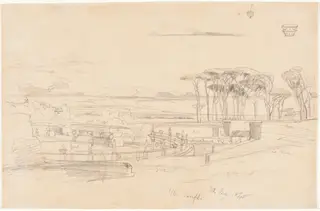 Villa Pamphili
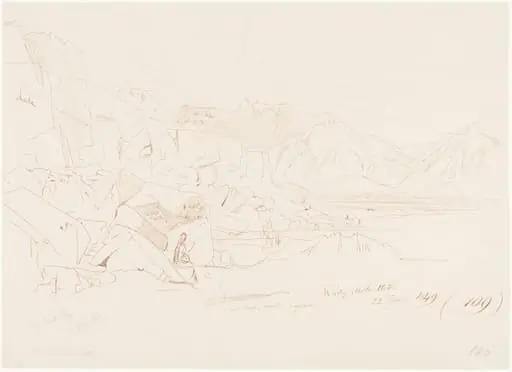 Wady Mokatteb
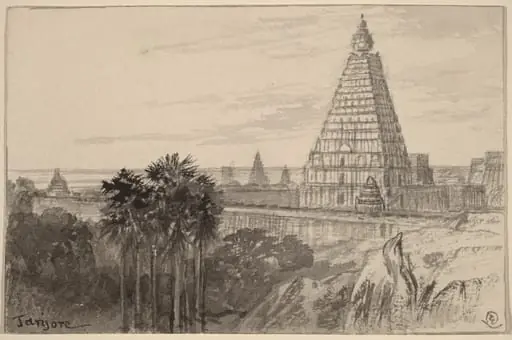 Tanjore, India
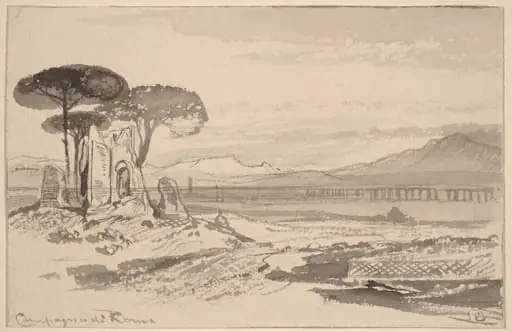 Campagna di Roma
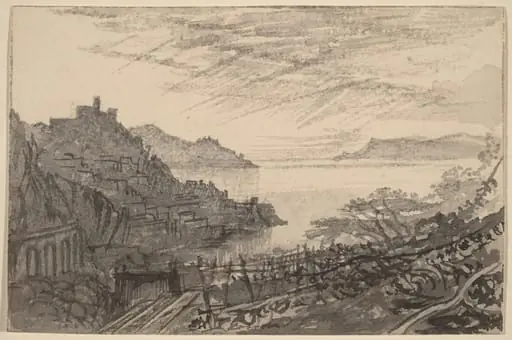 View of a Bay from a Hillside (Amalfi)
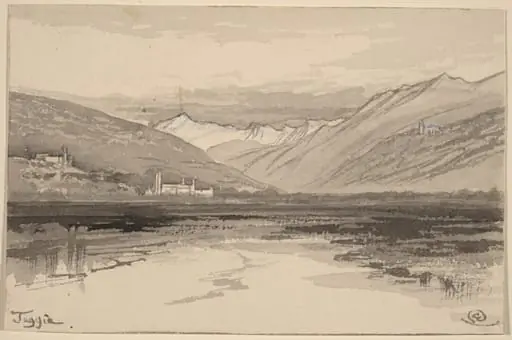 Taggia
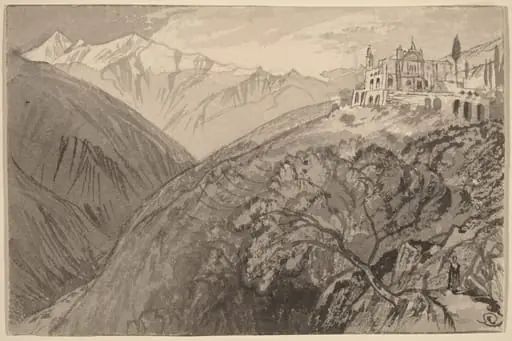 A Town on a Hilltop (Sanctuary of Lampedusa)
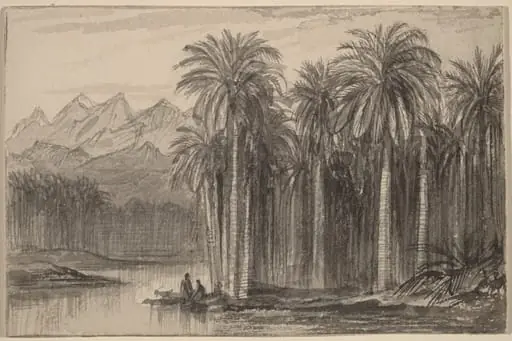 Figures Setting Out in Canoes from a Palm Grove (Wady Feiran)
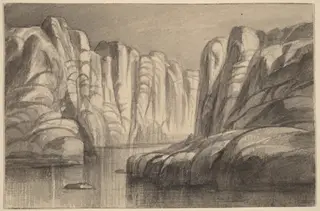 River Winding through a Rock Formation (Philae, Egypt)
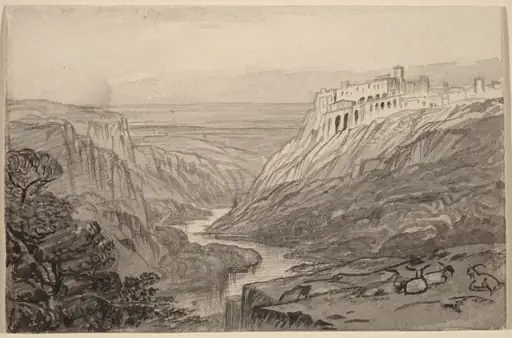 Goats Resting above a River Gorge (Narni, Italy)
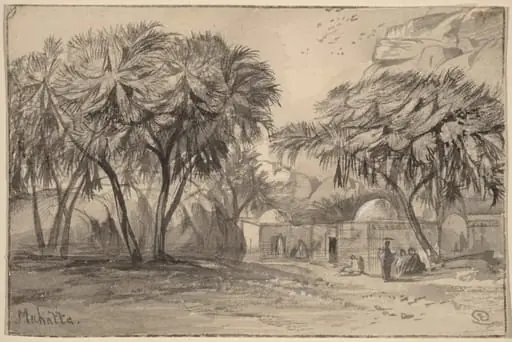 Mahatta
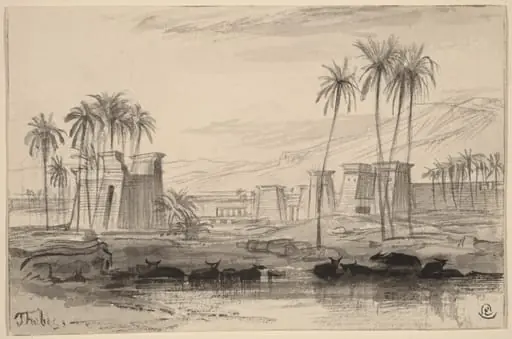 Thebes
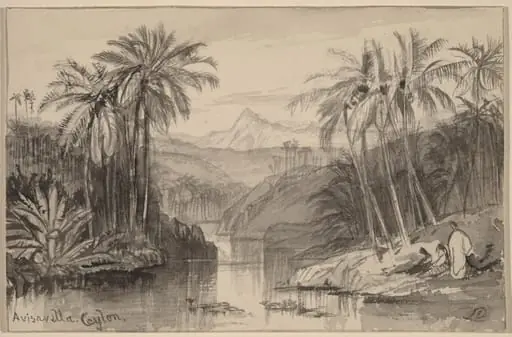 Avisavella, Ceylon
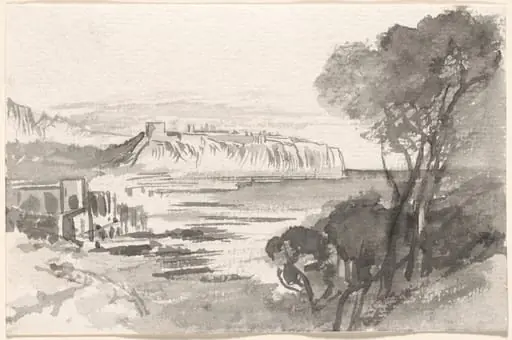 View across a Bay (Monaco)
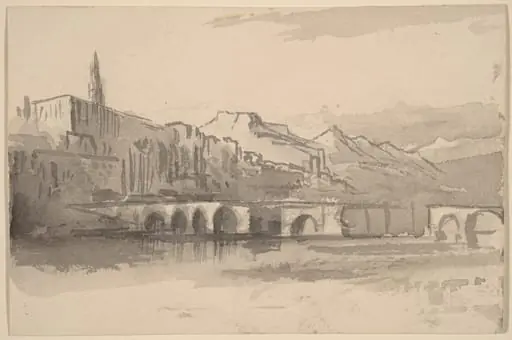 Bridge with Mountains in the Distance (Ventimiglia)
60 works in the catalog · 24 shown
Collections represented


Artists in a similar vein