Artwork
Villa Pamphili
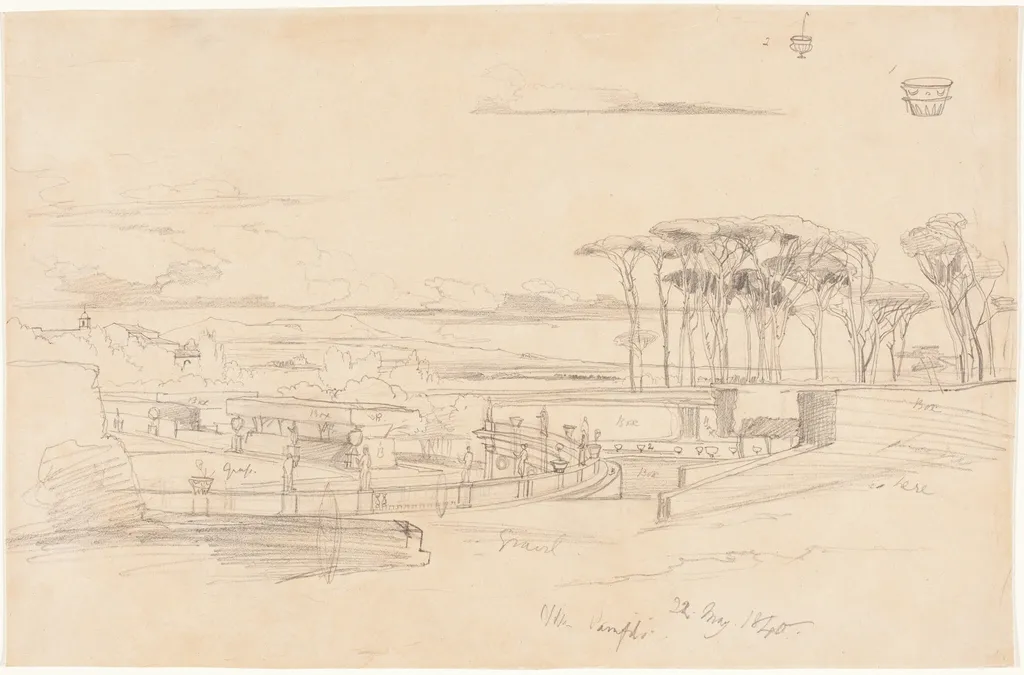
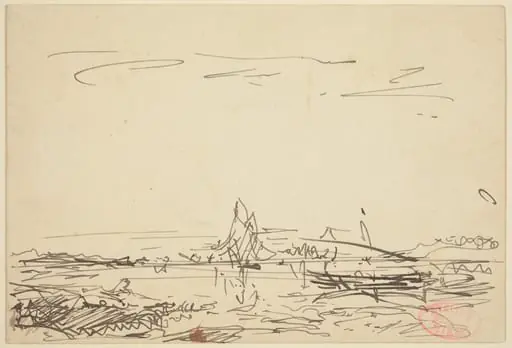
Villa Pamphili is a graphite drawing by the Romanticist artist Edward Lear. It dates from 1840 and is held in the collection of the National Gallery of Art.
- Inscription
- Inscribed:lower center to lower right in graphite: Villa Pamfili 22.May.1840.; graphite notations overall
About this work
Next, check out the National Gallery of Art, Washington to see more of this artist’s work.
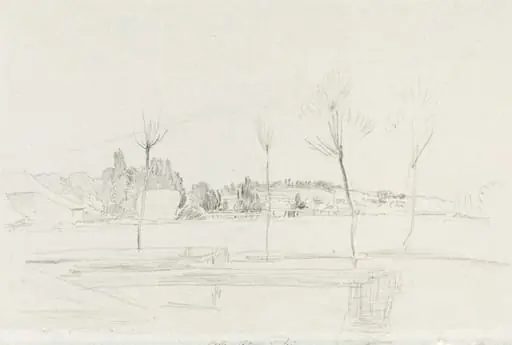
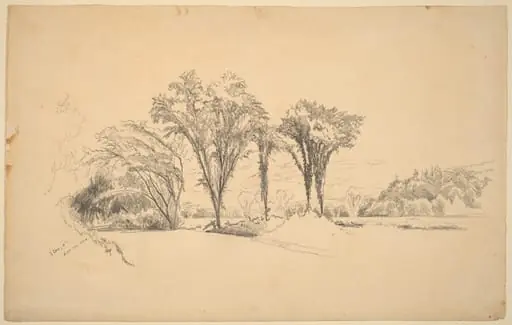
This sketch shows a quiet park with a long, empty pool in the middle. Trees line the far side, their branches bare but full of shape. Near the pool, a few small buildings peek out, and a few people walk along the edges.
The artist used light pencil strokes to keep it loose and quick. The date and name are scrawled in the corner, this was drawn in 1840.
Next, check out the National Gallery of Art, Washington to see more of this artist’s work.
Overview
Created in 1840, this graphite drawing on brown wove paper records a tranquil scene of the Villa Pamphili grounds. The composition centers on a long, empty pool flanked by bare‑lined trees and modest structures, while a few figures move along the perimeter. The work exemplifies Edward Lear’s habit of sketching landscapes encountered during his travels.
Subject & Meaning
The image captures a peaceful park setting, emphasizing the stillness of water and the skeletal forms of trees that frame the horizon. Small architectural elements appear intermittently, suggesting the integration of nature and built environment typical of Roman villas. The presence of walkers adds a subtle narrative of human activity within an otherwise serene landscape.
Technique & Style
Lear employed light, rapid graphite strokes to convey atmosphere, allowing the paper’s brown tone to suggest earthiness. The drawing’s loose handling creates a sense of immediacy, while the minimal shading preserves a sketch‑like quality. The choice of wove paper provides a uniform surface that supports the delicate line work without overwhelming detail.
History & Provenance
The piece bears Lear’s handwritten date and signature in the lower corner, confirming its creation during his 1840 Italian tour. As part of his broader practice of documenting sites visited, the drawing later entered collections of 19th‑century British art dealers before being acquired by a major American institution, where it remains accessible for study.
Own this work as a print
Artist & collection
Artist
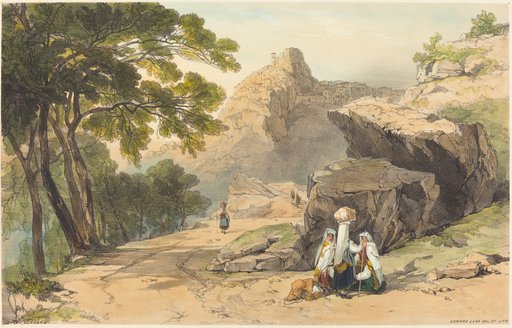
Edward Lear (12 May 1812 – 29 January 1888) was an English artist, illustrator, musician, author and poet, who is known mostly for his literary nonsense in poetry and prose and especially his limericks, a form he popularised but which term…



![The Ripetta in Rome [verso], by Augustin Pajou](https://artifactworldgallery.com/img/augustin-pajou--the-ripetta-in-rome-verso--4bc04e9c9476a91b-w320.webp)