Artist
Wilhelm Lehmbruck
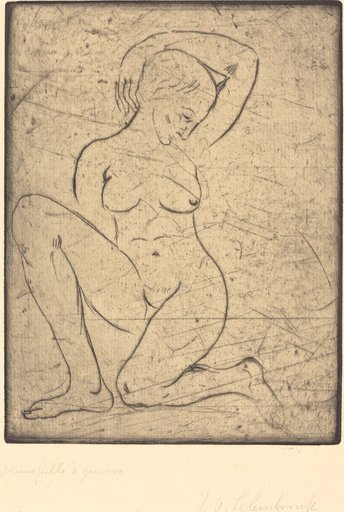
German Empire
Wilhelm Lehmbruck is a German Empire Expressionism artist. 28 works are cataloged here, principally at National Gallery of Art.
Wilhelm Lehmbruck (4 January 1881 – 25 March 1919) was a German sculptor. One of the most important of his generation, he was influenced by realism and expressionism.
Overview
Wilhelm Lehmbruck (4 January 1881-25 March 1919) was a German sculptor, printmaker, and medallist, recognized as one of the most important sculptors of his generation and a pioneer of modern twentieth-century sculpture. Working at the intersection of naturalism and expressionism, he created a concentrated body of work focused primarily on the human body, characterized by elongated forms, emotional intensity, and a profound sense of melancholy. His career, though cut short by suicide at age 38, produced works that were celebrated internationally during his lifetime and continue to be held in major collections worldwide, including the Museum of Modern Art in New York, the National Gallery of Art in Washington D.C., and the Tate Gallery in London. The Lehmbruck Museum in Duisburg, designed by his son Manfred, houses the largest collection of his work and serves as a center for international sculpture.
Biography & dates
Lehmbruck was born in Meiderich, near Duisburg, as the fourth of eight children in a miner's family. After primary school, he attended the Kunstgewerbeschule (School of Applied Arts) in Düsseldorf from 1895 to 1899, supporting himself through illustrations for scientific publications and decorative work following his father's death in 1899. From 1901 to 1906, he studied at the Kunstakademie Düsseldorf under Karl Janssen, becoming his master student. In 1906, he joined the Verein der Düsseldorfer Künstler and the Société nationale des beaux-arts in Paris, exhibiting at the Grand Palais from 1907.
In 1908, Lehmbruck married Anita Kaufmann; they had three sons: Gustav Wilhelm (born 1909), Manfred (born 1913), and Guido (born 1917). With support from Düsseldorf collector Carl Nolden, he moved to Paris in 1910, settling in Montparnasse and later on avenue de Maine. There he participated in the Salon d'Automne and formed significant friendships and professional connections. His first solo exhibition took place in 1914 at the Galerie Paul Levesque in Paris.
The outbreak of World War I forced his return to Germany. The family settled in Berlin-Friedenau, where he established a studio on Fehlerstraße 1, near the Noack bronze foundry. From 1915 to 1916, he served as a paramedic at a military hospital in Berlin-Friedenau, an experience that deeply affected him. With Max Liebermann's support, he was appointed war painter in Strasbourg from January to April 1916, but was officially exempted from military service due to severe hearing impairment. In December 1916, he fled to Zurich, where he lived and worked until early 1919, producing some of his most significant works and forming connections with pacifist artists and writers including Ludwig Rubiner, Else Lasker-Schüler, and Fritz von Unruh.
In early 1919, Lehmbruck returned to Berlin for portrait commissions and was appointed to the Prussian Academy of Arts. However, suffering from severe depression, he took his own life on 25 March 1919 in his Berlin-Friedenau apartment. He is buried in the Waldfriedhof in Duisburg-Wanheimerort, beside his wife Anita.
Style & movement
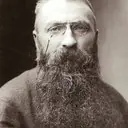
Lehmbruck's sculptural work occupies a pivotal position between naturalism and expressionism, evolving from academic training toward increasingly abstracted and emotionally charged forms. His early works maintained fidelity to naturalistic style and close observation of the model, but his Paris period marked a decisive transformation. Under the influence of Auguste Rodin's work and through contact with artists such as Constantin Brâncuși, Alexander Archipenko, and Amedeo Modigliani, Lehmbruck developed a distinctive approach characterized by elongated proportions, simplified volumes, and visible traces of the artist's hand in the clay, from which bronze casts were subsequently made. The human body remained his almost exclusive subject throughout his career. His figures, particularly female nudes, are marked by a profound sense of melancholy and an elongation of form that recalls Gothic architecture. The suffering he witnessed during his service as a paramedic in World War I fundamentally altered his work; after 1914, he ceased depicting female figures and turned primarily to male subjects that symbolized human anguish and vulnerability. His late sculptures, such as Der Gestürzte (Fallen Man), from 1915-16, are anonymous and strongly abstracted, with no individual facial features discernible, expressing universal human misery rather than particular identity. Lehmbruck's technical practice centered on modeling in clay, with subsequent bronze casting. The tactile quality of his working process is often visible in the finished works through preserved fingerprints and gestural marks. Architect Ludwig Mies van der Rohe, a close friend, regularly incorporated Lehmbruck's sculptures into his buildings and designs, alongside those of Aristide Maillol, indicating the modernist architectural community's regard for his formal innovations.
Major works
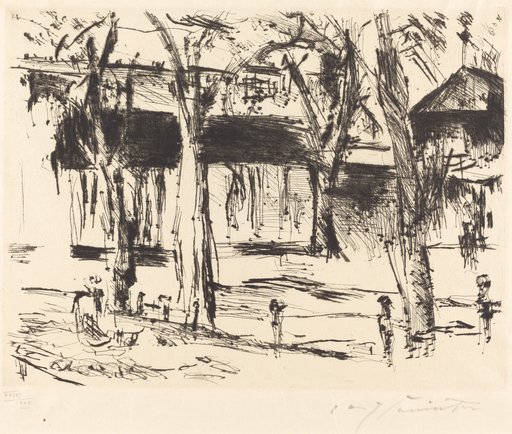
Lehmbruck's oeuvre, though compact due to his early death, includes several works recognized as central to modern sculpture. Die Kniende (Kneeling Woman, 1911) stands as perhaps his most celebrated sculpture, with four stone casts produced according to his specifications. This work served as a focal point at documenta I in 1955 and documenta III in 1964 in Kassel. The Berlin version remained in the Kronprinzenpalais, the world's first museum of contemporary art, and was destroyed by bombing in 1945; surviving fragments were later exhibited at the Museum für Gegenwart. Der Gestürzte (Fallen Man, 1915-16) represents the culmination of his wartime work, embodying the suffering he witnessed as a paramedic through an elongated, abstracted male figure. Der Sitzende Jüngling (Seated Youth) counts among his major achievements, with the model provided by Arthur Degner, an artist he knew through the Sonderbund. His graphic work constitutes a significant portion of his output, comprising nearly one hundred etchings, drypoints, and lithographs. He executed his first etching plate in Paris in 1910, and from 1911 produced his own print editions. Major series include Mutter und Kind, Das Quartier Latin, and Nudes. During his Berlin and Zurich periods, he continued producing lithographs, often portraits of the writers and artists in his circle. Works by Lehmbruck are held in numerous public collections internationally, including the Museum of Modern Art (New York), National Gallery of Art (Washington D.C.), Tate Gallery (London), Städel Museum (Frankfurt), Neue Nationalgalerie (Berlin), Honolulu Museum of Art, Aichi Prefectural Museum of Art (Nagoya), Indiana University Art Museum (Bloomington), Nasher Sculpture Center (Dallas), National Galleries of Scotland (Edinburgh), Norton Simon Museum (Pasadena), Schleswig-Holstein Museums (Norderstedt), and Von der Heydt Museum (Wuppertal). One of his sculptures is installed in the Villa Tugendhat.
Influences & students
Lehmbruck's artistic formation drew upon multiple sources. His academic training at the Kunstakademie Düsseldorf under Karl Janssen provided foundational technical skills in a naturalistic tradition. The decisive influence on his mature style came from Auguste Rodin, whose sculptures impressed him deeply and prompted his travels to England, Italy, the Netherlands, and Paris. In Paris, Bernhard Hoetger facilitated his entry into artistic circles where he encountered Ossip Zadkine, Alexander Archipenko, Constantin Brâncuși, and Amedeo Modigliani. The architect Ludwig Mies van der Rohe became a particularly close friend and advocate, while art critic Julius Meier-Graefe and gallerist Paul Cassirer, who managed his graphic works from 1913, played significant roles in promoting his career. Collector Karl Ernst Osthaus provided crucial early support through the 1912 exhibition at the Folkwang Museum in Hagen.
The sources do not indicate that Lehmbruck established a studio with formal pupils or a teaching position that would have created a circle of direct followers. His influence operated more diffusely through his exhibited works and his example as a sculptor who successfully merged figurative tradition with modernist abstraction. Joseph Beuys later identified Lehmbruck as the artist who, through a reproduction of one of his works, triggered Beuys's own vocation as a visual artist. During his Zurich period, Lehmbruck associated with pacifist and avant-garde circles, including Hans Richter, Ludwig Rubiner, Else Lasker-Schüler, Leonard Frank, Yvan Goll, Claire Studer, and Fritz von Unruh, though these were largely peer relationships rather than pedagogical ones.
Legacy
Lehmbruck's posthumous reputation has been shaped by both institutional recognition and political appropriation. During the Nazi period (1933-1945), he was designated as a representative of degenerate art, a classification that paradoxically affirmed his significance within modernism while threatening the preservation of his works. His rehabilitation began with documenta I in 1955, where Die Kniende served as a commanding presence, and continued with documenta III in 1964, securing his place in the canon of twentieth-century sculpture. The Lehmbruck Museum in Duisburg, opened in 1964 and designed by his son Manfred Lehmbruck (1913-1992), constitutes the most substantial monument to his legacy. The museum holds approximately 100 sculptures, 40 paintings, 900 drawings, and 200 graphic works by Wilhelm Lehmbruck, alongside significant international modern sculpture by artists including Ernst Barlach, Käthe Kollwitz, Alexander Archipenko, Raymond Duchamp-Villon, Henri Laurens, Jacques Lipchitz, Naum Gabo, Pablo Picasso, Salvador Dalí, and Max Ernst. Scholarly attention to his work has been sustained through major publications and exhibitions, including the catalogue raisonné of his sculptures by Dietrich Schubert (2001), the retrospective at the Leopold Museum Vienna in 2016, and the centenary publication Kneeling Woman 100 Years (2011). His prints were catalogued by Erwin Petermann in 1964. The market for his works remains active, with his graphics particularly sought after. The Lehmbruck Museum continues to function as a center for international sculpture, fulfilling the broader cultural mission that his son's architectural design envisioned.
Works by Wilhelm Lehmbruck
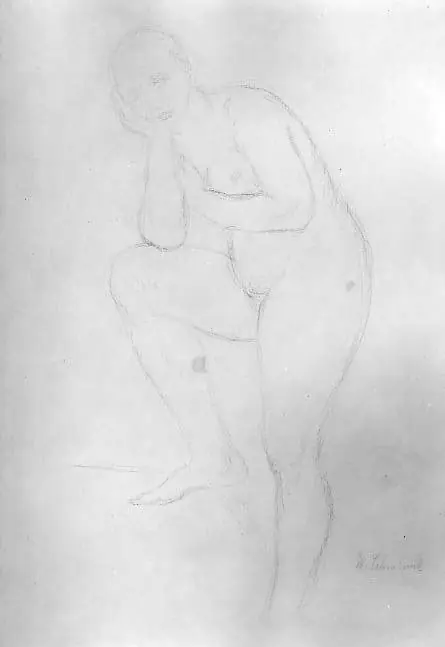 Standing Nude model, Facing Left
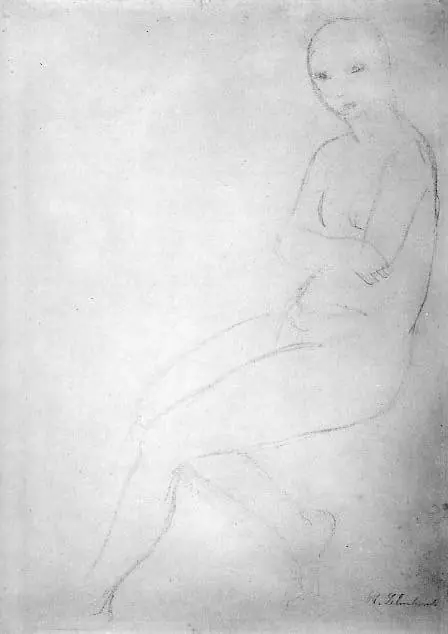 Seated Nude Model, Facing Left
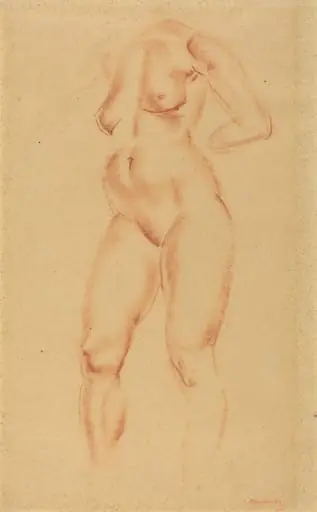 Nude
Nude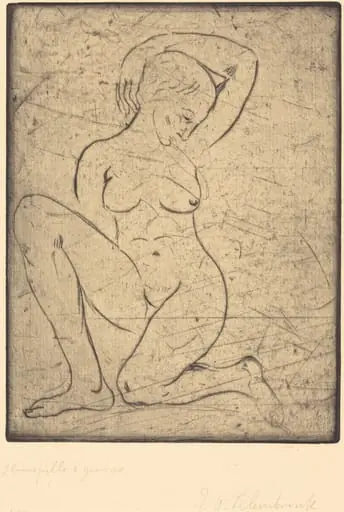 Kneeling, Small (Kniende, klein)
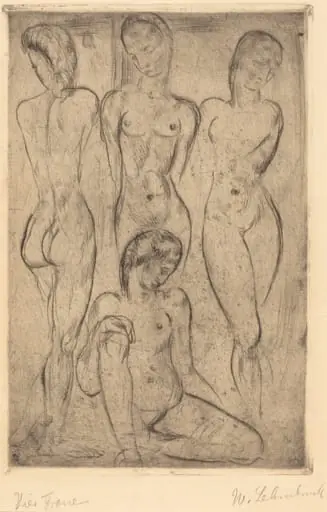 Four Women; Three Standing, One Sitting (VierFrauen; drei stehend, eine sitzend)
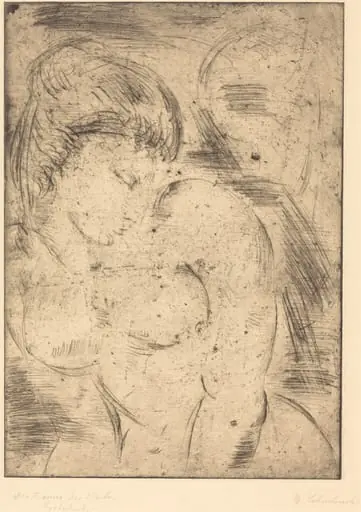 Woman's Dream (Der Traum des Weibes)
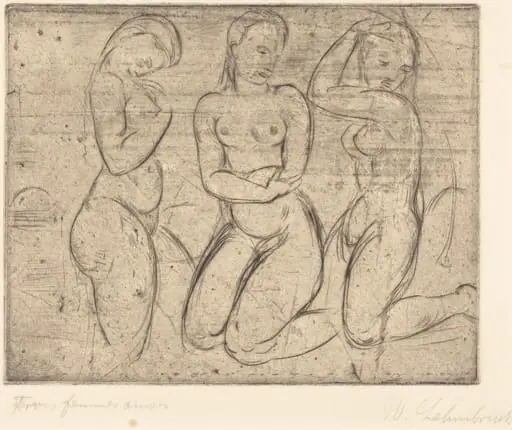 Three Kneeling Women (Drei Frauen knied)
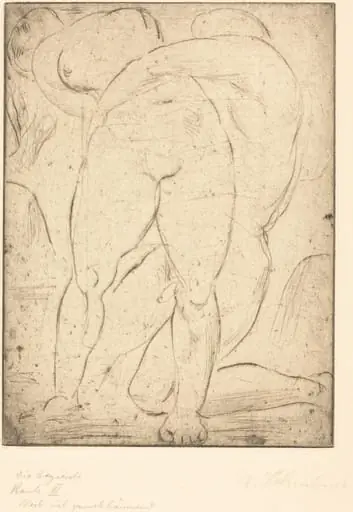 Passion II (Leidenschaft II)
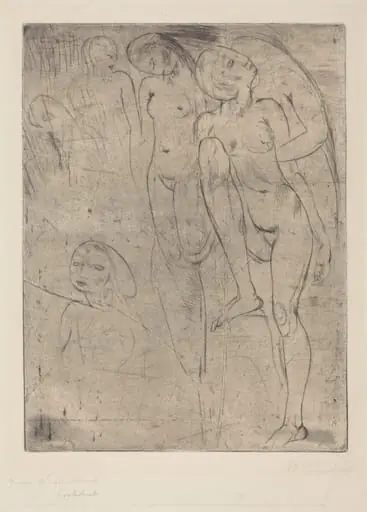 Large Resurrection (Grosse Auferstehung)
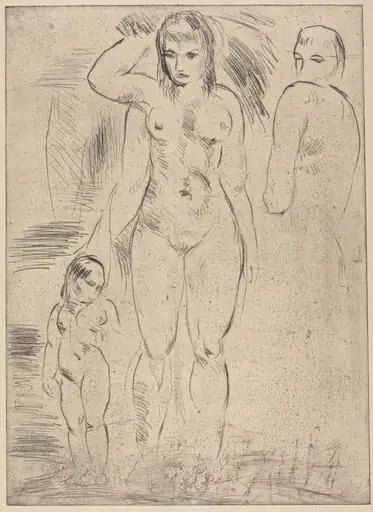 Woman and Child (Weib und Kind)
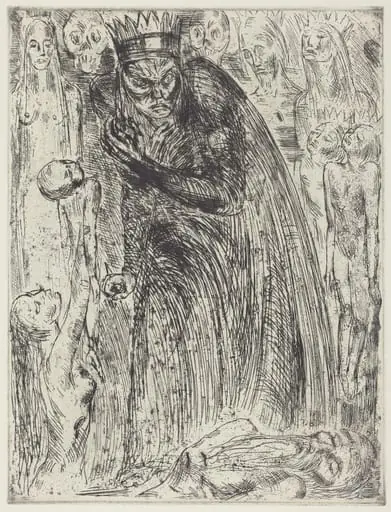 Macbeth V (The Vision of Lady Macbeth)
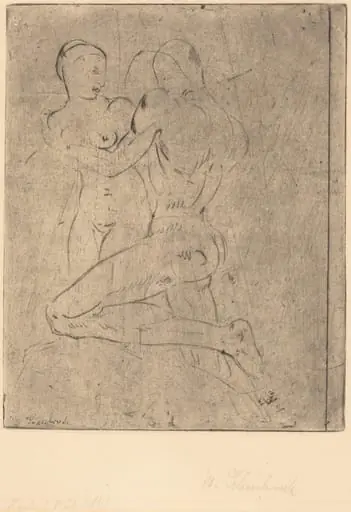 Rape II (Raub II, Weib halb)
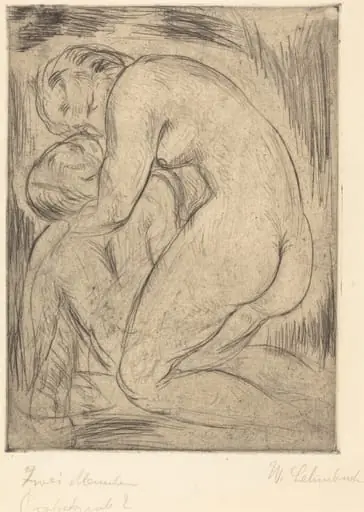 The Dead Man (Der tote Mann)
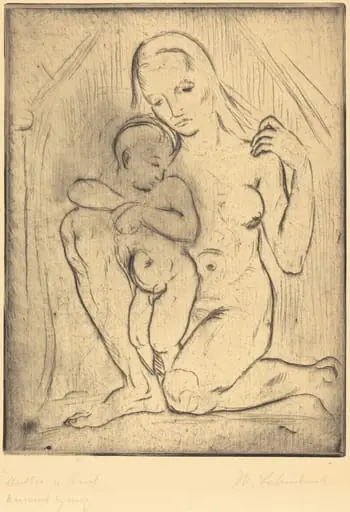 Mutter und Kind (Mother and Child)
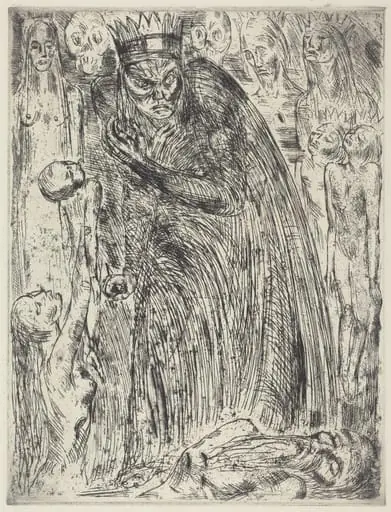 Macbeth V (The Vision of Lady Macbeth)
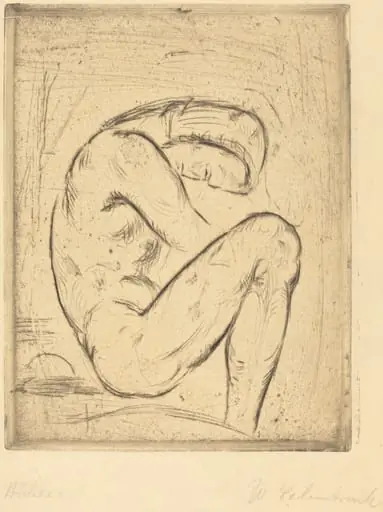 Büsser
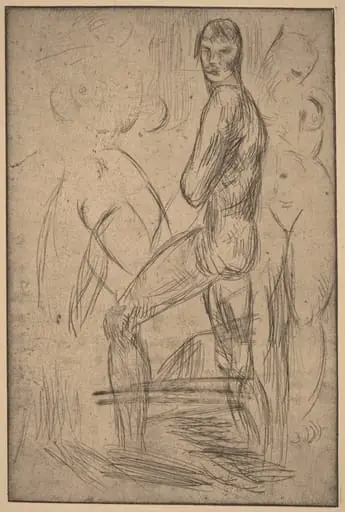 Standing Male Nude and Two Female Nudes
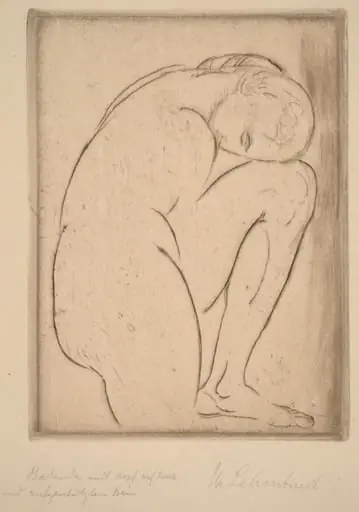 Badende mit Kopf auf Knie (Bather with Her Head on Her Knee)
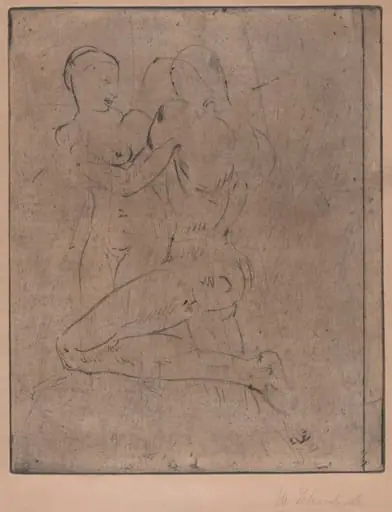 Rape II (Raub II, Weib halb)
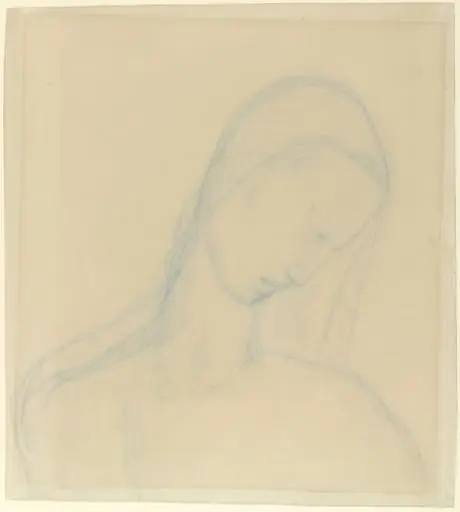 Untitled
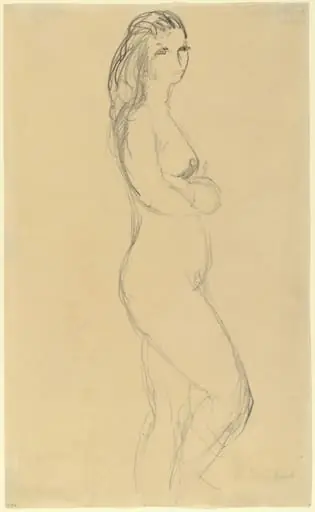 Untitled
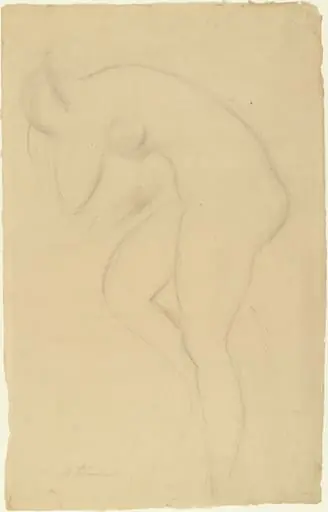 Untitled
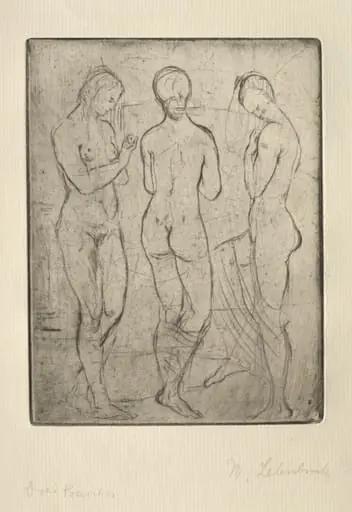 Three Women
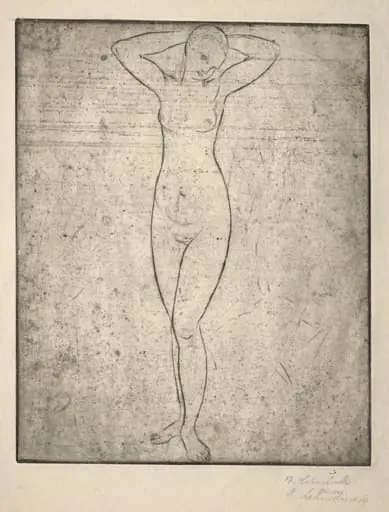 Standing Girl with Arms Behind her Head
28 works in the catalog · 24 shown
Collections represented


Artists in a similar vein