Artist
Charles Frederic Ulrich

United States
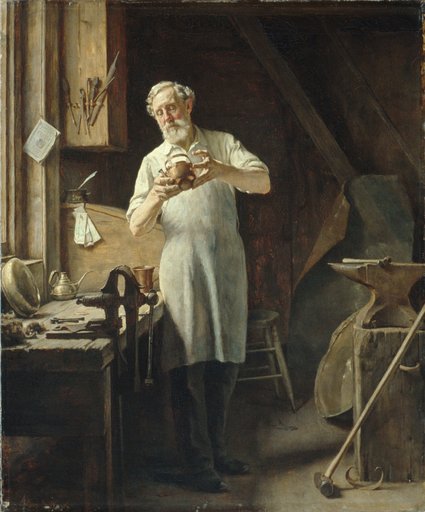
Charles Frederic Ulrich is an United States Impressionism artist. 4 works are cataloged here, principally at Philadelphia Museum of Art.
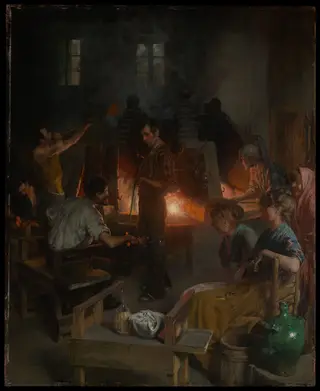
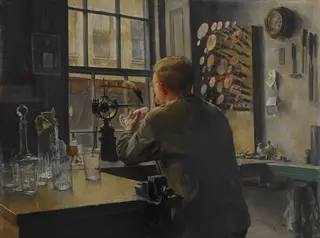
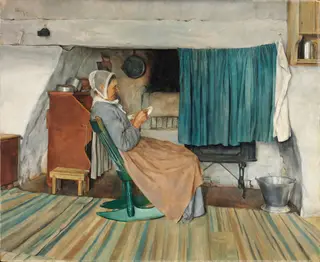
Charles Frederic Ulrich (18 October 1858 – 15 May 1908) was an American Realist painter who spent most of his career in Germany. He is best known for his genre scenes of working-class people.
Overview
Charles Frederic Ulrich (18 October 1858-15 May 1908) was an American Realist painter who spent most of his career in Europe, particularly Germany. Born in New York City to a German father, Friedrich Ulrich, he became known for genre scenes of working-class people and socially engaged subjects that distinguished him from many of his contemporaries. Though he began his training in the United States, his artistic identity was forged through decades of European residence, and he died in Berlin at the age of forty-nine. His work is held in major American collections including the Metropolitan Museum of Art, the Brooklyn Museum, the Philadelphia Museum of Art, and the Fine Arts Museums of San Francisco.
Biography & dates
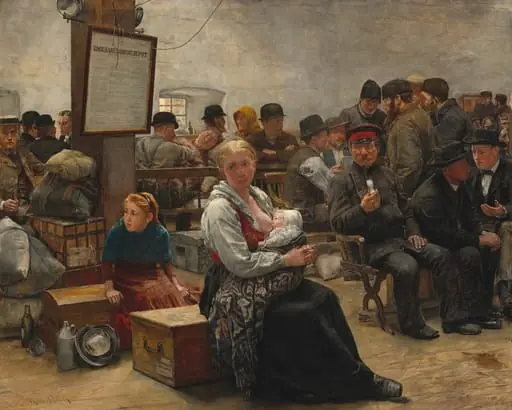
Ulrich was born in New York City on 18 October 1858. He began his art studies at the National Academy of Design and the Cooper Union in New York. In 1875, following the completion of his studies there, he made his first trip to Germany, visiting Munich and enrolling at the Academy of Fine Arts. His primary instructors were Ludwig von Löfftz and Wilhelm von Lindenschmit. He became friends with fellow American John Henry Twachtman and joined the circle of American-born artists associated with Frank Duveneck in Munich and the Bavarian town of Polling. Between 1879 and 1881, Ulrich returned to the United States, where he studied the methods of Dutch Golden Age painters. In 1883, he was named an Associate Member of the National Academy of Design and a full member of the Society of American Artists. His painting In the Land of Promise (1884), depicting an immigrant at Castle Garden's reception station, attracted the attention of Thomas B. Clarke, a lace and linen manufacturer and contemporary art collector. Ulrich painted Clarke's portrait, and Clarke promoted his career, awarding him the first Thomas B. Clarke Prize for "Best American Figure Composition." In the summer of 1884, Ulrich returned to Europe with William Merritt Chase and Robert Frederick Blum, visiting Belgium and the Netherlands. He shared an apartment with Blum in Haarlem for much of the next three years. Europe remained his home: he lived in Venice in 1886, in the Netherlands around 1890, and from 1899 to 1902 in Rome. He also visited Venice repeatedly after 1890. In 1888 and 1892, he organized exhibitions of American art in Munich. He exhibited at the London Royal Academy of Arts and the Glaspalast in Munich, and in 1893 joined the Berlin Secession at the Große Berliner Kunstausstellung. In 1897, he married Margarethe Oppenheim (1877-1939), daughter of banker Hugo Oppenheim. His name appears on the 1906 membership list of the Deutscher Künstlerbund, making him one of its earliest members. Ulrich died of pneumonia in Berlin on 15 May 1908.
Style & movement
Ulrich worked in a naturalistic Realist style, primarily producing genre works and portraits with a strong social dimension. During his 1879-1881 return to the United States, he made a detailed study of Dutch Golden Age painting methods, focusing particularly on the interior scenes of Pieter de Hooch and Johannes Vermeer and the portraiture of Frans Hals and Anthony van Dyck. This influence of seventeenth-century Dutch painting is evident in the refinement of his portraits and his careful treatment of interior spaces. His genre works often carried social commentary, a concern that set him apart from many artists of his generation. While his companion Robert Frederick Blum concentrated on quiet scenes from everyday life during their time together in Haarlem, Ulrich continued to pursue socially engaged subjects. His subjects included scenes from an orphanage and The Village Printing Shop, Haarlem, Holland, which depicted working children in a printing shop interior. His portraiture maintained the refined technique derived from his study of Dutch masters, while his genre scenes addressed contemporary social conditions with a directness that aligned him with Realist tendencies of the late nineteenth century.
Major works
Ulrich's most notable work, In the Land of Promise (1884), depicts an immigrant in the reception station at Castle Garden and established his reputation when it won the first Thomas B. Clarke Prize for "Best American Figure Composition." This painting is held at the Corcoran Gallery.
During his approximately six-month stay in Haarlem in 1884, he produced several genre works: The Village Printing Shop, Haarlem, Holland (also known as De stadsdrukkerij, Haarlem, Holland), a portrait of a typesetter, a portrait of a young man counting newspapers in a printing shop, and a scene in an orphanage. He also painted multiple works on the orphanage theme, including a painting titled Waifs.
His portrait of Thomas B. Clarke was painted in 1884 in gratitude for Clarke's support. Works by Ulrich are found in the collections of the Metropolitan Museum of Art and the Brooklyn Museum in New York, the Philadelphia Museum of Art, and the Fine Arts Museums of San Francisco.
Influences & students
Ulrich's primary teachers at the Munich Academy of Fine Arts were Ludwig von Löfftz and Wilhelm von Lindenschmit. Löfftz was also the teacher of John Henry Twachtman, with whom Ulrich became friends. Through Twachtman and his Munich connections, Ulrich became part of the circle of American artists associated with Frank Duveneck, working in both Munich and the Bavarian town of Polling.
William Merritt Chase was an artist he greatly admired, and in 1884 he traveled through Belgium and the Netherlands with Chase and Robert Frederick Blum. During his time in Haarlem, he shared an apartment with Blum, and the two artists remained closely associated for approximately three years. The Dutch Golden Age masters Pieter de Hooch, Johannes Vermeer, Frans Hals, and Anthony van Dyck were significant influences on his approach to interior scenes and portraiture. There is no record of pupils or followers in the provided sources.
Legacy
Ulrich's legacy rests primarily on his socially engaged Realist genre scenes and his role as an American artist who exile in Europe. His work In the Land of Promise remains his most recognized painting, held at the Corcoran and accessible through their collection. His association with Thomas B. Clarke, who acted as his discoverer and patron, helped establish his early reputation, and the Thomas B. Clarke Prize he won marked a significant early recognition.
His long residence in Europe and integration into German artistic circles, including his early membership in the Deutscher Künstlerbund from 1906 and participation in the Berlin Secession, positioned him as a transatlantic figure at a time when many American artists sought European training but fewer remained permanently abroad. His death in Berlin at age forty-nine cut short a career that had spanned both American and European contexts. Today, his work is represented in major American museum collections, though he remains less widely known than some of his contemporaries such as Twachtman or Chase.
Works by Charles Frederic Ulrich
Collections represented


Artists in a similar vein