Artist
Felix Ivo Leicher

Felix Ivo Leicher is a Baroque artist. 2 works are cataloged here, principally at Kunsthistorisches Museum.
Felix Ivo Leicher (18 or 19 May 1727 – 20 February 1812) was a Czech-Austrian painter of altarpieces and secular works, which was spread to a wide area throughout the Habsburg Empire and beyond.
Overview
Felix Ivo Leicher (18 or 19 May 1727-20 February 1812) was a Czech-Austrian painter whose altarpieces and secular works circulated throughout the Habsburg Empire and beyond. Born in Bílovec, Moravia (then part of Silesia), he rose from humble origins as a weaver to become one of the most prolific religious painters of late Baroque and early Neoclassical Austria. Though long overshadowed by his teacher Franz Anton Maulbertsch, recent scholarship has recovered numerous works from anonymity, establishing Leicher as a distinct artistic voice whose lyrical, restrained manner complemented the more expressive tendencies of his era. His paintings remain in churches and museums across Central Europe, with the Belvedere in Vienna holding a notable cabinet piece.
Biography & dates
Leicher was born in Bílovec, a Silesian town in Moravia, where a commemorative plaque now hangs to the right of the main entrance of the parish church. Initially trained as a weaver and later studying cutlery, he found his vocation in painting through apprenticeship to Franz Schaffer (also rendered as Francis Andrew Schaffer), a local painter of limited subsequent renown, from approximately 1745 to 1749. In 1751 he entered the Academy of Fine Arts Vienna, where he became a pupil of Franz Anton Maulbertsch. His early promise was recognized when his painting Anointing Saul the King won second prize in a 1754 competition; a preparatory sketch for this work survives in the German National Museum in Nuremberg. Leicher maintained lifelong friendly relations with Maulbertsch, collaborating with him on frescoes and paintings for a church in Mikulov. He established a busy practice painting altarpieces for churches across Moravia, Silesia, and Vienna, while in the latter part of the 18th century he also produced smaller cabinet paintings with secular themes. In 1786 he exhibited pictures with secular subjects. He died in Vienna (Neubau) on 20 February 1812.
Style & movement
Leicher's artistic identity remains inextricably linked to that of his teacher Maulbertsch, yet scholarly analysis has gradually distinguished his more restrained temperament. His composition, handling of form, light, and color all show significant effects of Maulbertsch's example, which he admired throughout his life. However, Leicher's approach is quieter, his expression more lyrical and narrative-tuned, lacking the dramatic expressive manifestation that Paul Troger's influence brought to Maulbertsch's work. Some critics detect additional inspiration from Michelangelo Unterberger, a professor at the Vienna Academy whose moderate variant of academic style offered simple, clear compositional solutions and a lyrical tone. Leicher also drew upon Venetian painters of the 18th century, particularly the compositions of Giambattista Pittoni, and the imagery of Peter Paul Rubens, most evident in two paintings for the church altar of John the Baptist in Kroměříž. His development lacks obvious drama; even the altarpieces in Opava parish church of the Assumption, often considered his most accomplished works, maintain connection to the Rococo sensibility of his early period. The difficulty of separating his hand from Maulbertsch's has led to misattributions only recently corrected, with some works long given to Maulbertsch now restored to Leicher.
Major works
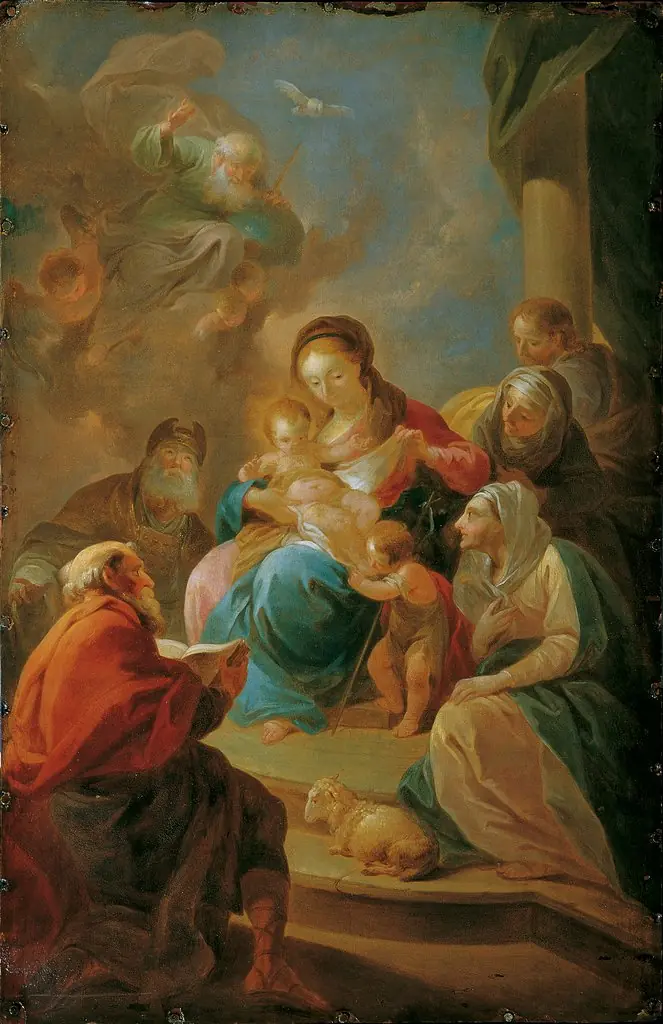
Leicher's output was dominated by religious commissions for churches throughout the Habsburg territories. Around 1760 he painted the altarpiece for the Church of the Holy Trinity in Fulnek, a characteristic example of his ecclesiastical work. For Vienna, he produced altarpieces for St. Thekla in Wieden (1755-56), a Holy Family for the side altar of the Piaristenkirche (1763), an altar for the Barnabitenkollegium (1765-66), and the Trattnerhofkapelle altar (1777). In 1788 he painted side altar images of Saints Anne and Barbara for Nassiedel. The rich coloristic main altar painting in his native Bílovec demonstrates the influence of his teachers. His secular production includes Die Heilige Sippe (The Holy Kinship), an oil on copper of 1770 measuring 92.5 × 60 cm, now in the Belvedere, Vienna. The Kroměříž church of John the Baptist preserves two important paintings showing Rubensian and Pittonesque influence. Many works remain unidentified in churches and collections, with authorship still being revealed even in smaller genre paintings, sketches, and drawings.
Influences & students
Leicher's formation began with Franz Schaffer, the otherwise little-known local painter in Bílovec who provided his foundational training from approximately 1745 to 1749. The decisive influence on his mature style came from Franz Anton Maulbertsch, under whom he studied at the Vienna Academy from 1751 and with whom he collaborated throughout his life. Their working relationship was so close that some paintings were jointly signed, and Leicher's works were frequently mistaken for those of his master. Maulbertsch's influence is visible in Leicher's coloristic richness and compositional energy, though Leicher moderated these qualities through his own more restrained temperament. The academic environment of the Vienna Academy also exposed him to the work of Michelangelo Unterberger, whose clearer, more moderate compositional methods some scholars believe also shaped Leicher's approach. No pupils of Leicher are recorded in the sources, and his stylistic adherence to Maulbertsch's model suggests he functioned more as a collaborator and executor than as an independent founder of a school.
Legacy
Leicher's posthumous reputation has been shaped by the enduring difficulty of distinguishing his work from that of Maulbertsch, a problem that has only gradually yielded to modern scholarship. For generations, many of his paintings were attributed to his more famous teacher, and the process of reclamation continues, with works still being identified in churches and collections across Central Europe. The 2007 study by Lubomír Slavíček, Felix Ivo Leicher, ein Maler ohne Eigenschaften? Versuch einer Stildefinition seines Oeuvres, represented a significant attempt to define his stylistic profile and assert his independent artistic identity. The commemorative plaque in Bílovec and his documented exhibition of secular works in 1786 indicate some contemporary recognition, yet his historical standing remains that of a skilled, prolific painter whose achievement was partly obscured by his proximity to a greater master. His works are now held in institutions including the Belvedere in Vienna and the German National Museum in Nuremberg, while numerous altarpieces remain in situ in Moravian, Silesian, and Austrian churches.
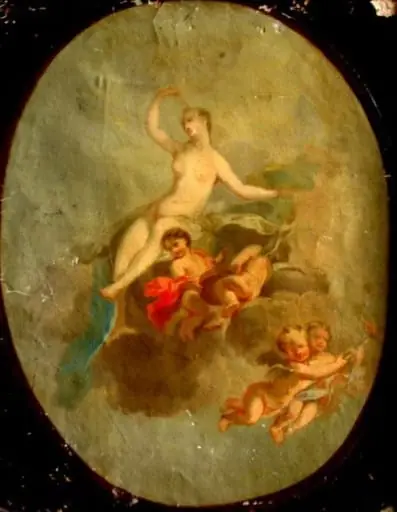
Works by Felix Ivo Leicher
Collections represented


Artists in a similar vein