Artist
Battista Franco

Republic of Venice
Battista Franco is a Republic of Venice Mannerism artist. 13 works are cataloged here, principally at Cleveland Museum of Art.
Overview
Battista Franco Veneziano (c. 1510-1561), baptized Giovanni Battista Franco and also known as il Semolei or simply Battista Franco, was an Italian Mannerist painter and printmaker active in Rome, Urbino, and Venice during the mid-sixteenth century. A native Venetian who spent crucial decades working in central Italy, he is recognized for paintings that reveal deep study of Michelangelo, as well as for drawings and etchings that display greater independence and vitality. His career bridged the Roman world of papal and ducal patronage and the Venetian tradition of color and decorative spectacle, making him a significant, if sometimes overlooked, figure in the diffusion of Mannerism across the peninsula.
Biography & dates
Born in Venice around 1510, Franco was the son of Iacopo. According to Giorgio Vasari, whose Vite includes a biography of the artist, Franco traveled to Rome in his twenties to study contemporary masters, particularly Michelangelo. He enrolled in the Accademia di San Luca in 1535. In 1536, he assisted with decorations for the entry of Charles V into Rome and Florence, working under Antonio da Sangallo the Younger after a recommendation from Raffaello da Monte Lupo. During this period he also copied Michelangelo's sculptures in the Sagrestia Nuova of San Lorenzo in Florence and struck up a close friendship with Bartolomeo Ammannati, with whom he lodged alongside Girolamo Genga from Urbino. He painted the Allegory of the Battle of Montemurlo in 1537, now in the Palazzo Pitti, and in 1541 completed a fresco of the Arrest of John the Baptist for the Oratory of San Giovanni Decollato in Rome. From 1545 to 1551 he worked in Urbino, entering the service of Duke Guidobaldo II della Rovere through Genga's mediation, though the duke reportedly found his painting less satisfactory than his draftsmanship. Franco returned to Venice by 1554, where he received numerous commissions and enjoyed considerable success. He died suddenly in 1561, perhaps from poisoning by substances used in his work, while decorating a chapel in San Francesco della Vigna for Patriarch Grimani.
Style & movement
Franco operated within the Mannerist idiom, and his painted works are marked by an obsessive attention to draftsmanship and minute detail that Vasari repeatedly noted. His style was heavily indebted to Michelangelo, whom he copied assiduously, including the Sistine Chapel Last Judgment and the Sagrestia Nuova sculptures. This devotion to copying, Vasari suggested, hindered the development of a fully personal manner, leaving his paintings somewhat lacking in coloristic freshness and spontaneous invention. Yet the same sources acknowledge that his drawings and etchings possess far more verve and originality than his paintings, suggesting that the graphic medium better suited his talents. In Venice, he adapted to the local coloristic environment, working in a city dominated by Titian and the emerging Tintoretto. His decorative work included grotesques and architectural painting, as seen in his contributions to the Scala d'Oro in the Palazzo Ducale and the ceiling of the Biblioteca Marciana.
Major works
Franco's surviving works are distributed across several Italian cities. The Allegory of the Battle of Montemurlo (1537) is held in the Palazzo Pitti, Florence. His fresco of the Arrest of John the Baptist (1541) remains in the Oratory of San Giovanni Decollato in Rome. In 1550 he painted The Resurrection and the Adoration of the Shepherds in the Gabrielli Chapel of Santa Maria sopra Minerva, Rome. Upon returning to Venice, he contributed to the ceiling frescoes of the Biblioteca Marciana. For San Francesco della Vigna, he executed a series of panels including a Baptism of Christ in the Barbaro chapel and decorations for the Grimani chapel walls and vault. He also painted the Raising of Lazarus for the Ducal Palace in Venice. Other attributed works include the Sibyls and Prophets in the vault of the fourth Gabrielli chapel in Santa Maria sopra Minerva, and frescoes in the Palazzo Chiericati in Vicenza, the Villa Emo, and the Villa Foscari. Drawings for ceramics designed for Duke Guidobaldo's kilns survive in various collections, including one plate design in the Cabinet des Dessins at the Louvre.
Influences & students
Franco's formative influence was unquestionably Michelangelo, whose works he studied and copied with near-obsessive dedication from his arrival in Rome. The friendship and professional association with Bartolomeo Ammannati and Girolamo Genga provided important collegial networks, particularly during his time in Florence and Urbino. Franco himself may have served as a mentor to Federico Barocci, alongside Genga, during the latter's residence in Urbino, though this connection is described as possible rather than certain. Vasari's biography, while critical of Franco's dependence on models, documents these relationships and preserves Franco within the historiography of sixteenth-century Italian art. Franco was the father of Giacomo Franco, who became an etcher and publisher, continuing the family's involvement in print culture.
Legacy
Franco's posthumous reputation has been shaped by Vasari's mixed assessment, which praised his draftsmanship while lamenting his perceived lack of painterly originality. Modern scholarship, represented by Sydney J. Freedberg's Pelican History of Art and the 2007 study by Massimo Firpo and Fabrizio Biferali, has reevaluated his position within mid-Cinquecento art, particularly recognizing the quality of his etchings and drawings. His works are held in major institutions including the British Museum, the National Gallery of Art, the Art Institute of Chicago, the Prado, and the Städel Museum, among others. The fictionalized treatment of his life and his work at Villa Foscari in Felix Kucher's 2016 novel Malcontenta indicates a continuing cultural fascination. Franco represents a case study in the tensions between Roman disegno and Venetian colore, between imitation and invention, that characterized much of sixteenth-century Italian art.
Works by Battista Franco
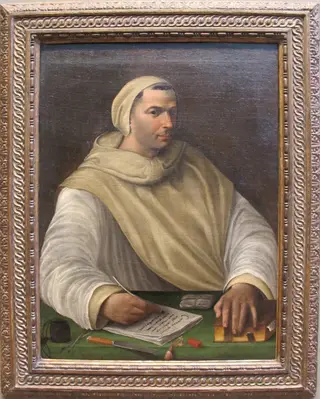 Ritratto di un monaco olivetano
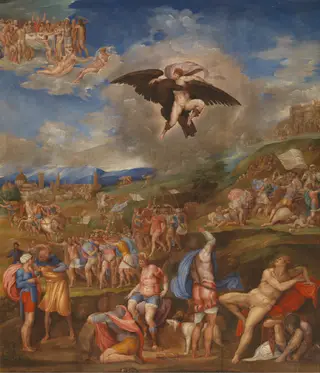 The Battle of Montemurlo
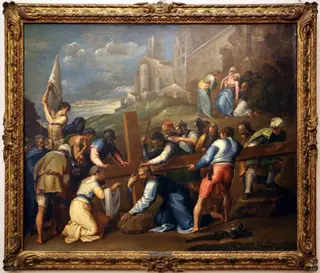 Road to Calvary
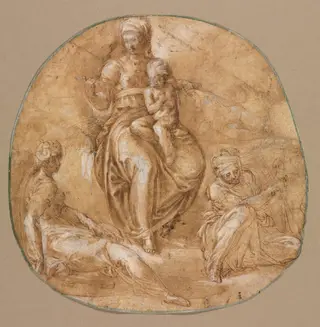 Virgin and Child with St. Catherine of Alexandria and Saint Anne (?)
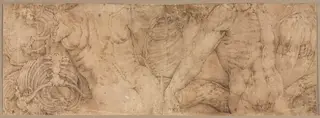 Torsos with Rib Cages
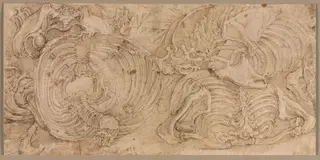 Rib Cages
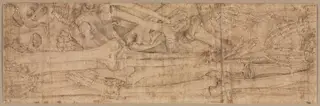 Arm Bones
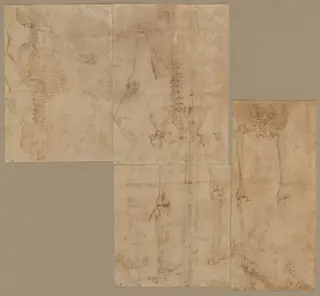 Skeleton
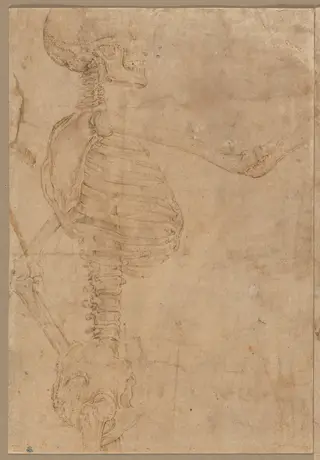 Half-Length Skeleton in Profile
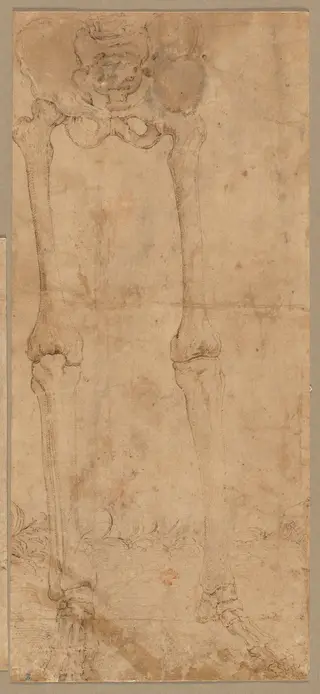 Lower Half of Skeleton from the Front
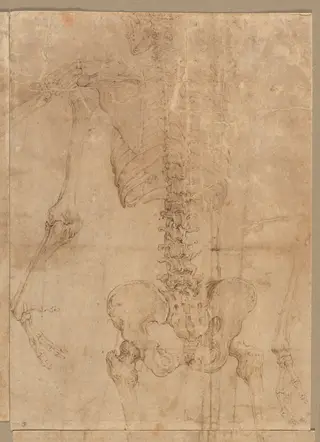 Upper Half of Skeleton from the Back
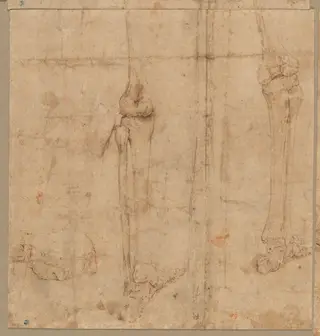 Lower Half of Skeleton from the Back
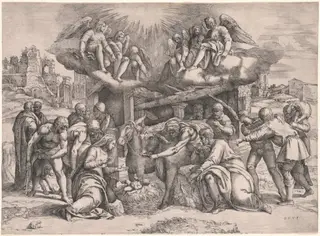 The Adoration of the Shepherds
Collections represented


Artists in a similar vein