Artist
Anton Wilhelm Tischbein
Germany
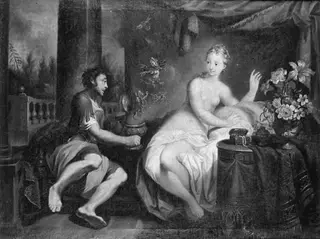
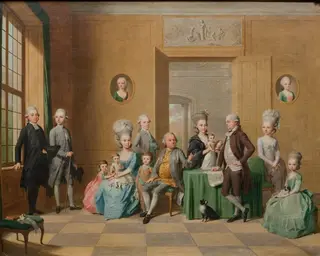
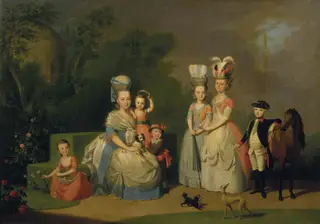
Anton Wilhelm Tischbein is a Germany Rococo painting artist. 3 works are cataloged here, principally at Statens Museum for Kunst.
Anton Wilhelm Tischbein, known as the Hanauer Tischbein (1 March 1730, Haina - 1 November 1804, Hanau) was a German painter from the Tischbein family of artists.
Overview
Anton Wilhelm Tischbein (1730-1804), known as the Hanauer Tischbein, was a German portrait painter and a prominent member of the extensive Tischbein family of artists. Born in Haina and based primarily in Hanau, he built a successful career spanning court patronage, private commissions from wealthy patricians, and educational reform. His work is distinguished by its grounding in Baroque training and its adaptation to the tastes of the German nobility and bourgeoisie in the latter half of the eighteenth century. Several of his paintings are held in the permanent collection of the Historisches Museum Hanau at Schloss Philippsruhe.
Biography & dates
Anton Wilhelm Tischbein was born on 1 March 1730 in Haina, the son of a master baker. He had four older brothers, all of whom became painters, including the celebrated Johann Heinrich Tischbein the Elder. His initial training came from his brother Johann Valentin Tischbein. In 1753, he enrolled at the Royal Academy of Art in The Hague, an institution that retained international prestige for its Baroque-influenced curriculum. In 1758, he entered court service as secretary to Count Christian August von Solms-Laubach, maintaining connections to Laubach throughout his life. A pivotal move came in 1769, when he relocated to Hanau to serve as court painter to William I, Elector of Hesse, then still Erbprinz Wilhelm of Hesse-Kassel. From 1772 onward, he participated in establishing the Staatliche Zeichenakademie in Hanau, serving as both member and teacher. He died in Hanau on 1 November 1804.
Style & movement
Tischbein's artistic formation occurred within the late Baroque tradition, shaped by his studies at The Hague academy. Portraiture constituted his principal output, characterized by formal compositions executed for aristocratic and patrician clients. Beyond portraits, he produced historical and mythological scenes, as well as small-scale cabinet pieces known as Kabinettstücke. His decorative work included the embellishment of the Lustschloss at Wilhelmsbad, a pleasure palace near Hanau. The breadth of his practice, from intimate small works to architectural decoration, reflects the versatile demands placed on court artists of his era.
Major works
Tischbein's oeuvre centered on portraiture, though specific titles of individual major works are not recorded in the available sources. His commissions included portraits of the princely family he served, as well as members of prominent Frankfurt patrician families such as Johann Christian Senckenberg, the Brentanos, and the La Roches. His historical and mythological paintings, together with his Kabinettstücke, supplemented his portrait work. The Lustschloss Wilhelmsbad near Hanau featured his decorative painting. Multiple works by Anton Wilhelm Tischbein are displayed in the permanent exhibition of the Historisches Museum Hanau at Schloss Philippsruhe.
Influences & students
Tischbein's earliest influence was his brother Johann Valentin Tischbein, who provided his first instruction. The Royal Academy of Art in The Hague, where he studied from 1753, exposed him to international Baroque methods. Within his own family, he belonged to a remarkable dynasty of painters: his brother Johann Heinrich Tischbein the Elder achieved particular distinction. Tischbein himself contributed to artistic education through his role in founding and teaching at the Staatliche Zeichenakademie in Hanau from 1772, though specific pupils are not named in the sources.
Legacy
Tischbein's legacy rests on his position within the Tischbein artistic dynasty and his role in establishing institutional art training in Hanau. The 2004 exhibition Anton Wilhelm Tischbein 1730-1804 at Schloss Philippsruhe, accompanied by a catalog by Anton Merk, marked a significant posthumous reassessment of his career. His work remains accessible through the permanent collection of the Historisches Museum Hanau. Scholarly literature includes entries by Hans Vollmer in the Thieme-Becker Kunstlerlexikon (1939) and a monograph by Ernstotto zu Solms-Laubach (1958).
Works by Anton Wilhelm Tischbein
Collections represented


Artists in a similar vein