Artist
Bartolomeo Bulgarini
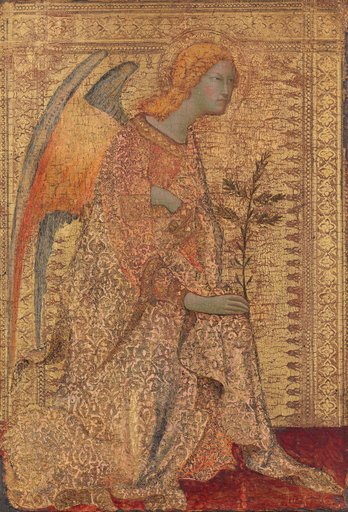
![Annunciate Angel, the Apostle Andrew, a Bishop Saint (Savinus?), and Saints Dominic and Francis of Assisi [left]; Virgin Annunciate and Saints Bartholomew, Lawrence, Lucy, and Agatha [right]](https://artifactworldgallery.com/img/bartolomeo-bulgarini--annunciate-angel-the-apostle-andrew-a-bishop-saint-savinus-a--941c87c7443f3f1e-w320.webp)
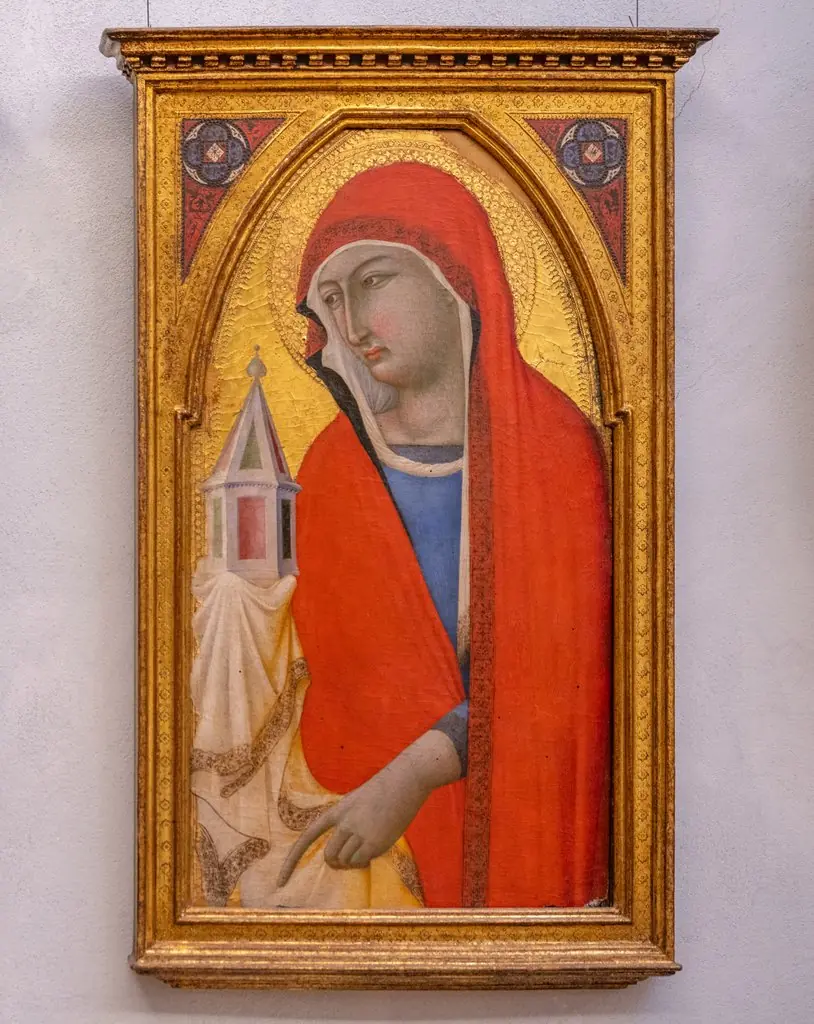
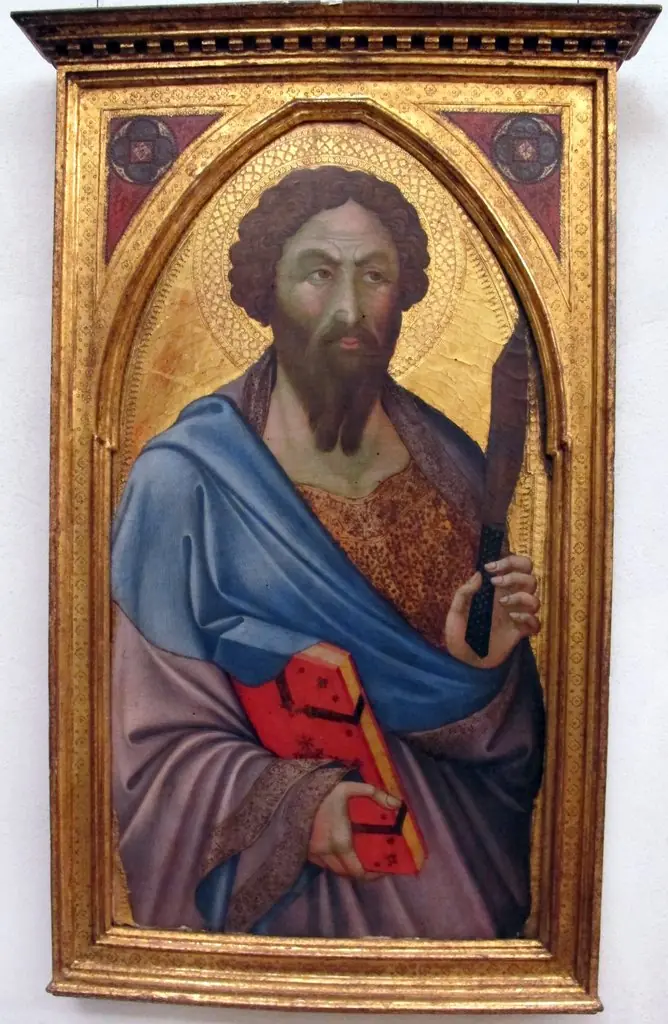
Bartolomeo Bulgarini is a Byzantine icon painting artist. 4 works are cataloged here, principally at Capitoline Museums.
Overview
Bartolomeo Bulgarini (c. 1300/1310-1378), also known as Bulgarino or Bologhini, was an Italian painter of the Trecento who spent his career in Siena and is now recognized as a significant figure of the Sienese school. Working in an Italo-Byzantine style on gold grounds, he bridged the generation of Duccio's followers and the post-Black Death era, producing altarpieces and civic commissions for prominent patrons including Siena Cathedral and the hospital of Santa Maria della Scala. Though documented and praised by Giorgio Vasari in the sixteenth century, Bulgarini's oeuvre was only reunited with his name in modern scholarship after decades of attribution debates involving composite names such as Ugolino Lorenzetti and the Master of the Ovile Madonna. His public profile rose unexpectedly in January 2021, when a small roundel attributed to him appeared as an inset in Botticelli's Portrait of a Young Man holding a Roundel, which sold at Sotheby's for a record $80 million (over $92 million with fees).
Biography & dates
Bulgarini was born into a noble Sienese family with members who had held prominent offices and served in the Council of Nine, the city's governing body from 1287 to 1355. This social standing likely facilitated access to prestigious civic patronage. He trained in the workshop of Duccio's students, with scholars suggesting Ugolino di Nerio, Pietro Lorenzetti, or both as his teachers. His earliest documented works date to the late 1330s and early 1340s, including painted wooden covers for the Biccherna, the civic treasury administration; a documented Biccherna tablet from 1353 survives in the Archivio di Stato, Siena, and two further attributed tablets from 1329 and 1339 are held in Berlin and Paris respectively.
His early altarpiece with Saints Ansanus and Galganus flanking the Virgin and Child, now in the Pinacoteca Nazionale of Siena, may have been commissioned for the Palazzo della Signoria. He also received commissions from religious communities in Lucca, Florence, San Gimignano, and other Tuscan cities. The deaths of his teachers' generation, Simone Martini in 1344 and Pietro and Ambrogio Lorenzetti in 1348 (probably from the Black Death), created an opening to which Bulgarini rose, completing unfinished works by Simone and the Lorenzetti for the Comune of Siena and possibly working for the Papal Curia in Rome. From the 1360s until his death, he painted for the hospital of Santa Maria della Scala in Siena, where he became an oblate in 1366. He died in Siena on 4 September 1378.
Style & movement
Bulgarini belongs to the Sienese school and worked in the Italo-Byzantine tradition, employing tempera on panel with gold grounds. His style evolved through distinct phases that complicated attribution for centuries. Initially closest to Ugolino di Nerio, he moved toward mannerisms associated with Pietro Lorenzetti, and later developed a particular interest in the refined elegance of Simone Martini. This stylistic trajectory, traced by Millard Meiss in the 1930s, helped consolidate the dispersed group of works formerly divided between Ugolino Lorenzetti and the Master of the Ovile Madonna into a single coherent oeuvre.
His compositions for major religious institutions show careful attention to the specific devotional and relic contexts of their destinations. In the Assumption of the Virgin with Doubting Thomas, painted for Santa Maria della Scala in the early 1360s, he depicted Thomas with his back to the viewer, an unusual choice that scholars have interpreted as aligning the saint's posture with that of worshippers and Sienese officiants before the Virgin's belt or girdle, a relic from Constantinople that the hospital had recently acquired. The panel's dimensions, 205 by 112 cm, indicate its function as a major altarpiece for the newly constructed chapel housing these relics.
Major works
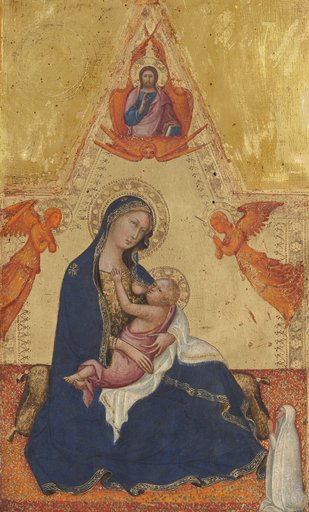
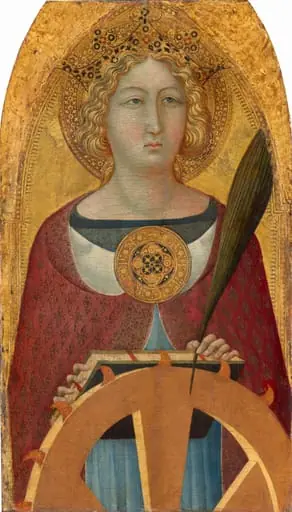
The St. Victor Altarpiece (1348-1350), commissioned by the Commune for Siena Cathedral, was one of four altarpieces depicting the city's patron saints; the others were by Simone Martini, Ambrogio Lorenzetti, and Pietro Lorenzetti. Unlike those signed and dated counterparts, the St. Victor panel was identified only through late sixteenth-century inventories by Guigurta Tommasi naming Bulgarini. The altarpiece is now dismembered: the Nativity is at the Fogg Art Museum, Cambridge, Massachusetts, and the Crucifixion is at the Louvre, Paris. These panels formed the core around which modern scholars reconstructed Bulgarini's catalogue. The Assumption of the Virgin with Doubting Thomas (early 1360s), painted for Santa Maria della Scala, remains at the Pinacoteca Nazionale in Siena. Other attributed works include the Blinding of St. Victor at the Städel Art Museum in Frankfurt; an Enthroned Madonna at the Wallraf-Richartz-Museum in Cologne; a Biccherna tablet (1353) at the Archivio di Stato, Siena; additional Biccherna tablets attributed to 1329 and 1339 at the Kunstgewerbemuseum, Berlin, and the Bibliothèque nationale de France, Paris; a Crucifixion at the Hermitage, St. Petersburg; Saints Matthias and Thomas (c. 1350) at the Metropolitan Museum of Art, New York; Saint Catherine (c. 1335) at the National Gallery of Art, Washington; and works at the Isabella Stewart Gardner Museum, Boston; the Columbia Museum of Art; the Museo Thyssen-Bornemisza, Madrid; and elsewhere.
Influences & students
Bulgarini's formation occurred within the circle of Duccio's followers, specifically under the influence of Ugolino di Nerio and Pietro Lorenzetti. The composite name Ugolino Lorenzetti, coined by Bernard Berenson in 1917 for a group of stylistically related works, directly reflects this dual inheritance. Simone Martini's elegant linearity also shaped Bulgarini's mature manner, particularly after the deaths of his immediate teachers opened new possibilities in Sienese painting. No pupils or followers are documented in the surviving sources, and Bulgarini appears to have been the last major representative of his generation in Siena to be commemorated by Vasari, suggesting he may not have established a significant workshop tradition. His oblate status at Santa Maria della Scala from 1366 indicates a deepening religious commitment in his later years that may have limited teaching activity.
Legacy
Bulgarini's posthumous reputation was preserved by Giorgio Vasari's mention in The Lives of the Artists, making him the only Sienese painter of his generation so commemorated. Yet his actual oeuvre dissolved into anonymity for centuries, fragmented between the notnames Ugolino Lorenzetti and the Master of the Ovile Madonna. The reconstruction of his catalogue began with Bernard Berenson's 1917 grouping, Ernst Dewald's subsequent separation of the Master of the Ovile Madonna, and Millard Meiss's 1936 synthesis, which united the two groups and linked them to the documented Biccherna painter. The decisive identification came in the 1980s when Henk van Os recognized the Fogg Nativity and Louvre Crucifixion as parts of the documented St. Victor altarpiece painted around 1350, confirmed by Siena Cathedral archives.
The January 2021 sale of Botticelli's Portrait of a Young Man holding a Roundel at Sotheby's for over $92 million introduced Bulgarini to a broad public through the small inset roundel of a bearded saint attributed to him, demonstrating how attribution history and market spectacle can unexpectedly converge. His scholarly reputation rests on the solidification of his oeuvre through documentary and stylistic analysis rather than this commercial episode.
Works by Bartolomeo Bulgarini
Collections represented


Artists in a similar vein