Artwork
Saint Catherine of Alexandria
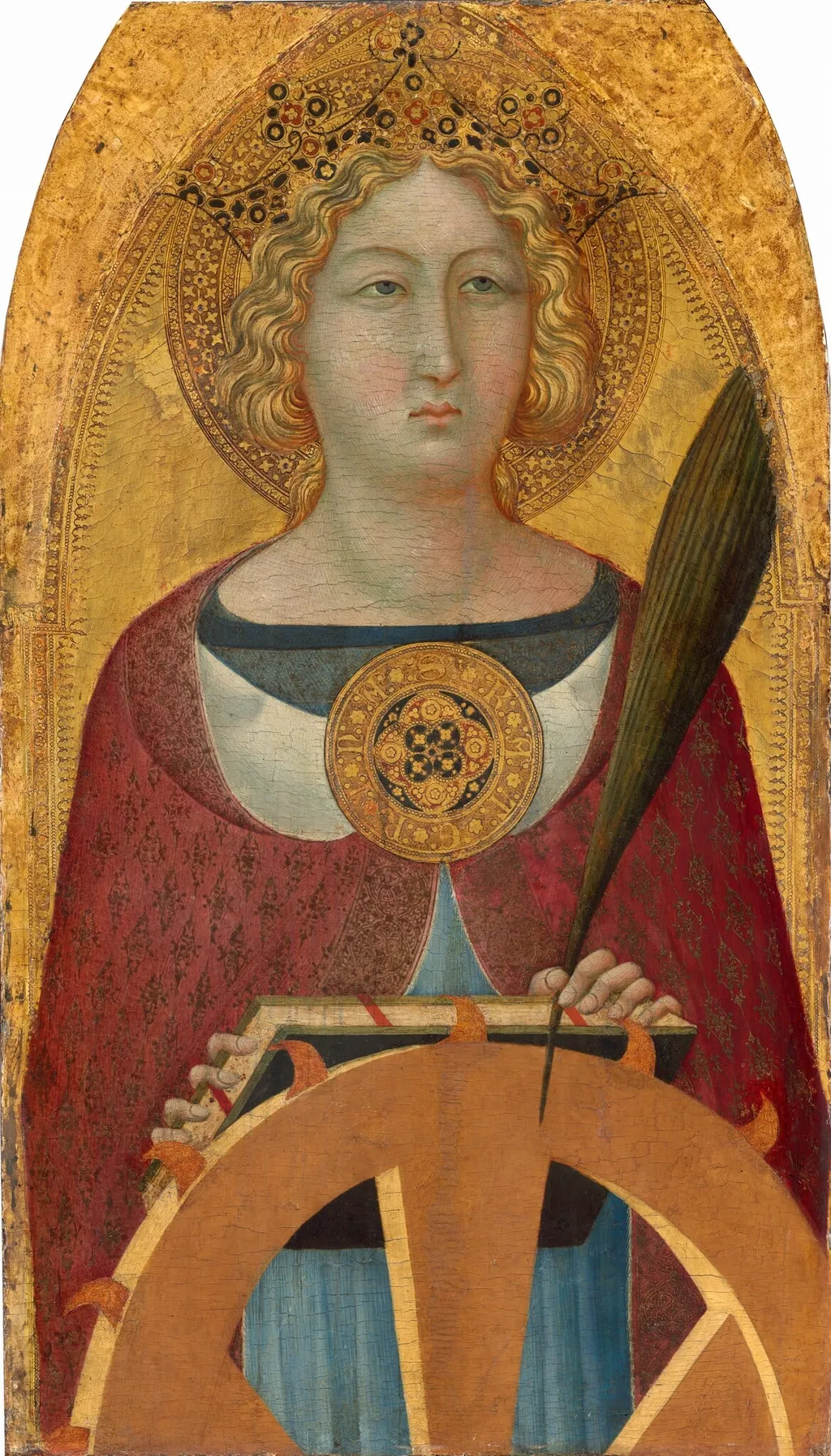
Saint Catherine of Alexandria is a tempera painting by the Byzantine icon painting artist Bartolomeo Bulgarini. It dates from 1338 and is held in the collection of the National Gallery of Art.
- Inscription
- Inscribed:on the gilded brooch of the saint's mantle: S.K.A.T.E.R.I.N.A
About this work
A young woman in a red dress and crown holds a book and a broken spiked wheel. The wheel recalls the torture Saint Catherine escaped, the book her learning, and gold in her halo glows behind her head. Bartolomeo Bulgarini painted it in tempera around 1338.
Subject & Meaning
As a representation of this specific saint, the artwork falls within the genre of religious art, focusing entirely on her figure.
The painting depicts Saint Catherine of Alexandria, a religious subject central to the work's identity. As a representation of this specific saint, the artwork falls within the genre of religious art, focusing entirely on her figure. Created in 1337 by Bartolomeo Bulgarini, the piece serves as a devotional image of the martyr.
While the specific symbolic attributes often associated with Catherine, such as the wheel or sword, are not detailed in the provided records, the work's primary meaning is established by its depiction of the saint herself. The subject matter is explicitly identified as Catherine of Alexandria, marking the painting as a dedicated portrayal of her life or sanctity within the context of 14th-century religious iconography.
Technique & Style
Saint Catherine of Alexandria by Bartolomeo Bulgarini is executed in tempera on panel, a technique characteristic of mid-14th-century Italian devotional painting. The work is classified as a religious painting and forms part of the Samuel H. Kress Collection at the National Gallery of Art in Washington, D.C. The use of a wooden panel support with tempera pigments aligns with the materials and methods typical of Sienese workshops of the period, allowing for the layered, luminous surface treatment associated with the medium. Beyond these documented attributes of medium, support, and classification, the available sources do not provide further specific information regarding handling, condition, or detailed stylistic qualities.
History & Provenance
Created in 1337 by Bartolomeo Bulgarini, this tempera panel was documented by 1706 in the chapel of the Madonna at the Monastery of San Cerbone near Lucca, where it remained until at least 1845. The work subsequently entered private collections, likely passing through the Lasinio family in Pisa and Monsignor Gabriele Laureani in Rome before residing with Giulio Sterbini by 1905. By 1921, Godfroy Brauer owned the painting in Paris or Nice.
Following Brauer's death, his estate sold the piece at Christie's in London on July 5, 1929. After intermediate transactions involving dealers in Lucerne, Amsterdam, and Munich between 1929 and 1932, Duveen Brothers acquired it in 1937. The Samuel H. Kress Foundation purchased the work in 1940, donating it to the National Gallery of Art in Washington, D.C., in 1943.
The painting Saint Catherine of Alexandria by Bartolomeo Bulgarini (1337) is held by the National Gallery of Art in Washington, D.C., where it is part of the Samuel H. Kress Collection and was gifted to the museum in 1943. Its provenance traces from a monastery near Lucca through several private owners and dealers before its acquisition by the Kress Foundation. The work is catalogued in the National Gallery’s collection records as a tempera on panel depicting Saint Catherine of Alexandria.
Exhibition records for the piece are not detailed in the consulted documentation, and no specific exhibition history is documented in the sources provided.
Legacy
The painting's provenance reflects a continuous scholarly and collector interest spanning centuries, moving from its original home in the Monastery of San Cerbone to private Italian dealers, then to major European markets, and finally to the United States, where its acquisition by the Samuel H. Kress Foundation in 1940 and donation to the National Gallery of Art in 1943 cemented its status as a key example of 14th‑century Italian religious art. Documentation of these transfers, recorded in the work's provenance, and its cataloguing as a tempera panel depicting Catherine of Alexandria have reinforced its reputation among art historians as an important testament to early Bolognese influence and to the diffusion of Catherine’s legend in medieval visual culture.
Overview
Bartolomeo Bulgarini, an Italian painter from Siena, created Saint Catherine of Alexandria around 1338. This tempera on panel painting exemplifies the Byzantine-influenced style prevalent during the Trecento period. It portrays the Christian martyr Catherine of Alexandria, a revered figure whose story is conveyed through specific visual symbols. The artwork is housed in the National Gallery of Art, Washington, D.C.
Context
Bartolomeo Bulgarini was active in Siena during a pivotal time, working both before and after the devastating Black Death of the mid-14th century. His artistic output contributes to the rich Sienese school of painting, known for its devotional works and distinctive stylistic approach. This period saw a continuation of established religious themes and visual conventions, even as new artistic currents began to emerge.
Artist & collection
Artist
Bartolomeo Bulgarini (c. 1300/1310–1378), also known as Bulgarino or Bologhini, was an Italian painter of the Trecento in Siena, active both before and after the Black Death of 1348. Bulgarini's name came into popular…

![Saint Catherine of Alexandria, with an Angel [right panel], by Pietro Lorenzetti](https://artifactworldgallery.com/img/pietro-lorenzetti--saint-catherine-of-alexandria-with-an-angel-right-panel--8acb359f1d360041-w320.webp)
![Saint Mary Magdalene, with an Angel [left panel], by Pietro Lorenzetti](https://artifactworldgallery.com/img/pietro-lorenzetti--saint-mary-magdalene-with-an-angel-left-panel--c015f106a0790d0d-w320.webp)