Artwork
Hebe
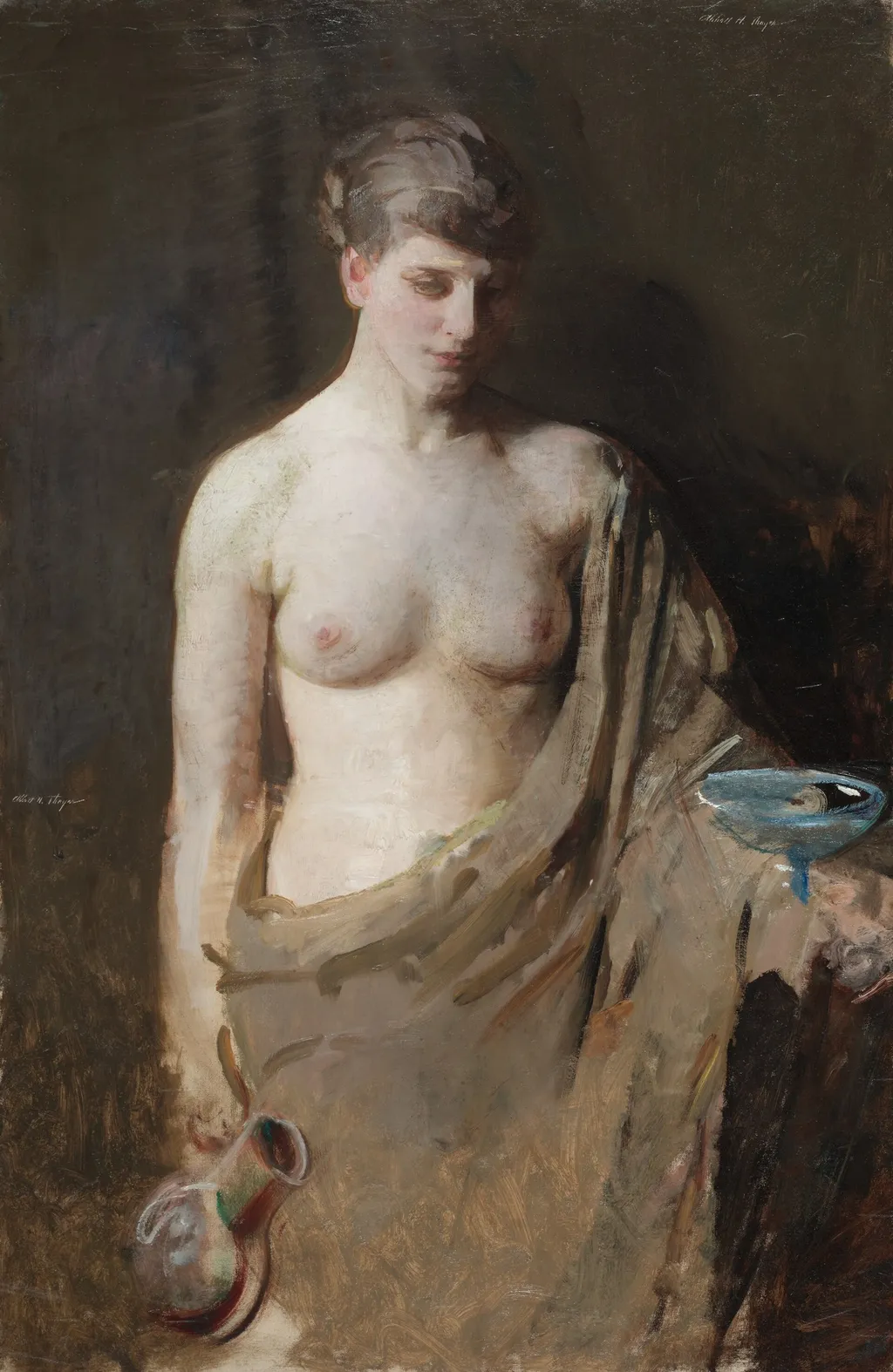
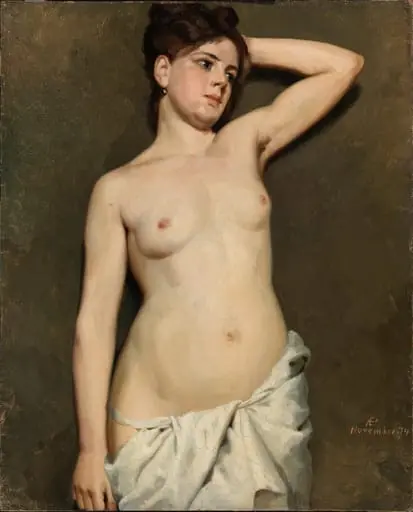
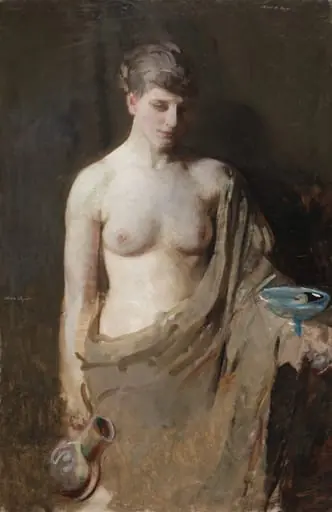
Hebe is an oil painting by the American Impressionist artist Abbott Handerson Thayer. It dates from 1896 and is held in the collection of the Cleveland Museum of Art.
About this work
Subject & Meaning
The composition emphasizes the female form, specifically highlighting the breast, aligning with classical traditions of idealized nudity.
Abbott Handerson Thayer's 1890 oil painting depicts Hebe, the Greek goddess of youth, represented as a standing female figure. The iconography centers on specific attributes associated with her mythological role as cupbearer to the gods: a pitcher and a bowl, which she holds or are positioned near her. The composition emphasizes the female form, specifically highlighting the breast, aligning with classical traditions of idealized nudity.
While the sources confirm the presence of these symbolic vessels and the figure's identity through the title, they do not provide further textual analysis regarding specific allegorical meanings or narrative contexts beyond the visual depiction of the goddess with her traditional emblems.
Technique & Style
Abbott Handerson Thayer's Hebe, created in 1890, is an oil painting executed on canvas. The work measures 117.0 cm in height and 75.0 cm in width. As an oil-on-canvas piece, it depicts the goddess Hebe alongside a pitcher and a bowl, with specific attention to the female breast.
The painting is held in the collection of the Cleveland Museum of Art, where it is cataloged as object number 1918.172. The medium of oil paint allows for the characteristic handling and finish associated with Thayer's American academic style during this period.
History & Provenance
Abbott Handerson Thayer executed the oil painting Hebe in 1890 within the United States. Created on canvas, the work measures 117.0 by 75.0 centimeters. While specific details regarding the original commission or the initial ownership chain are not provided in the available records, the painting's history includes its acquisition by the Cleveland Museum of Art.
The institution catalogs the piece under the accession number 1918.172, indicating it entered their collection in or before 1918. The artwork remains held in the museum's collection in Cleveland, where it is recognized as a depiction of a female figure accompanied by a pitcher and bowl.
Hebe by Abbott Handerson Thayer is held in the collection of the Cleveland Museum of Art, where it remains part of the institution's holdings. The painting is catalogued under accession number 1918.172, indicating its entry into the museum's collection in 1918. Executed in oil on canvas, the work measures 117.0 cm in height by 75.0 cm in width. No exhibition history beyond its institutional placement is documented in the available sources.
Overview
Abbott Handerson Thayer's painting, Hebe, completed in 1896, depicts a classical figure rendered in oil. The artwork portrays a young woman, partially draped, holding a pitcher and bowl, embodying a serene and contemplative presence. This piece reflects Thayer's focus on figure studies and is held in the collection of The Cleveland Museum of Art.
Context
As an American painter recognized for his figure studies and portraits, Abbott Handerson Thayer often explored classical themes. His broader interests extended to natural observation, evident in his later work on animal camouflage. This engagement with the natural world informed his approach to depicting the human form, emphasizing careful observation and rendering of light and shadow to convey presence and form.
Own this work as a print
Artist & collection

Artist
Abbott Handerson Thayer (August 12, 1849 – May 29, 1921) was an American painter, naturalist, and teacher.