Artwork
Mount Monadnock
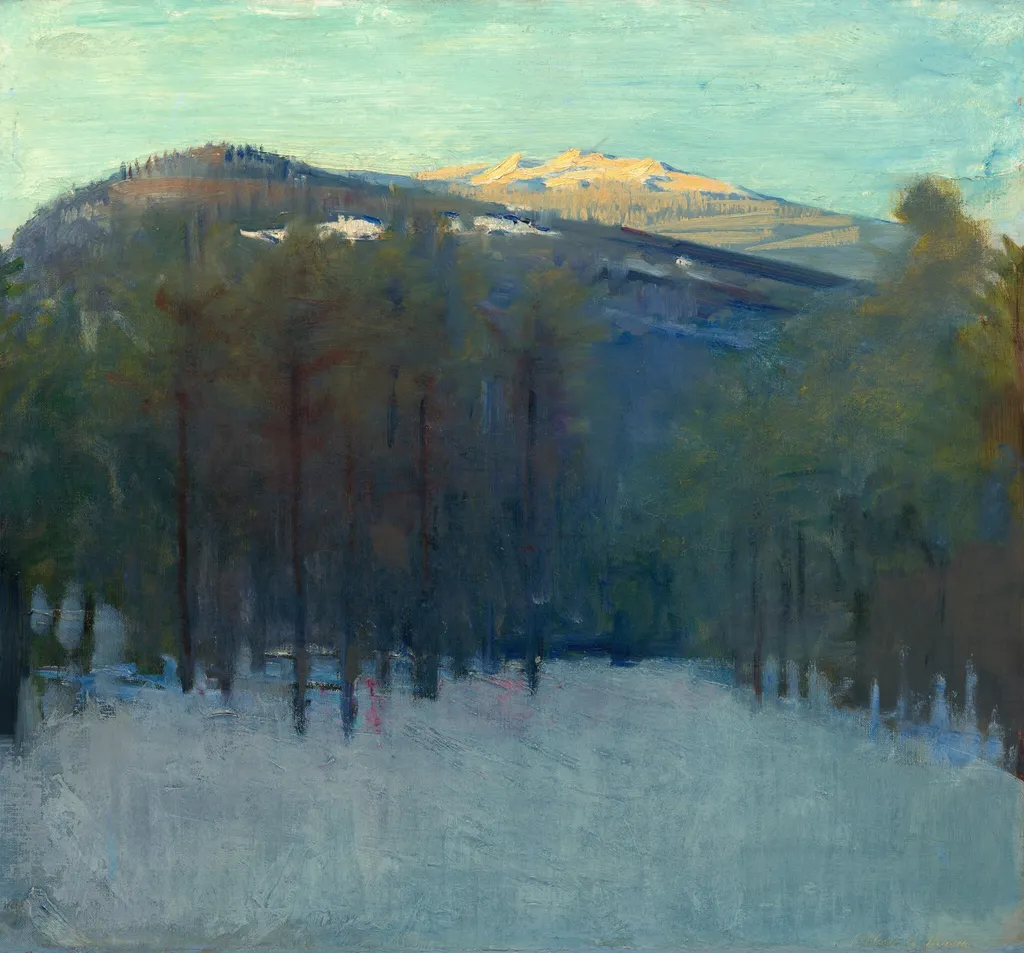
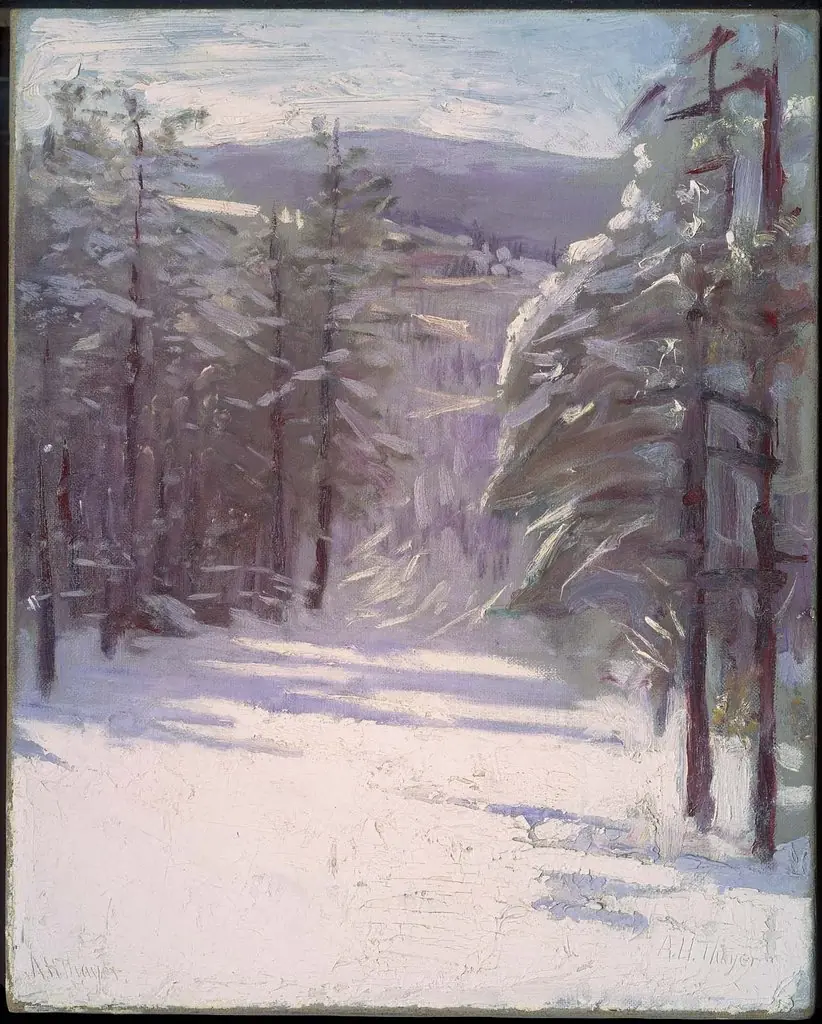
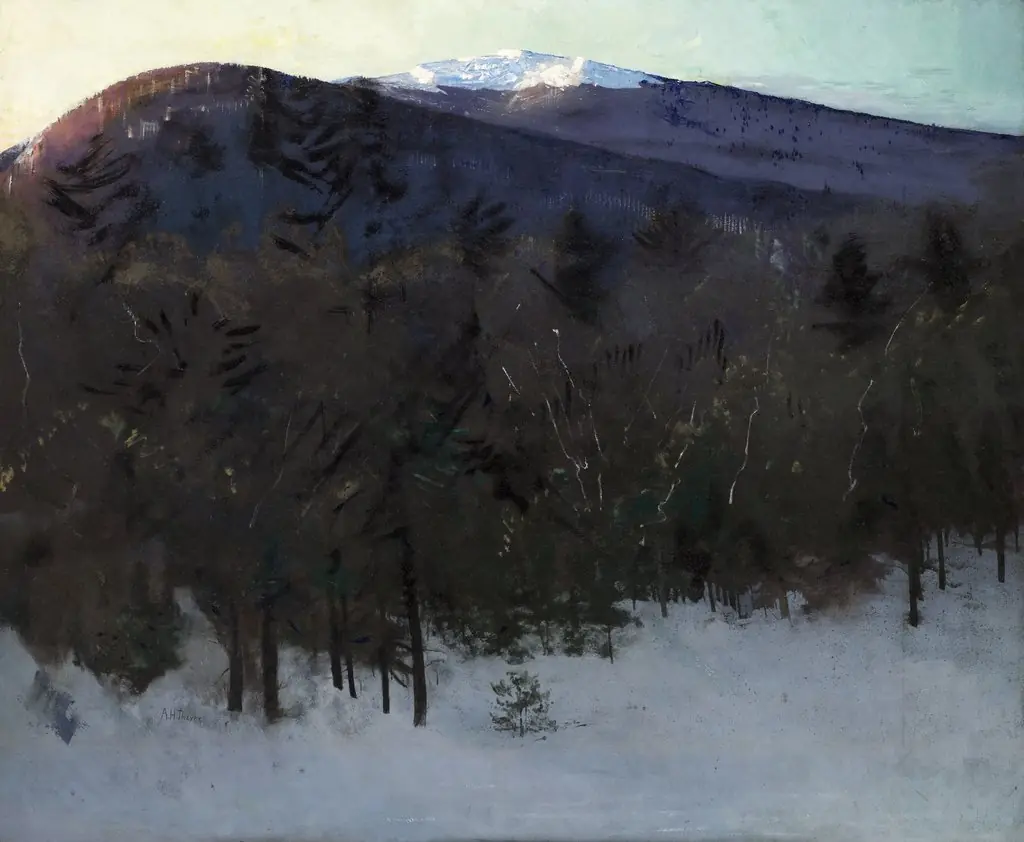
Mount Monadnock is an oil painting by the American Impressionist artist Abbott Handerson Thayer. It dates from 1912 and is held in the collection of the National Gallery of Art.
- Inscription
- Inscribed:lower right: Abbott H. Thayer; center right verso: To Franklin MacVeagh / from Abbott Thayer / In Memory of the former's great kindness / in the summer of 1911. / Dublin N.H.
About this work
Subject & Meaning
Mount Monadnock is depicted as a solitary, enduring natural landmark symbolizing permanence and spiritual resilience, reflecting the artist's fascination with the mountain's unchanging presence amid seasonal cycles. The work conveys themes of transcendence and the sublime through its stark, contemplative portrayal of the peak against a muted sky, devoid of human figures to emphasize nature's solitary power. This symbolic focus aligns with the artist's broader philosophy of finding spiritual meaning in the natural world, where landscapes served as metaphors for inner contemplation.
The painting's subject thus represents both a physical and metaphysical exploration of nature's enduring essence, rooted in the artist's personal reverence for the New Hampshire mountain.
Technique & Style
Forms are softly modeled with delicate transitions of tone rather than sharp edges, producing a hazy, luminous effect.
The painting is executed in oil on canvas, measuring 56.4 cm in height and 61.4 cm in width.
The handling is refined and atmospheric, characteristic of Thayer's late-career approach to landscape. Forms are softly modeled with delicate transitions of tone rather than sharp edges, producing a hazy, luminous effect. The composition emphasizes the mountain's profile through a muted palette of greens, grays, and ochers, with minimal extraneous detail to focus attention on the central motif.
History & Provenance
Abbott Handerson Thayer created the oil-on-canvas painting Mount Monadnock in 1912. The artist initially retained ownership before presenting the work to Franklin MacVeagh in Cornish, New Hampshire. It subsequently passed by descent to MacVeagh's son, Eames MacVeagh, of Chicago.
In 1934, the Corcoran Gallery of Art in Washington, D.C., purchased the painting from the MacVeagh family. The work remained in the Corcoran's collection until 2014, when it was acquired by the National Gallery of Art.
Context
Mount Monadnock, painted by Abbott Handerson Thayer in 1912, was created during his mature period when he focused on transcendent natural forms as spiritual symbols. Thayer developed a distinctive approach to depicting nature, often simplifying forms and using soft focus to convey emotional resonance, which positioned him outside mainstream modernist movements. The work entered the Corcoran Gallery of Art in 1934 after passing through the artist's circle and a private collection, and it was acquired by the National Gallery of Art in 2014.
Its significance has been examined in scholarship on American Symbolism and the spiritual dimensions of early 20th-century landscape painting.
Overview
Created circa 1912, this oil on canvas portrays Mount Monadnock in New Hampshire. The composition centers the mountain beneath a pale blue sky, its slopes cloaked in dense forest and a hint of snow at the summit. The scene conveys a tranquil, open‑air atmosphere, inviting the viewer to contemplate the natural landscape without narrative distraction.
Own this work as a print
Artist & collection

Artist
Abbott Handerson Thayer (August 12, 1849 – May 29, 1921) was an American painter, naturalist, and teacher.