Artwork
Bull in a City Street
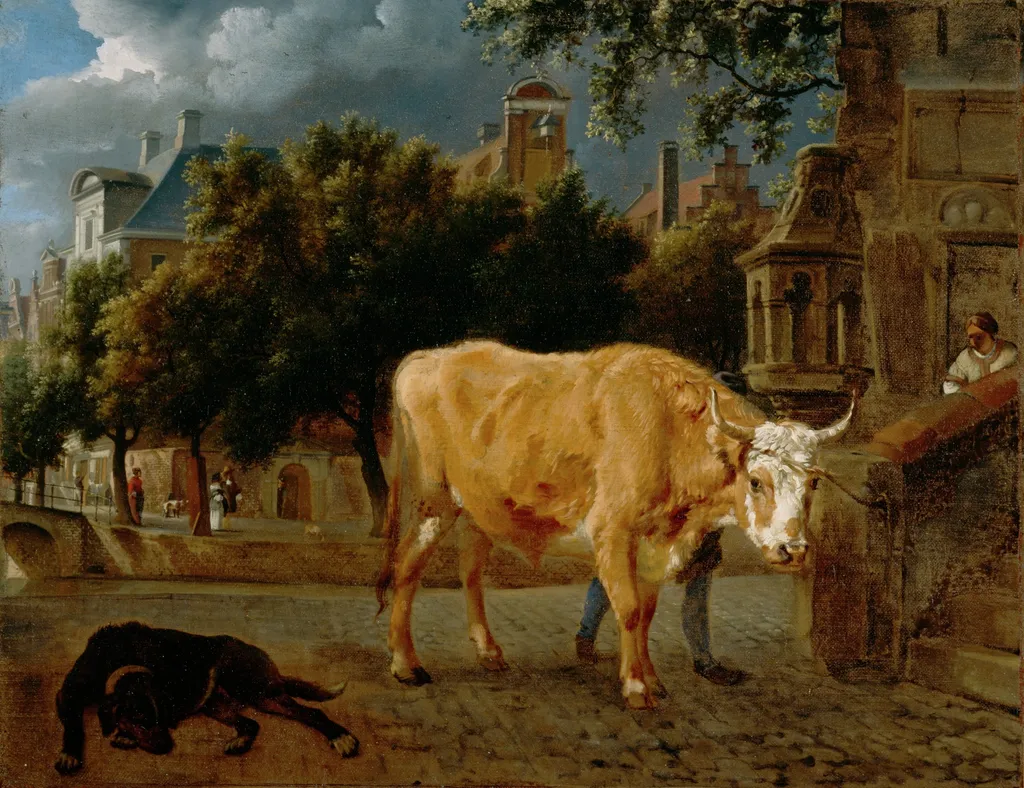
Bull in a City Street is an oil painting by the Dutch Golden Age artist Adriaen van de Velde. It dates from 1670 and is held in the collection of the Detroit Institute of Arts.
About this work
Technique & Style
3 cm in width, a small scale suited to detailed cabinet pictures of the period.
Bull in a City Street is an oil painting classified as a cityscape, executed in 1670 by Adriaen van de Velde in collaboration with Jan van der Heyden, whose joint authorship reflects a typical division of labor in which one artist supplied the figures or animals and the other the architectural and urban setting. The work is painted in oil on a modest support measuring 31.4 cm in height by 40.3 cm in width, a small scale suited to detailed cabinet pictures of the period. Stylistically, the painting combines the precise topographical cityscape tradition associated with Van der Heyden with Van de Velde's naturalistic animal painting, depicting a bull and a dog within an Amsterdam street scene.
The handling of oil paint allows for the fine, descriptive detail characteristic of Dutch Golden Age cityscapes, while the inclusion of livestock in an urban setting produces a distinctive genre hybrid that merges cityscape with animal painting.
History & Provenance
Bull in a City Street is a collaborative oil painting dated 1670, executed by Jan van der Heyden and Adriaen van de Velde. The work depicts an Amsterdam street scene featuring a bull and a dog. It entered the provenance of American collector William T. Blodgett before being acquired by the Detroit Institute of Arts, where it remains today. The painting was exhibited as part of the Hudson-Fulton celebration at the Metropolitan Museum of Art.
The painting is held by the Detroit Institute of Arts, where it is inventoried as Bull in a City Street (accession number 70.14).
It was included in the exhibition The Hudson-Fulton celebration, held at the Metropolitan Museum of Art in New York, as documented in the accompanying catalogue.
Overview
Created in 1670, this oil painting by Adriaen van de Velde portrays a tranquil Amsterdam street traversed by a large, light‑brown bull. A black dog follows the animal, while modest figures and modest buildings line the cobbled road. The work is part of the collection of the Detroit Institute of Arts.
Subject & Meaning
The central figure, a bull, dominates the composition, suggesting themes of strength and the intrusion of rural life into an urban setting. The accompanying dog and the few passersby provide a sense of everyday activity, emphasizing the coexistence of commerce, livestock, and city dwellers in 17th‑century Amsterdam.
Context
Painted during the Dutch Golden Age, the work reflects the period’s interest in realistic genre scenes and cityscapes. Van de Velde, known primarily for pastoral subjects, integrates an urban backdrop, illustrating the fluid boundaries between countryside and city life in the Netherlands of the late 1600s.
Own this work as a print
Artist & collection

Artist
Adriaen van de Velde, was a Dutch painter, draughtsman, and print artist. His favorite subjects were landscapes with animals and genre scenes. He also painted beaches, dunes, forests, winter scenes, portraits in…