Artwork
Two Cows and a Young Bull beside a Fence in a Meadow
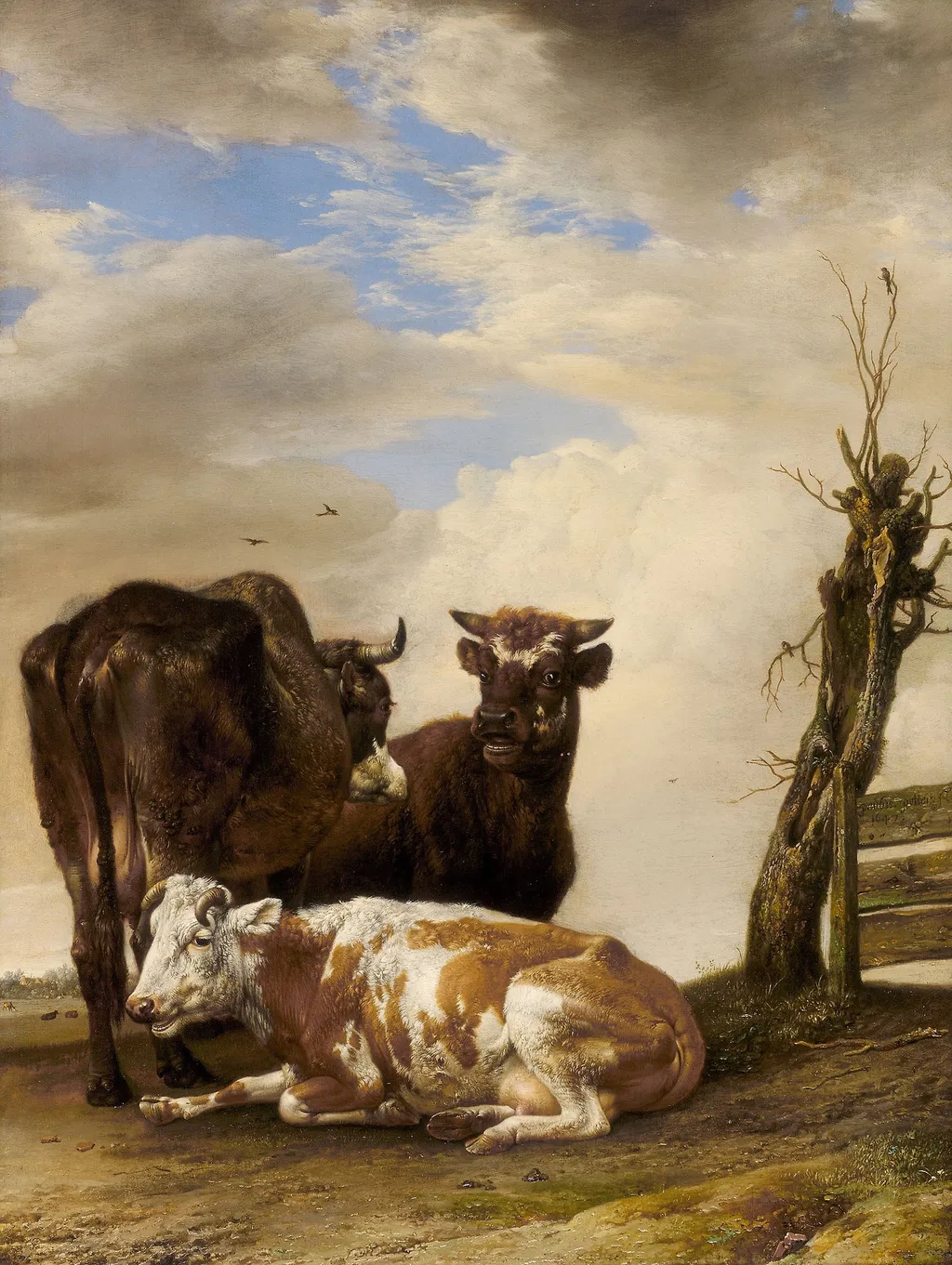
Two Cows and a Young Bull beside a Fence in a Meadow is an oil painting by the Dutch Golden Age artist Paulus Potter. It dates from 1647 and is held in the collection of the Art Institute of Chicago.
About this work
Overview
Two Cows and a Young Bull beside a Fence in a Meadow is an oil painting on oak panel by the Dutch artist Paulus Potter, dated 1647.
Two Cows and a Young Bull beside a Fence in a Meadow is an oil painting on oak panel by the Dutch artist Paulus Potter, dated 1647. Measuring 49.5 by 37.2 cm, the work is held by the Art Institute of Chicago, where it is accessioned as 1997.336 and displayed in Gallery 213. The painting exemplifies Potter's role in elevating animal subjects to independent artistic genre, transforming livestock into dignified emblems of the Dutch natural world during the Golden Age.
Subject & Meaning
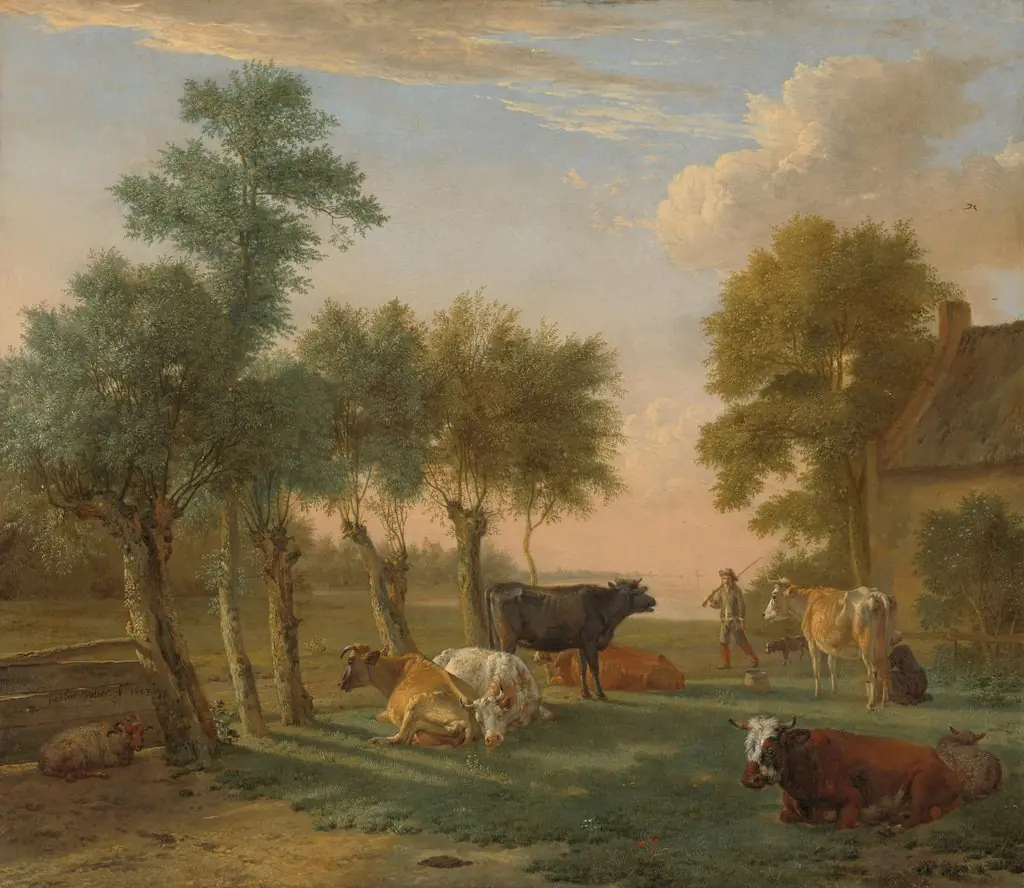
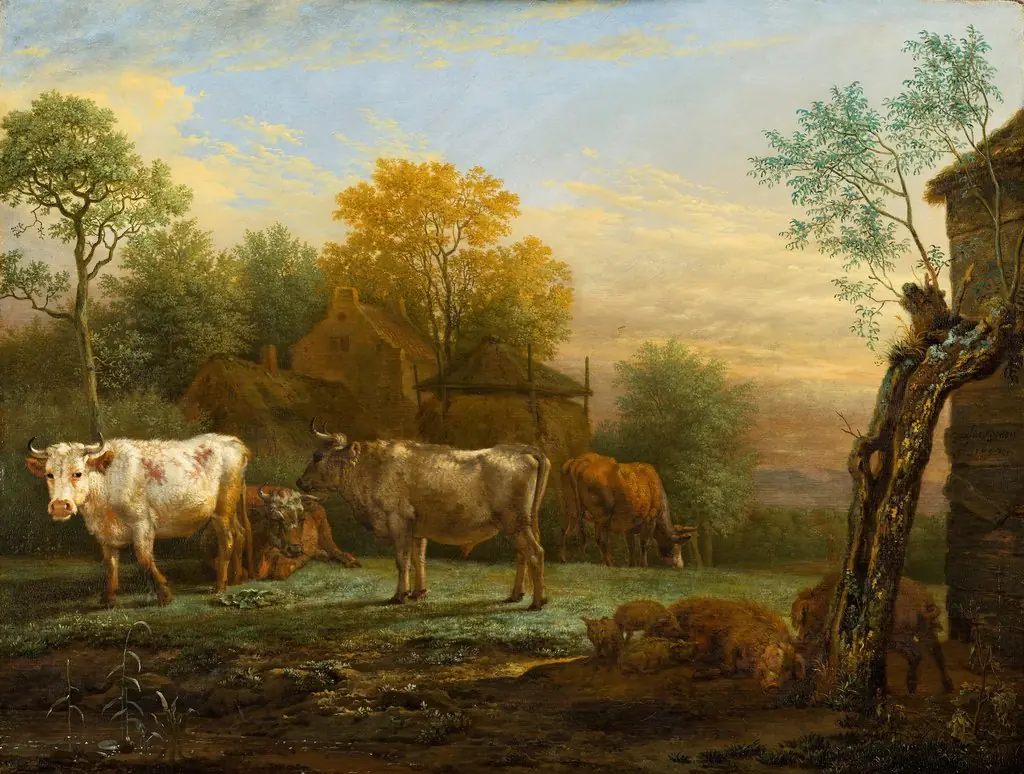
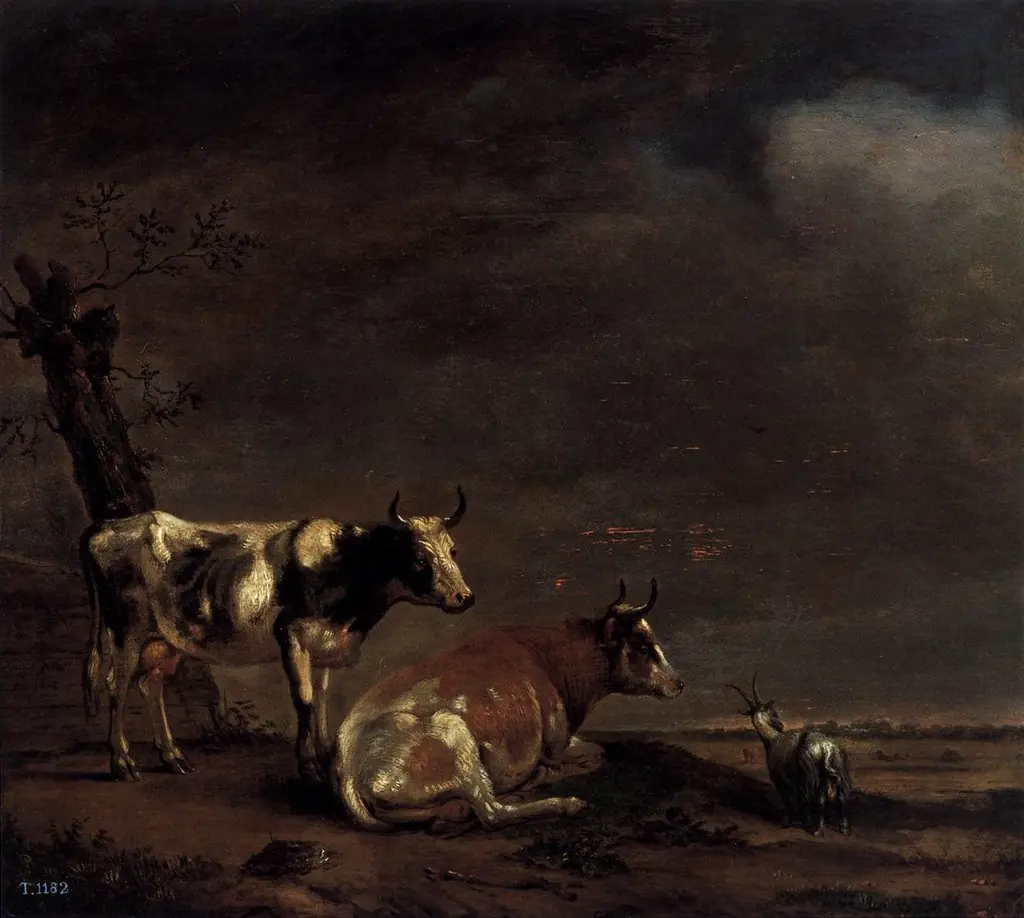
The composition presents three cattle in a meadow: a dark brown cow stands at left withNU head lowered and turned away, while behind it a brown cow with a white forehead marking reclines with head raised facing forward. In the foreground, a brown and white spotted young bull reclines with head turned left. A leafless pollarded tree and simple wooden fence appear to the right, with two small birds in the middle distance. The vast sky dominates the upper portion of the canvas, heavy grey clouds parting to reveal blue patches. Beyond straightforward pastoral description, the cattle carried symbolic weight in the Dutch Republic. During this period of growing national identity and prosperity following independence from Spanish rule, such animals represented wealth and the cultivated Dutch landscape. The prominence given to farm animals reflected the new market among the wealthy merchant class for art celebrating republican prosperity and land ownership.
Technique & Style
Potter executed the work in oil on oak panel, a support typical of Dutch cabinet pictures. The artist inscribed the work on the fence: Paulus. Potter. f./1647. Light falls from the left, casting soft shadows beneath the cattle and tree. The paint surface shows smooth blending in the sky, while the animals' hides receive more textured, detailed brushwork. This lavish attention to physical appearance, the varied texture and coloring of hair, characteristic poses, and bulky contours approaches portraiture in its specificity. The low vantage point, typical of Potter's animal landscapes, places the viewer at eye level with the cattle, lending them monumental presence. The handling likely derived from drawings made from life, a practice that informed Potter's naturalistic rendering.
History & Provenance
The painting was created in 1647, during the final years of Potter's short life. He had become a member of the Guild of Saint Luke in Delft, and by 1649 moved to The Hague. The work entered the collection of the Art Institute of Chicago through a complex bequest, with credit given in memory of Harold T. Martin from Eloise W. Martin and Joyce Martin Brown, along with the Charles H. and Mary F. S. Worcester Collection, the Lacy Armour Endowment, and through prior gift of Frank H. and Louise B. Woods. The accession number is 1997.336.
Context
Paulus Potter was baptized on 20 November 1625 in Enkhuizen. His family moved to Leiden in 1628 and Amsterdam in 1631, where he studied painting with his father, Pieter Symonsz Potter. By 1649 he had settled in The Hague near Jan van Goyen, and in July 1650 married Adriana van Balckeneynde, whose father was a leading building contractor who introduced him to Dutch elite circles. Amalia of Solms-Braunfels, a member of the stadholder's family, purchased a painting featuring a pissing cow from him, though court ladies reportedly advised against the acquisition. In May 1652, Nicolaes Tulp invited Potter back to Amsterdam, where Tulp, impressed by his civilized behavior, commissioned an equestrian portrait of his son Dirck. Potter died of tuberculosis in early 1654, two months after his twenty-eighth birthday, having already made his will in January 1653. His brief career nonetheless established animal painting as an independent genre in the Dutch Republic, moving beyond subsidiary roles in history or landscape painting.
Legacy
The painting's continuing display at the Art Institute of Chicago, with its public domain status enabling broad digital reproduction, sustains Potter's reputation as the preeminent animal painter of the Dutch Golden Age. The institution provides curator's interpretation accessible to visitors, reflecting ongoing scholarly interest in how such works encoded social meaning. Potter's approach to cattle as subjects worthy of near-portrait attention influenced subsequent developments in animal painting and remains a touchpoint for understanding how Dutch artists negotiated between naturalistic observation and the symbolic demands of a prosperous republic.
Own this work as a print
Artist & collection
Artist
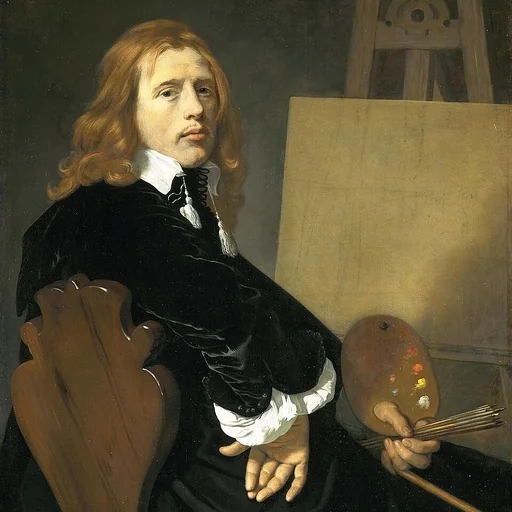
Paulus Potter (Dutch pronunciation:; 20 November 1625 (baptised) – 17 January 1654 (buried)) was a Dutch painter who specialized in landscapes featuring animals, often from a low vantage point.