Artwork
In the painter's studio
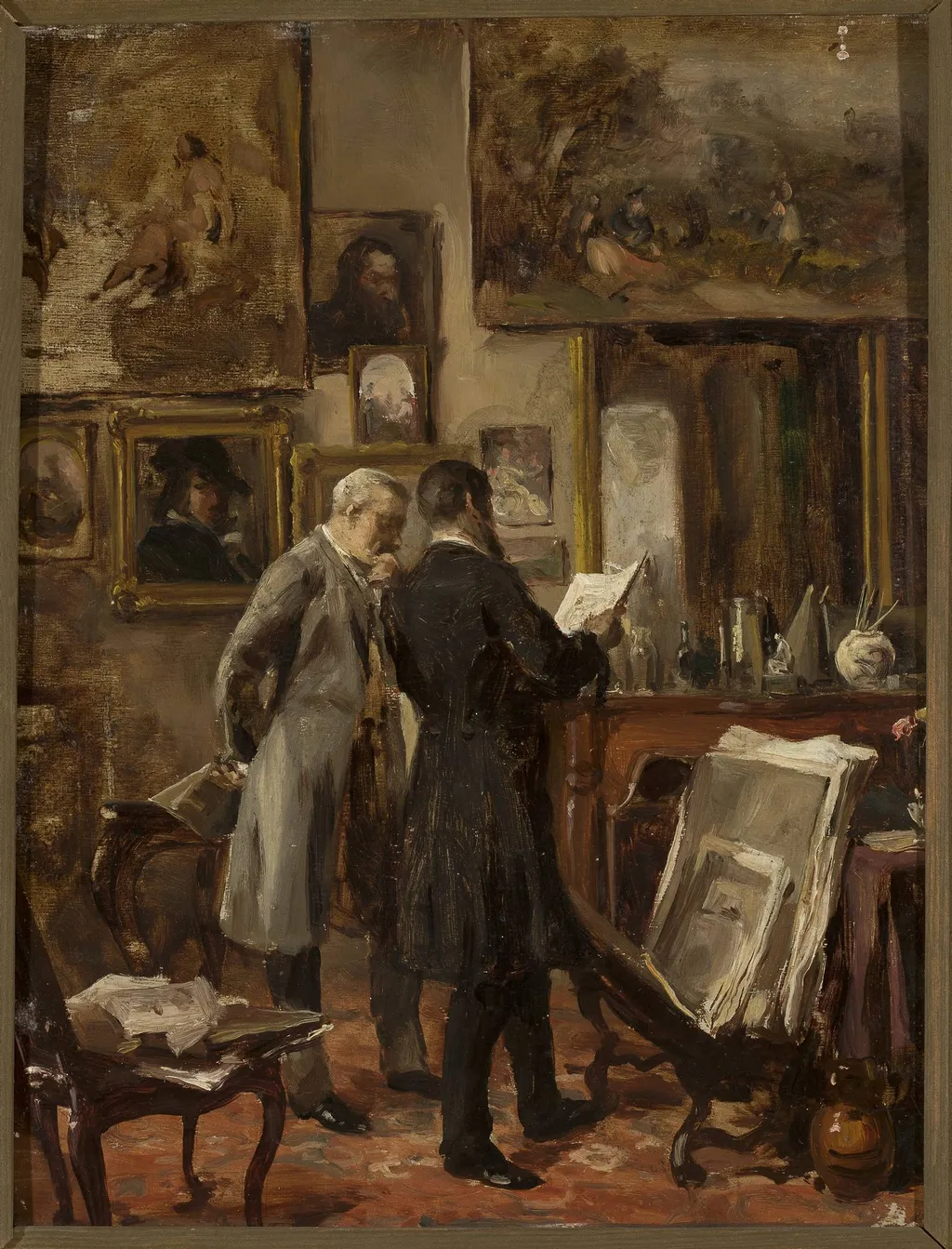
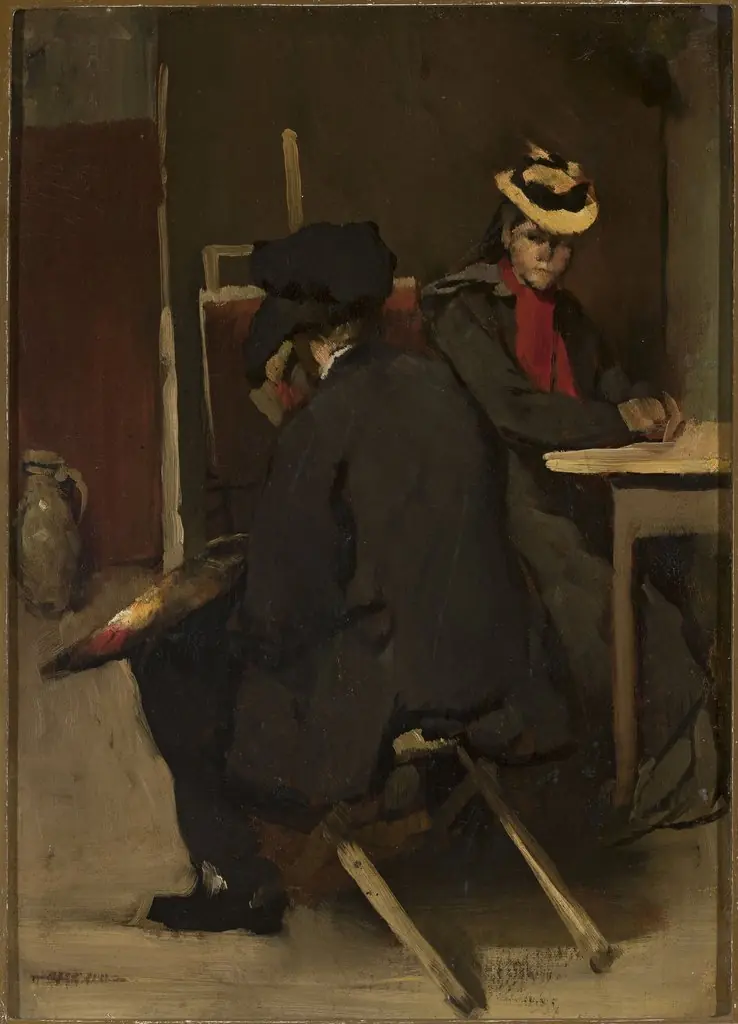
In the painter's studio is an oil painting by the Realist artist Aleksander Gierymski. It dates from 1885 and is held in the collection of the National Museum in Warsaw.
About this work
Overview
5 centimetres, the work depicts two men in a cluttered artist's studio, surrounded by framed paintings hung from floor to ceiling.
In the painter's studio is an oil painting on oak panel by the Polish artist Aleksander Gierymski (1850-1901), a leading figure of late nineteenth-century Realism and an important precursor of Impressionism in Poland. Measuring 32 by 24.5 centimetres, the work depicts two men in a cluttered artist's studio, surrounded by framed paintings hung from floor to ceiling. The painting is held in the collection of the National Museum in Warsaw. Though modest in scale, the work offers significant insight into Gierymski's engagement with questions of artistic practice and the material conditions of painting, themes that resonate throughout his career as he moved between realistic genre scenes and increasingly experimental treatments of light and colour.
Subject & Meaning
The scene presents two male figures in an interior identified as a painter's studio. The older man on the left, dressed in a light gray coat, holds a book or portfolio behind his back and inclines his head toward a younger man in dark clothing who stands with his back to the viewer, holding a sheet of paper. The studio environment is densely packed with visual stimuli: framed paintings cover the walls, a large gilt-framed canvas rests on an easel with its surface apparently blank or in preparation, and a wooden table holds bottles, brushes, and a ceramic vessel. A chair in the foreground is strewn with scattered papers. The composition invites interpretation as a meditation on the act of looking and the processes of artistic creation and evaluation. The blank or unfinished canvas on the easel, set amid numerous completed works, suggests a moment suspended between conception and realisation. The interaction between the two figures, one apparently showing or discussing something with the other, may allude to the social and commercial dimensions of artistic life, the transmission of knowledge, or the judgement of work in progress. The paintings within the painting, described as depicting figures, landscapes, and portraits in varying states of finish, further emphasise the theme of artistic labour and its multiple stages.
Technique & Style
The painting is executed in oil on oak panel, a support that indicates a preference for durability and a connection to Northern European painting traditions. The palette is dominated by browns, umbers, and muted grays, with restrained touches of red appearing in the floor and a terracotta pot. Light enters from an unseen source, illuminating the central figures while leaving the corners of the composition in shadow, a handling that demonstrates Gierymski's sustained interest in the effects of light. The brushwork is notably loose and visible, with thick impasto applied in the highlights and thinner, sketchier treatment reserved for background details. This varied handling suggests the influence of both Realist directness and the emerging Impressionist concern for the materiality of paint. The visible brushstrokes and the attention to atmospheric effects align with Gierymski's broader artistic trajectory, which saw him increasingly experiment with light and colour in his later career, particularly after his exposure to Impressionist works in Paris in 1890. The relatively small dimensions of the panel, 32 by 24.5 centimetres, indicate an intimate, portable format that may have served as a study or a work for private contemplation rather than a large public statement.
History & Provenance
Specific details regarding the commission, exact date of creation, and early provenance of In the painter's studio are not recorded in the available sources. The work's compact dimensions and intimate subject matter suggest it may have originated as a private study or a piece developed within the circle of Gierymski's patron, Ignacy Korwin Milewski, the prominent Polish collector who supported the artist financially and purchased numerous works from him. Milewski, who began accumulating his collection around 1880, was particularly devoted to Gierymski's work, paying for it generously according to the artist's own testimony. The painting is now held by the National Museum in Warsaw, having entered the collection through institutional accession. No exhibition history for this specific work is documented in the provided sources.
Context
Aleksander Gierymski was born in Warsaw on 30 January 1850 and trained at the Academy of Fine Arts in Munich, graduating with a gold medal in 1872. His early career was shaped by Italian sojourns and by his association with the Warsaw periodical Wędrowiec, where he worked with Stanisław Witkiewicz and other positivist writers and painters. During his most productive period, from 1879 to 1888, Gierymski absorbed himself in the lives of Warsaw's poor, producing works such as Jewess with Oranges and Sandblasters that grounded Realist observation in social concern. In the painter's studio belongs to this broader engagement with the visible world, though its subject shifts from urban genre to the meta-commentary of artistic practice itself. Gierymski's move away from Poland in 1888, following a lack of recognition and livelihood, led to periods in Germany, France, and finally Italy, where he died in a mental hospital in Rome in 1901. The critical neglect he suffered in his lifetime has given way to substantial posthumous recognition; art historians have rediscovered his work as foundational for Polish painting at the turn of the century, noting his role as a precursor of luminous and colour experiments that paralleled French Impressionism. His naturalistic vision, sometimes criticised as brutal, and his insatiable study of light effects positioned him as a seeker of what has been termed pure painting.
Legacy
Gierymski's artistic legacy has undergone significant rehabilitation since his death. For decades underappreciated in Poland, he has risen to be considered among the most outstanding Polish painters of his era, recognised for his innovative contributions to realism and his pioneering experiments with light and colour. The patronage of collectors such as Ignacy Korwin Milewski proved crucial in preserving his work; Milewski's collection, assembled with methodical attention to the Munich school and Polish national themes, now forms part of the core of Polish national heritage. In the painter's studio participates in this legacy as a work that reveals the artist's self-conscious reflection on his own medium. While it lacks the overt social commentary of Gierymski's better-known Warsaw period paintings, it shares with them a commitment to direct observation and unidealised representation. The work's current residence in the National Museum in Warsaw ensures its accessibility for continued scholarly attention and public engagement, contributing to the ongoing reassessment of Gierymski's place in European art history.
Own this work as a print
Artist & collection
Artist
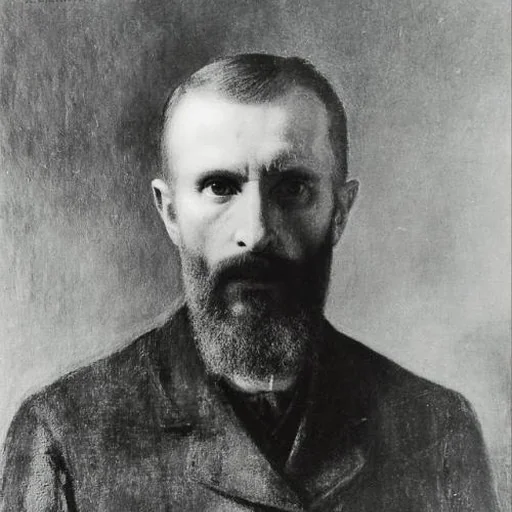
Ignacy Aleksander Gierymski (30 January 1850, Warsaw – d. 6–8 March 1901, Rome) was a Polish painter of the late 19th century, the younger brother of Maksymilian Gierymski. He was a representative of Realism as well as…