Artwork
Orpheus Enchanting the Animals
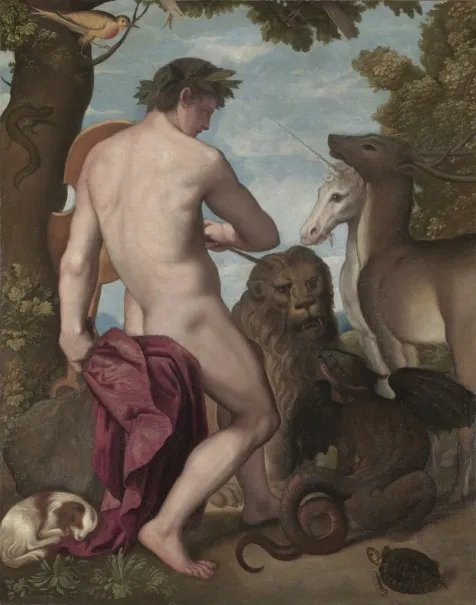
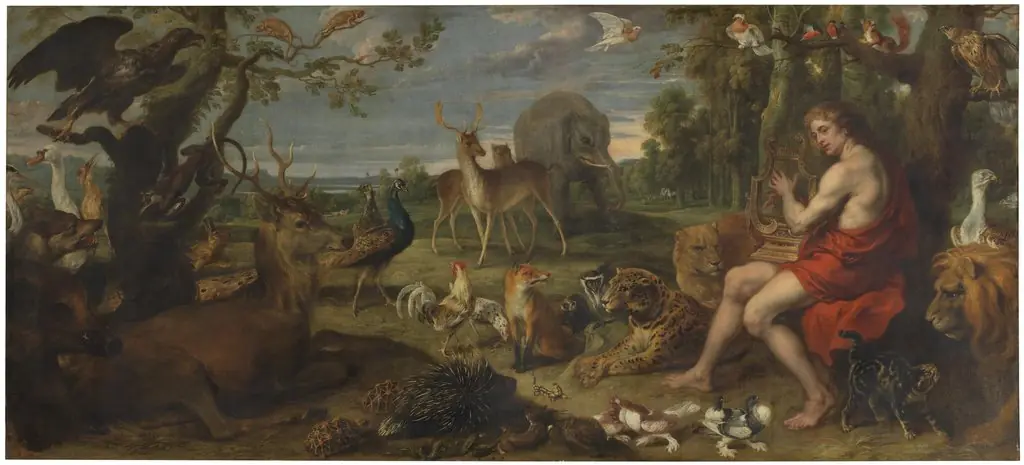
Orpheus Enchanting the Animals is an oil painting by Alessandro Varotari. It dates from 1601 and is held in the collection of the Museo del Prado.
About this work
Subject & Meaning
Central to the composition is the hero playing a lira da braccio, an instrument associated with Renaissance depictions of the bard.
The painting illustrates the mythological figure Orpheus using his music to charm a gathering of wild beasts. Central to the composition is the hero playing a lira da braccio, an instrument associated with Renaissance depictions of the bard. Surrounding him are various animals, including a lion, a dog, a turtle, and a unicorn, all rendered in a state of peaceful coexistence under the spell of his melody.
This imagery symbolizes the harmonizing power of art and music, capable of taming nature's fiercest instincts. The inclusion of the unicorn, a creature often linked to purity and myth, alongside standard wild animals, reinforces the supernatural quality of Orpheus's gift. The work serves as a visual allegory for the civilizing influence of the arts.
Technique & Style
The painting is executed in oil paint on canvas, a standard support for early seventeenth-century mythological compositions. Its dimensions are 167 cm in height by 109 cm in width, giving it a tall, vertical format suited to the figural arrangement of Orpheus surrounded by animals.
Stylistically, the work is described as a mythological painting produced after Titian by an anonymous seventeenth-century artist, though it was formerly attributed to Alessandro Varotari. The composition centers on Orpheus playing a lira da braccio, with a menagerie of responsive creatures, including a unicorn, lion, dog, and turtle, gathered around him, a hallmark subject of the Orpheus-charming-the-animals theme.
History & Provenance
Created in 1601, the painting Orpheus Enchanting the Animals is an oil on canvas work measuring 167 cm by 109 cm. While initially attributed to Alessandro Varotari, current scholarship identifies the piece as the work of an anonymous 17th-century artist executed after Titian. The creation history indicates the work was produced in Spain. Its provenance traces through the Spanish royal collection, having been owned successively by Philip V, Elisabeth Farnese, Charles III, and Ferdinand VII.
The painting is currently held by the Museo del Prado, where it has previously been displayed in locations including the Royal Palace of Aranjuez and the Royal Palace of La Granja de San Ildefonso.
The painting is held in the collection of the Museo del Prado. Its historical ownership includes Philip V of Spain, Elisabeth Farnese, Charles III of Spain, and Ferdinand VII of Spain. The work has been associated with several royal locations, including the Royal Palace of Aranjuez and the Royal Palace of La Granja de San Ildefonso.
The artwork was featured in the exhibition titled "Unicorn: The Mythical Beast in Art."
Context
Orpheus Enchanting the Animals is an oil on canvas mythological painting executed in 1601. The composition shows the mythic musician surrounded by a unicorn, lion, dog and turtle, rendered with a lira da braccio in his hand. Originally recorded as the work of an anonymous 17th‑century follower of Titian, later scholarship reattributed it to Alessandro Varotari, an Italian painter active in the early Baroque period.
The picture entered the Spanish royal collections, appearing in the holdings of Ferdinand VII, Charles III, Elisabeth Farnese and Philip V, and was later displayed in the exhibition “Unicorn: The Mythical Beast in Art.” Its transmission from Titian’s influence through Varotari’s reinterpretation illustrates the diffusion of High Renaissance mythological motifs into Baroque patronage networks and has been cited in studies of 17th‑century mythological painting.
Legacy
The work entered the Spanish royal collections, being owned by Ferdinand VII, Charles III, Elisabeth Farnese, and Philip V. It was later shown in the exhibition "Unicorn: The Mythical Beast in Art", highlighting its continued relevance.
Originally attributed to Alessandro Varotari, its authorship was later re‑evaluated as the work of an anonymous 17th‑century follower of Titian, reflecting shifting scholarly reputation. The painting is classified as a mythological work, underscoring its thematic legacy within the genre.
Overview
Alessandro Leone Varotari, known as Il Padovanino, completed Orpheus Enchanting the Animals in 1601. This oil painting depicts the mythological figure Orpheus, renowned for his musical abilities, captivating various creatures with his instrument. The work exemplifies the Venetian artist's engagement with both late-Mannerist and early-Baroque styles. It is currently housed in the collection of the Museo del Prado.
Artist & collection
Artist
Alessandro Leone Varotari (4 April 1588 – 20 July 1649), also commonly known as Il Padovanino, was a Venetian painter of the late-Mannerist and early-Baroque Venetian school, best known for having mentored Pietro…