Artwork
Aberystwyth Harbour
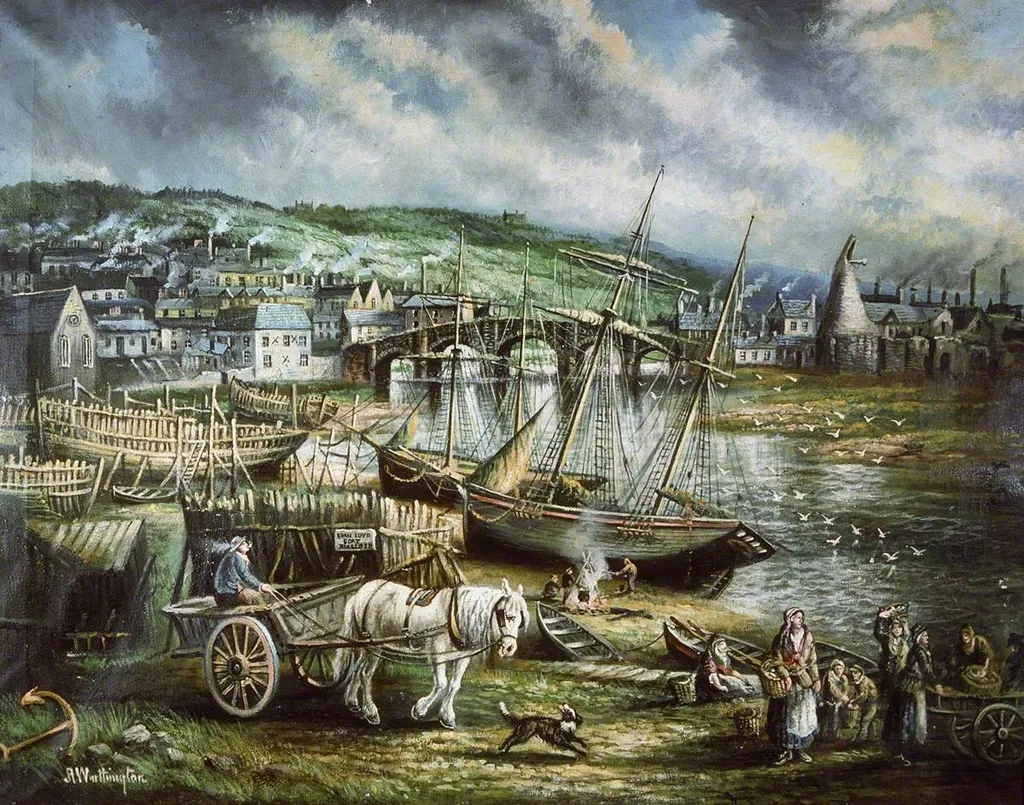
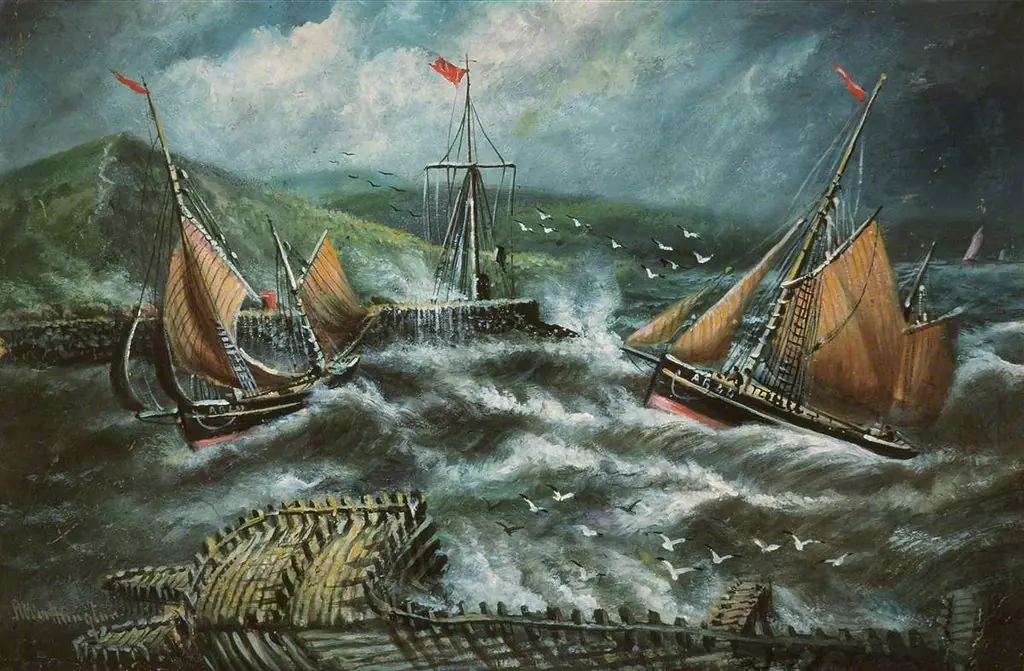
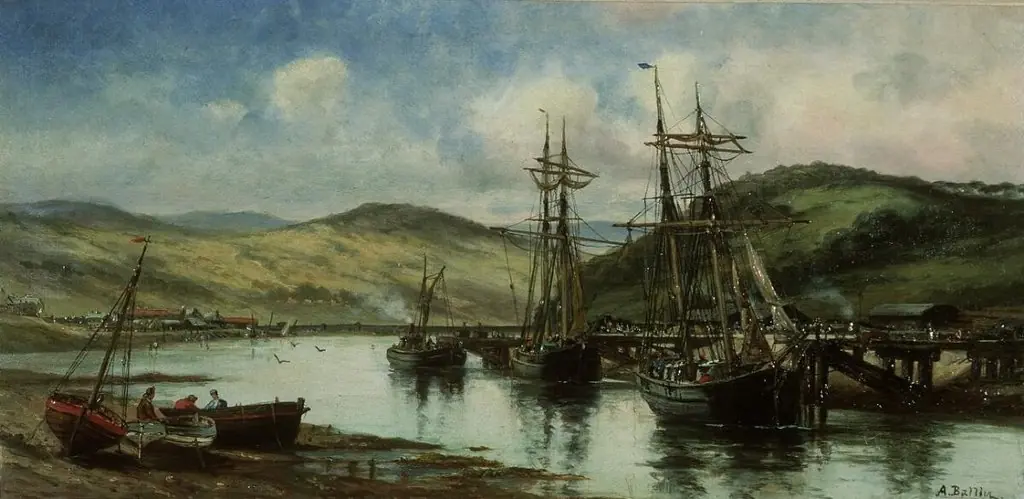
Aberystwyth Harbour is an oil painting by the Impressionist artist Alfred Worthington. It dates from 1895 and is held in the collection of the National Library of Wales.
About this work
Overview
The painting is held in the National Library of Wales Framed Works of Art collection, having been acquired as a gift from Mrs W.
Aberystwyth Harbour is an oil-on-canvas marine painting by the Victorian artist Alfred Worthington, dated 1889. Measuring 101 by 129.5 cm, the work depicts the harbour of Aberystwyth on the Welsh coast, featuring a large sailing vessel, figures engaged in maritime activity, and the distinctive stone bridge and townscape of the port. The painting is held in the National Library of Wales Framed Works of Art collection, having been acquired as a gift from Mrs W. R. Hankey in 1954. It is catalogued under accession number PB02640 and is designated as public domain. The work exemplifies Worthington's documentary approach to Welsh coastal life in the late nineteenth century and serves as a significant visual record of Aberystwyth's maritime heritage during a period of transition from sail to steam.
Subject & Meaning
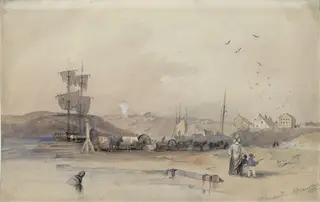
The painting presents a comprehensive view of Aberystwyth Harbour, with a large multi-masted sailing vessel anchored near shore as its central motif. The vessel's furled sails suggest a moment of rest or preparation rather than active departure. In the foreground, a white horse pulls a wooden cart with a seated driver, while a dog runs nearby, introducing elements of everyday labour and domesticity into the maritime setting. Several figures populate the waterfront, some standing with baskets, others seated in small boats or near the shore, indicating the harbour's role as a site of commerce and community. To the left, wooden fencing, a small structure, and a large anchor resting on the grass reinforce the nautical theme. The stone bridge with arches that spans the water behind the ship is identifiable as Trefechan Bridge, a local landmark. Beyond it, the town rises with numerous buildings, chimneys emitting smoke, and a church-like structure with a pointed roof, while green hills form the backdrop. Birds in flight over the water and the heavy, dark clouds mixed with lighter patches animate the sky. The scene captures a working harbour at a specific moment in time, documenting the coexistence of human industry, animal labour, and natural environment without overt romanticisation.
Technique & Style
Executed in oil on canvas, the painting employs a muted palette dominated by greens, grays, browns, and blues that conveys the atmospheric conditions of the Welsh coast. The brushwork varies across the composition: relatively detailed handling characterises the architecture and figures, while broader, more expressive strokes describe the sky and water. This differential treatment creates a visual hierarchy that directs attention to human activity and built structures while allowing the natural elements a more suggestive, atmospheric quality. Light falls unevenly across the scene, with shadowed areas under the clouds and brighter passages where light breaks through, producing a dynamic and naturalistic illumination. The signature in the lower left corner reads "J. Worthington," a variant of the artist's name. The overall style aligns with Victorian marine painting traditions, combining topographical accuracy with a sensitivity to weather and light that approaches the concerns of contemporary landscape painting.
History & Provenance
The painting is firmly dated to 1889, placing it in the mature phase of Worthington's career. It was acquired by the National Library of Wales as a gift from Mrs W. R. Hankey in 1954, entering the collection as accession number PB02640. The work is now part of the National Library of Wales Framed Works of Art collection. No earlier provenance or exhibition history is recorded in the available sources. The painting has been digitised and made available under a public domain mark, with photographic credit to the National Library of Wales.
Context
Alfred Worthington (1834-1927) was a Victorian artist who specialised in marine and coastal subjects, particularly of the Welsh coastline. Aberystwyth Harbour belongs to a body of work in which Worthington documented Welsh maritime life during a period of significant change. The late nineteenth century saw harbours like Aberystwyth undergoing transformation as steam power gradually supplanted sail and coastal trade patterns shifted. Worthington's painting captures this transitional moment, preserving the visual character of a working harbour dominated by sailing vessels and animal-powered transport. The work has received limited scholarly attention as an individual object, but it contributes to the broader understanding of Victorian marine painting and the visual culture of Welsh coastal communities. Its presence in the National Library of Wales underscores its value as a document of regional heritage. The painting's public domain status has facilitated its dissemination and study through digital platforms including Art UK and Wikimedia Commons.
Legacy
While Aberystwyth Harbour has not achieved the prominence of major national treasures, its afterlife is shaped by its accessibility and documentary value. The painting's entry into the National Library of Wales collection in 1954 ensured its preservation as part of the nation's cultural patrimony. Its digitisation and public domain designation have extended its reach beyond the physical collection, allowing it to serve as a resource for researchers, educators, and the public interested in Welsh maritime history, Victorian painting, or the specific topography of Aberystwyth. The work also exists within a broader corpus of Worthington's harbour scenes, including related depictions of Aberystwyth that suggest the artist's sustained engagement with this subject. The painting continues to function as a historical document, offering insights into the appearance and activity of a Welsh harbour in the late nineteenth century that are not fully captured by textual records alone.
Artist & collection
Artist
English painter in the 1880s–90s, Worthington captured Welsh coastal life and village scenes in oil.