Artwork
The Gage Family
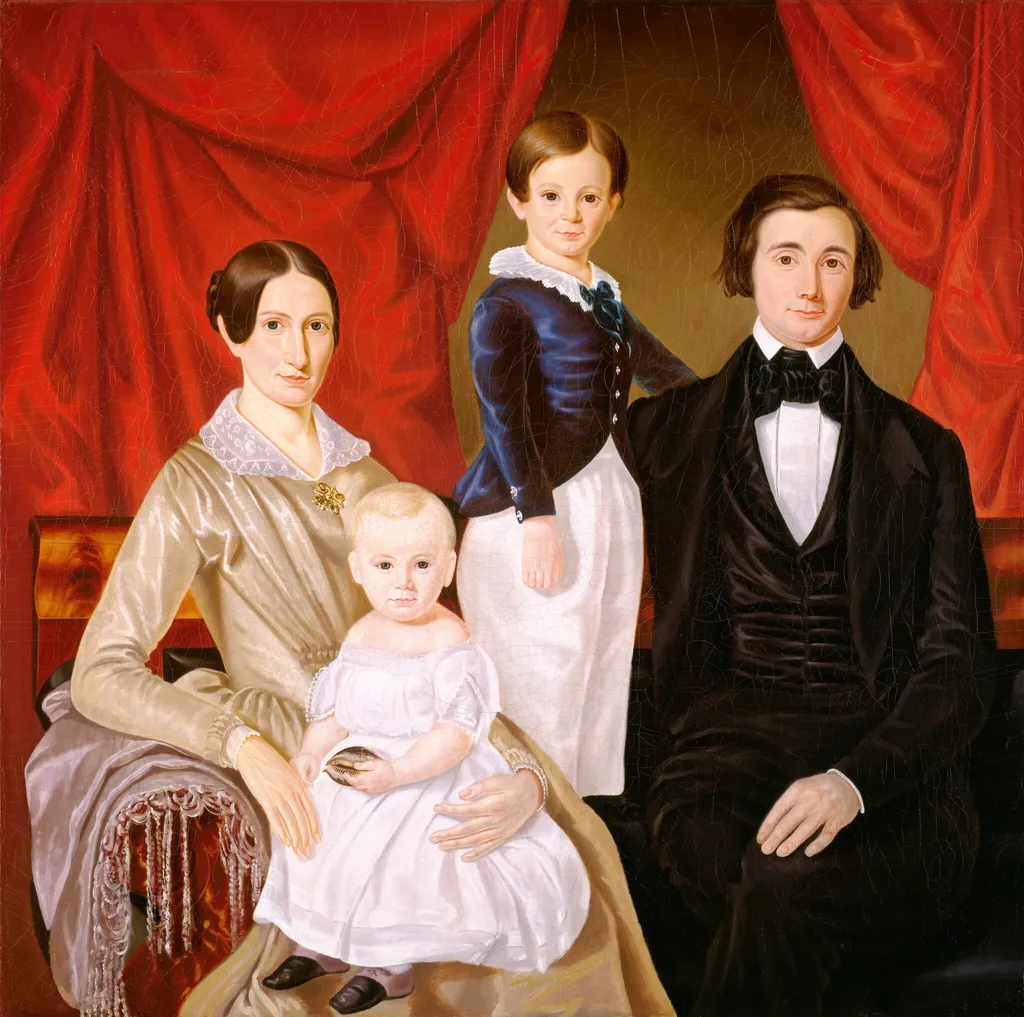
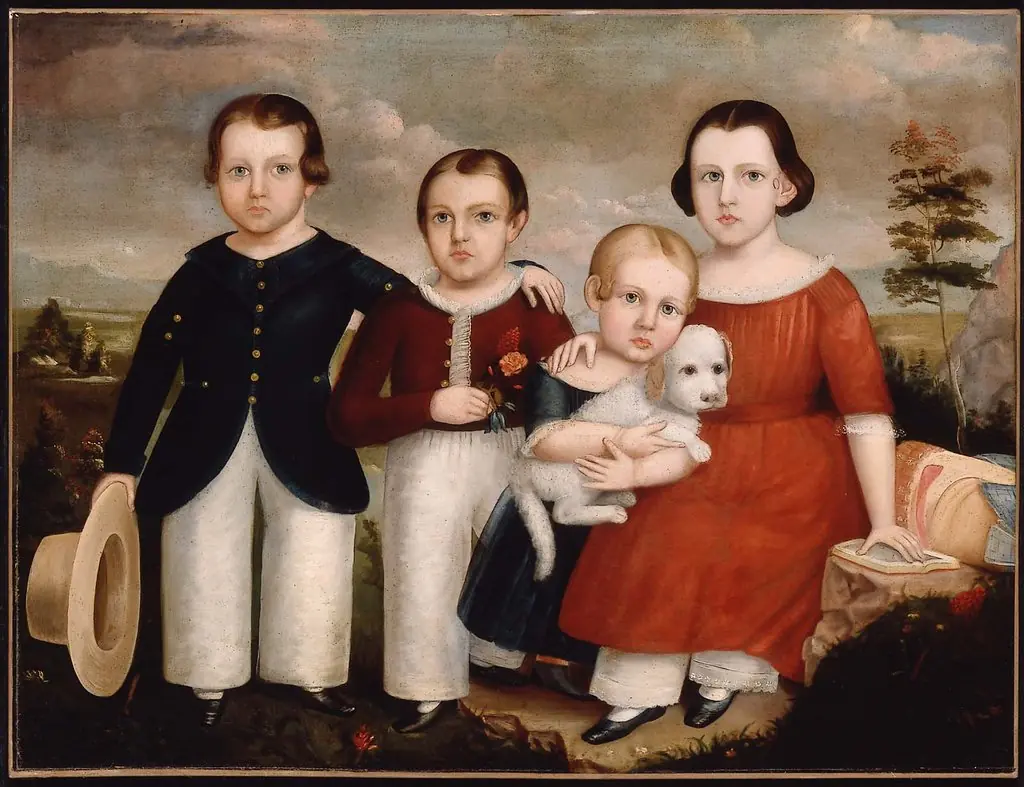
The Gage Family is an oil painting. It dates from 1846 and is held in the collection of the National Gallery of Art.
About this work
Technique & Style
The painting is executed in oil on bed ticking, a coarse, striped fabric typically used for mattress covers, which serves as an unconventional yet durable support for the portrait. The composition presents a tightly arranged group of six figures in a domestic interior, rendered with careful attention to individual likeness and costume detail characteristic of mid-19th-century American portraiture. Handling is precise and controlled, with smooth transitions between planar forms and controlled, matte modeling of faces and hands, suggesting the influence of academic training or closely observed studio practice.
The palette is subdued, dominated by earth tones and muted drapery, with highlights confined to facial features and metallic accents such as buttons and jewelry.
The fabric support shows signs of age-related cupping and minor planar distortions, consistent with its utilitarian origin and long-term display without relining. No major tears or losses are recorded, though localized abrasion is evident in the lower right quadrant, particularly around the seated boy's coat and the chair's upholstery.
History & Provenance
Coger sold the work in 1972 to Edgar William and Bernice Chrysler Garbisch, who bequeathed the portrait to the National Gallery of Art in Washington, D.
Created in 1846, this oil painting on bed ticking originated in Connecticut and remained within the Gage family for generations. In 1901, Julius Fisher Gage, who is depicted as the older boy in the composition, documented the work's date and identified the sitters in a note now held in curatorial files. The painting later entered the collection of Henry Coger in Ashley Falls, Massachusetts.
Coger sold the work in 1972 to Edgar William and Bernice Chrysler Garbisch, who bequeathed the portrait to the National Gallery of Art in Washington, D.C., in 1980. Its National Gallery of Art accession number is 1980.38.1, and it was exhibited at the Gallery in the 1981 display "American Naïve Paintings of the 18th and 19th Centuries."
Legacy
The Gage Family, an 1846 American portrait, entered the National Gallery of Art collection through the bequest of Edgar William and Bernice Chrysler Garbisch in 1980, having previously descended through the Gage lineage. Documentation from the family, including a 1901 note by Julius Fisher Gage, confirms the work's date and identifies the sitters, reinforcing its scholarly relevance as an example of 19th-century American portraiture. Its presence in the National Gallery's holdings has allowed continued study of the artist's technique and the social context of the period, contributing to the broader understanding of family portraiture in early American art.
Overview
The Gage Family is an oil painting depicting a family group seated on a simple wooden bench. The composition features a mother cradling an infant, flanked by two young girls. Behind them, the father stands, his hand resting on a boy's shoulder.
This work is notable for its use of an unconventional support material, contributing to its distinctive visual character.
Subject & Meaning
This portrait captures a domestic scene, presenting the Gage family in a direct and unadorned manner. The arrangement of the figures, with the parents anchoring the group and the children positioned around them, conveys a sense of familial unity and presence. The plain setting emphasizes the individuals themselves rather than their surroundings, focusing on their collective identity.
Context
The selection of bed ticking as a painting surface was an uncommon practice during the period when "The Gage Family" was created. Artists typically opted for finer-weave canvases or prepared wooden panels, which offered smoother grounds for their pigments. This choice suggests either a pragmatic decision or an intentional aesthetic preference to achieve a particular visual effect, differentiating it from more conventional portraits of the era.
Artist & collection

- Brother and Sister
 The Barrio Family
 The Younger Generation
 Dr. John Safford and Family
 Family Group
 The Williamson Family
 Joseph Moore and His Family
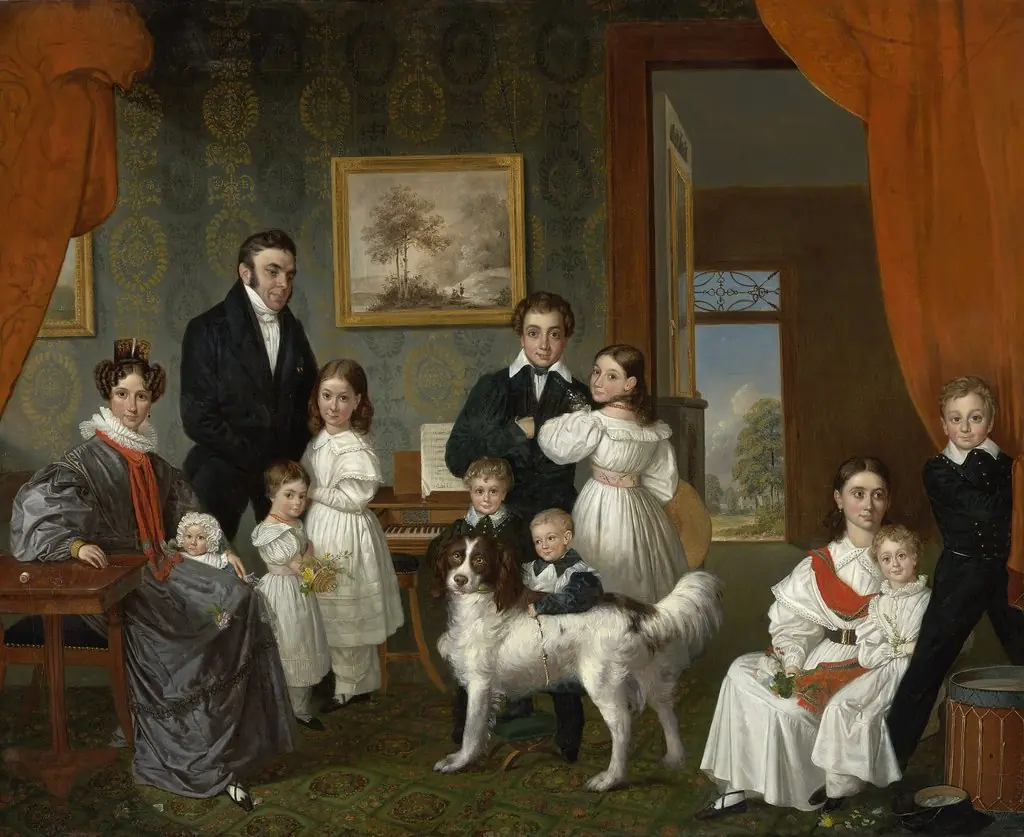 Portrait of the Baud family in their country house in Voorburg
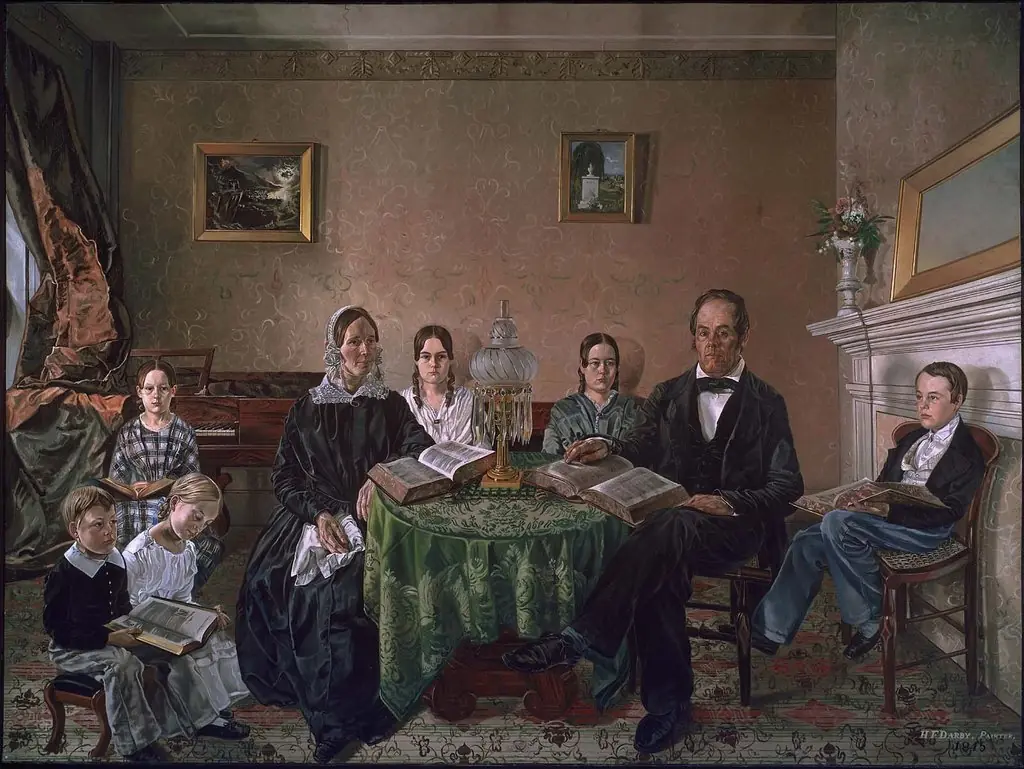 The Reverend John Atwood and His Family
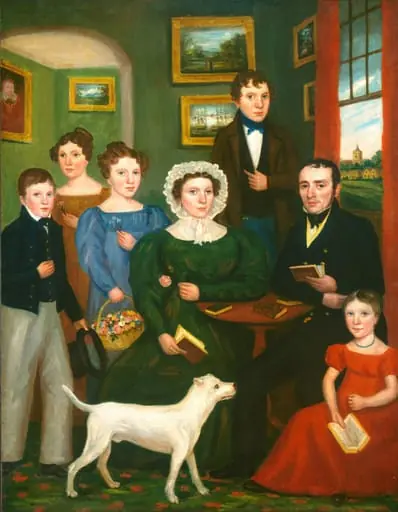 Portrait of an Unknown Family with a Terrier
 Familie cu copil
 The Nellis Children of Sherburne, New York