Artwork
Funerary Papyrus of Tayuhenutmut
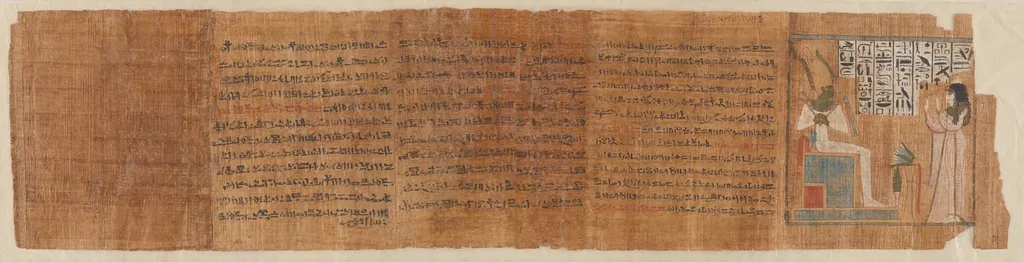
Funerary Papyrus of Tayuhenutmut is an unspecified painting by Ancient Egyptian. It dates from -1007 and is held in the collection of the Art Institute of Chicago.
- Accession no.
- 805
- Credit line
- Gift of Henry H. Getty, Charles L. Hutchinson, Robert H. Fleming, and Norman W. Harris
About this work
Overview
The Funerary Papyrus of Tayuhenutmut is a painted scroll created for a temple singer in ancient Egypt, intended to guide her soul through the afterlife. Made of papyrus with pigment, it contains selected spells and divine imagery meant to ensure safe passage and eternal existence. Such texts were commonly buried with the deceased, serving as spiritual tools rather than decorative art.
Subject & Meaning
Tayuhenutmut is depicted standing before Osiris, the god of the dead, with hands raised in worship before an offering table. This scene symbolizes her plea for divine favor and acceptance in the afterlife. The inclusion of specific spells, such as one to preserve her name, reflects the Egyptian belief that identity and memory were essential to continued existence beyond death.
Technique & Style
The papyrus was painted with mineral-based pigments in a rigid, symbolic style typical of New Kingdom funerary art. Figures are rendered in profile with hierarchical scaling, Osiris larger than the human figure, to denote spiritual importance. Text is meticulously inscribed in hieroglyphs alongside images, blending visual and verbal magic to activate the spells' power.
History & Provenance
Created during the New Kingdom, likely between 1550 and 1070 BCE, the papyrus belonged to Tayuhenutmut, a woman who served in the cult of the goddess Mut. It was buried with her, as was customary, to accompany her into the afterlife. The scroll’s survival suggests it was preserved in a dry, stable tomb environment, avoiding the decay common to organic materials.
Context
This papyrus draws from the Book of the Dead, a collection of mortuary texts that evolved during the New Kingdom. While hundreds of spells existed, individuals selected only a few tailored to their needs. Tayuhenutmut’s version reflects her status as a temple singer, emphasizing rituals and divine encounters relevant to her religious role and personal salvation.
Legacy
The papyrus remains a key example of how ancient Egyptians materialized their beliefs about death. Its preservation allows modern study of religious practices, scribal traditions, and the intersection of text and image in funerary culture. Though no longer used in rituals, it continues to inform understanding of ancient Egyptian cosmology and the human desire for continuity beyond life.

Artist & collection

 Scene from the Book of the Dead
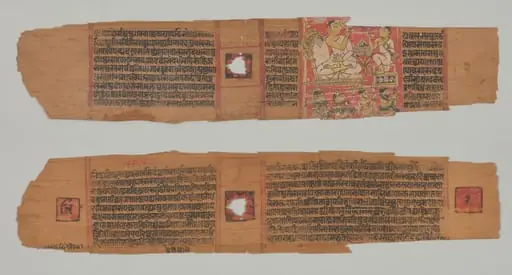 Folio 2 from a Parshvanatha Charitra (Life and Stories of Lord Parshva) of Bhavadeva-suri: Monk preaching to a disciple with a lay audience (recto); Text (verso)
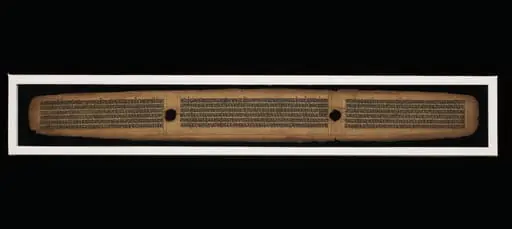 Astasahasrika Prajnaparamita
 Folio 1, from a Great Poem about Twos (Dvyashraya Mahakavya) of Hemachandra with Commentary by Abhayatilaka
 Genealogical text, folio 167 (verso) from a Kalpa-sutra and Story of Kalakacharya
 Blank leaf, folio 188 (verso), from a Manuscript of the Perfection of Wisdom in Eight Thousand Lines (Ashtasahasrika Prajnaparamita-sutra)
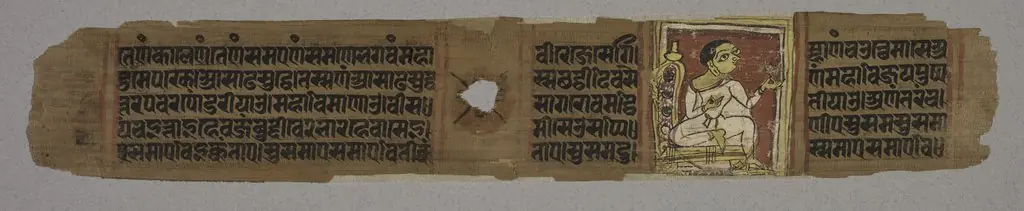 Monk Holding a Flower: Folio 2 (recto), from a Kalpa-sutra and Story of Kalakacharya
 Text, Folio 6 (recto), from a Manuscript of the Perfection of Wisdom in Eight Thousand Lines (Ashtasahasrika Prajnaparamita-sutra)
 Text, Folio 60 (verso), from a Manuscript of the Perfection of Wisdom in Eight Thousand Lines (Ashtasahasrika Prajnaparamita-sutra)
 Text, Folio 4 (verso), from a Manuscript of the Perfection of Wisdom in Eight Thousand Lines (Ashtasahasrika Prajnaparamita-sutra)
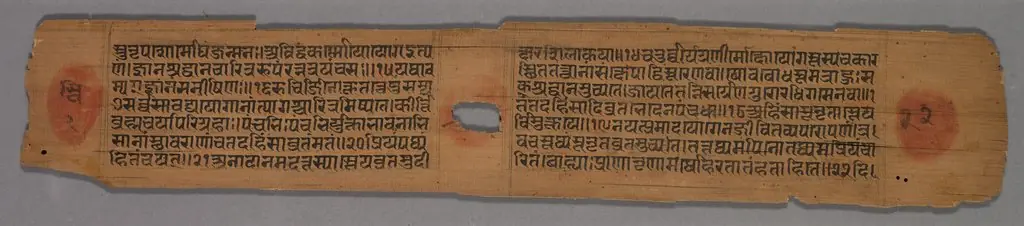 Leaf from a Jain Manuscript: Yoga-shastra: Text (recto); Leaf from a Jain Manuscript: Yoga-shastra: Jain monk with Disciple and Two Laymen, Two Nuns and a Laywoman below (verso)
- Colophon, folio 188 (recto), from a Manuscript of the Perfection of Wisdom in Eight Thousand Lines (Ashtasahasrika Prajnaparamita-sutra)