Artwork
Folio 1, from a Great Poem about Twos (Dvyashraya Mahakavya) of Hemachandra with Commentary by Abhayatilaka

Folio 1, from a Great Poem about Twos (Dvyashraya Mahakavya) of Hemachandra with Commentary by Abhayatilaka is an unspecified painting by the Indian Miniature artist Unknown. It dates from 1428 and is held in the collection of the Cleveland Museum of Art.
- Accession no.
- 1971.130
- Credit line
- Purchase from the J. H. Wade Fund
About this work
Overview
It features a devotional image of Parshva, the 23rd Jain Tirthankara, rendered in a flat, vibrant style typical of western Indian manuscript painting.
This folio opens a 15th-century illustrated manuscript of Hemachandra’s grammatical treatise, the Dvyashraya Mahakavya, accompanied by Abhayatilaka’s commentary. It features a devotional image of Parshva, the 23rd Jain Tirthankara, rendered in a flat, vibrant style typical of western Indian manuscript painting. The image serves both ritual and pedagogical functions, anchoring the text’s linguistic lessons in spiritual authority.
Subject & Meaning
Parshva, depicted in green robes and floating above a lotus with arms raised in serene gesture, represents a liberated soul in Jain cosmology. His presence at the manuscript’s outset signals the spiritual foundation of the grammatical teachings that follow. The choice of a Tirthankara underscores the Jain principle that true knowledge arises from ethical discipline and transcendence, framing the text’s linguistic analysis within a broader moral framework.
Technique & Style
The painting employs bold, unmodulated colors and sharp outlines, with no attempt at shading or spatial depth. Figures are stylized and placed against plain backgrounds, emphasizing symbolic presence over naturalism. This aesthetic reflects the conventions of medieval western Indian manuscript illumination, where clarity and devotional focus outweigh illusionistic detail, aligning with Jain artistic traditions that prioritize spiritual clarity over worldly representation.
History & Provenance
Created in the 15th century, likely in Gujarat or Rajasthan, this manuscript preserves a 12th-century grammatical work by the Jain scholar Hemachandra. Its production coincided with a revival of Jain textual scholarship under royal patronage. The painting’s style and materials suggest it was made for a learned monastic or courtly audience, intended for study and reverence rather than mass circulation.
Context
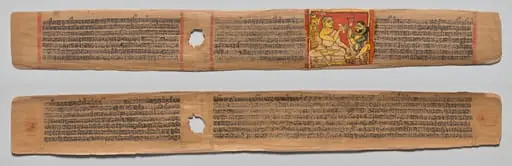
Hemachandra’s text used stories of kings to illustrate Sanskrit and Prakrit grammar, blending linguistic instruction with moral narrative. By opening with Parshva, the manuscript links grammatical precision to spiritual discipline, a core Jain value. The adjacent folio, depicting Hemachandra with his patron Kumarapala, reinforces the interdependence of religious authority and royal support in sustaining scholarly traditions during this period.
Legacy
This folio exemplifies how Jain textual culture integrated visual devotion with intellectual rigor. Its enduring presence in museum collections reflects its role as a bridge between religious practice and linguistic scholarship. The painting’s formal simplicity and symbolic clarity continue to inform modern understandings of medieval Indian manuscript art and its pedagogical functions.

Artist & collection









- Folio 2 (verso), from a Great Poem about Twos (Dvyashraya Mahakavya) of Hemachandra with Commentary by Abhayatilaka
 Leaf from a Jain Manuscript: page from a Great Poem about Twos (Dvyashraya Mahakavya) of Hemachandra, with commentary by Abhayatilaka: Text (recto)
 King Kumarapala Pays Reverence to Hemachandra: Folio 2 (recto), from a Great Poem about Twos (Dvyashraya Mahakavya) of Hemachandra with Commentary by Abhayatilaka
 Leaf from a Jain Manuscript: page from a Great Poem about Twos (Dvyashraya Mahakavya) of Hemachandra, with commentary by Abhayatilaka: Monk in the Gift-giving Gesture before a Layman (verso)
 Text, folio 22 (verso) from a Yoga-shastra of Hemachandra
 Folio 2, from a Great Poem about Twos (Dvyashraya Mahakavya) of Hemachandra with Commentary by Abhayatilaka
 Text, folio 2 (verso) from a Parshvanatha Charitra (Life and Stories of Lord Parshva) of Bhavadeva-suri
 Monk Holding a Flower: Folio 2 (recto), from a Kalpa-sutra and Story of Kalakacharya