Artwork
Madonna and Child, with a Bishop, St John The Baptist and Angels
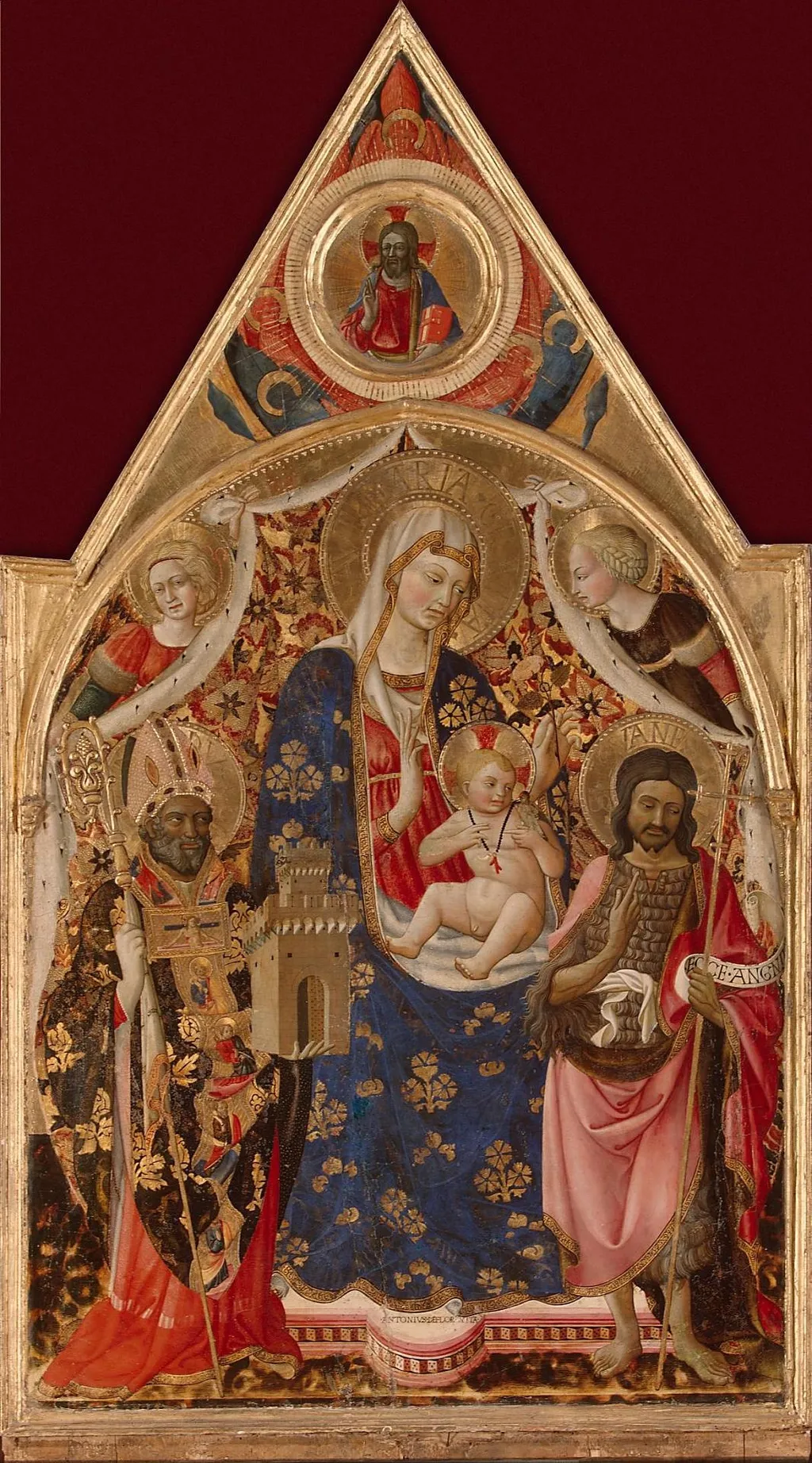
Madonna and Child, with a Bishop, St John The Baptist and Angels is a tempera painting by the Early Renaissance artist Antonio da Firenze. It dates from 1415 and is held in the collection of the Hermitage Museum.
About this work
Subject & Meaning
The stylistic mixture of Gothic and early Renaissance elements underscores its transitional character within the Florentine quattrocento.
The work portrays the Virgin Mary holding the infant Jesus together with John the Baptist and a bishop saint, arranged on a two-sided wooden panel that functioned as a procession banner. One face shows a Maestà composition with the Madonna and Child enthroned amid angels, while the reverse depicts the Crucifixion with Mary, John, and penitents, all surrounded by symbolic attributes such as a rose held by the Virgin, a coral pendant on the Child, and a mitre and crozier identifying the bishop. The iconography combines Marian devotion with intercessory saints, reflecting a votive context aimed at protection from plague and other calamities, as indicated by the presence of flagellants and the dedicatory inscription. The stylistic mixture of Gothic and early Renaissance elements underscores its transitional character within the Florentine quattrocento.
The symbolic use of coral, the golden halos incised with texts, and the inclusion of local saints convey a protective intercession narrative, while the reverse’s Crucifixion scene reinforces themes of sacrifice and communal penitence. The panel’s dual function as a religious banner and devotional image illustrates its role in public processional rites within the cultural milieu of 15th‑century Italy.
Technique & Style
The work was executed in tempera on a wooden panel, a format typical of early 15th‑century Italian religious painting. Both faces of the panel are painted, with the front presenting a Maestà that places the Virgin and Child on a throne surrounded by saints, including Saint Médard and Saint John the Baptist, while the reverse depicts the Crucifixion with Mary and John, framed by a pinacle containing an Annunciation scene. The figures are rendered with gold‑leaf backgrounds, incised golden halos, and coral pendants, and the composition retains a distinctly Gothic spatial logic, evident in the isometric treatment of space, the frontal poses of angels, and the use of symbolic attributes such as the bishop’s crozier and the martyr’s staff.
History & Provenance
The double-sided processional banner Madonna and Child, with a Bishop, St John the Baptist and Angels was commissioned for a Florentine confraternity of flagellants active during the early Quattrocento, likely the Disciplinati of Santa Maria Novella, whose penitential practices shaped the iconography. The work is dated to c. 1415 by internal records and stylistic analysis, aligning with Antonio da Firenze’s documented period of activity. Executed as a gonfalon with a pinnacle, it served as a public devotional object, invoking the Virgin and local saints, including Saint Médard, a regional intercessor patron of prisoners, as protectors during recurring plague and epidemic crises.
By the mid-nineteenth century the painting had entered the collection of the Hermitage Museum, Saint Petersburg, where it remains in the permanent holdings. Its presence in Russia is first attested by the Hermitage’s acquisition records, though the precise earlier provenance prior to museum entry is not documented in accessible sources.
The work is held in the collection of the Hermitage Museum in Saint Petersburg, Russia. It is identified as a painting by Antonio da Firenze, created around 1415 on a wooden panel. The piece originally functioned as a double-sided processional banner, or gonfalon, featuring a depiction of the Madonna and Child with saints on one side and a Crucifixion on the reverse.
While the sources confirm the museum's current custody and the artwork's identity as a processional banner, they do not provide a specific inventory or accession number. Furthermore, no details regarding the painting's exhibition history are recorded in the provided texts.
Context
Created by Antonio da Firenze around 1415, this double-sided tempera panel functioned as a votive gonfalon for processional use, likely commissioned by a confraternity of flagellants. Although produced during the early Quattrocento, the work exhibits a distinct stylistic synthesis, retaining Gothic architectural framing and Byzantine iconographic traits such as almond-shaped eyes, incised golden halos, and the Christus patiens posture. The composition utilizes inverse perspective in elements like the tower held by Saint Médard and the throne, creating a symbolic rather than unified spatial depth.
This deliberate archaism served a specific devotional purpose: invoking the Virgin and local saints as intercessors against divine wrath and epidemics. The piece stands as a significant example of Florentine religious art that bridges medieval traditions with early Renaissance functionalism, currently held in the Hermitage Museum.
Overview
Antonio da Firenze’s tempera panel, painted in 1415, presents a devotional scene centered on the Virgin Mary cradling the infant Christ. Flanking her are a dignified bishop holding a book, a youthful Saint John the Baptist with a lamb, and two attendant angels. The composition rests on a richly gilded throne, its base adorned with a miniature castle motif, and bears an inscription at the lower edge.
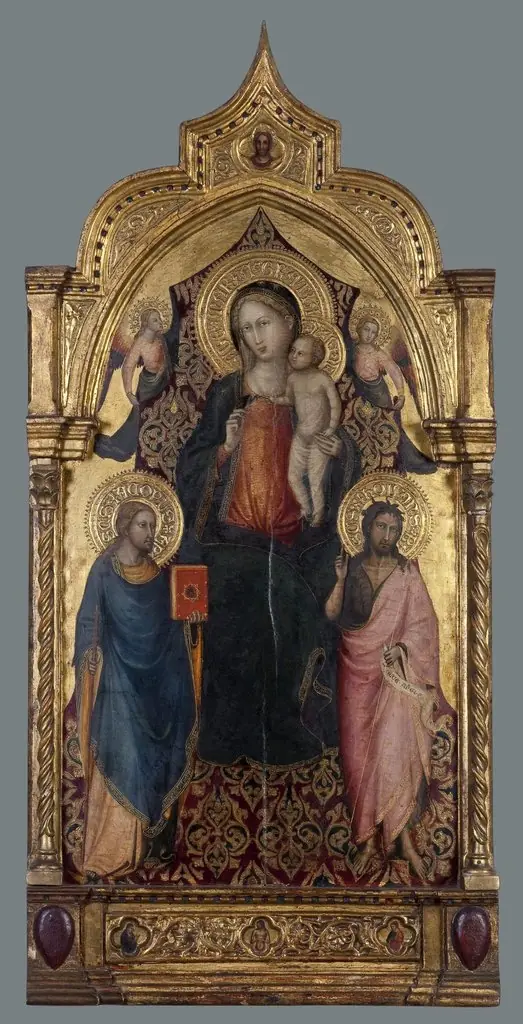
Artist & collection
Artist
A 15th-century Italian painter working in tempera panels, Antonio da Firenze made altar pieces full of bright colors and delicate gold patterns.

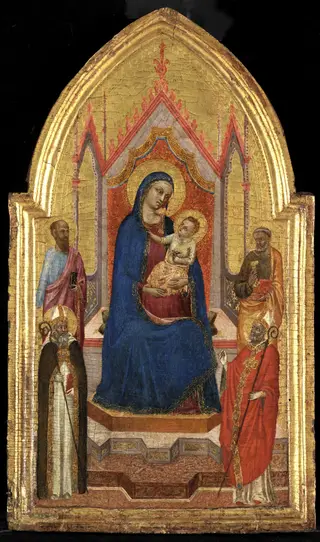 Madonna and Child Enthroned with Four Saints
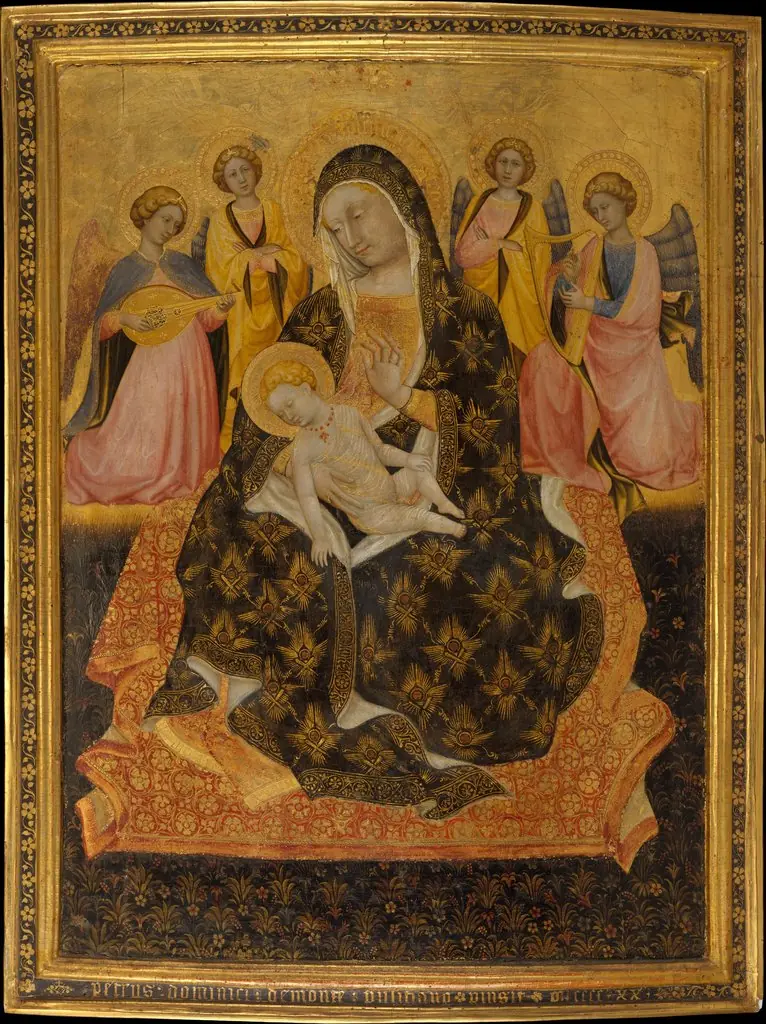 Madonna and Child with Angels
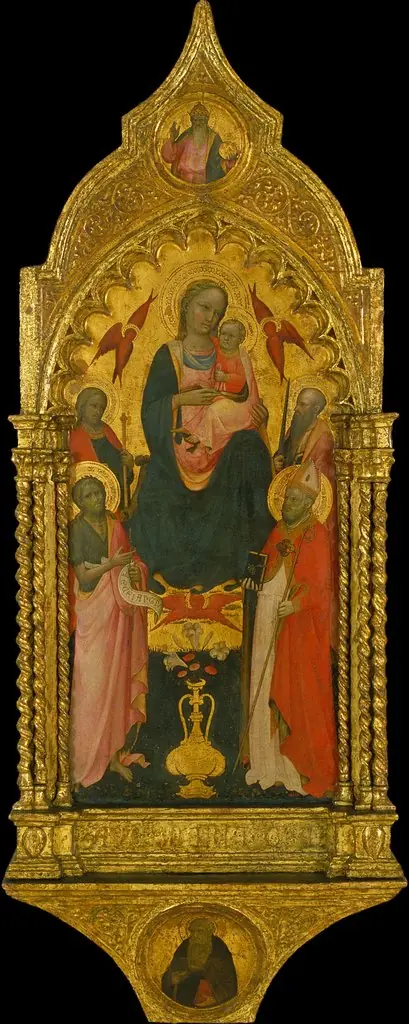 Virgin and Saints
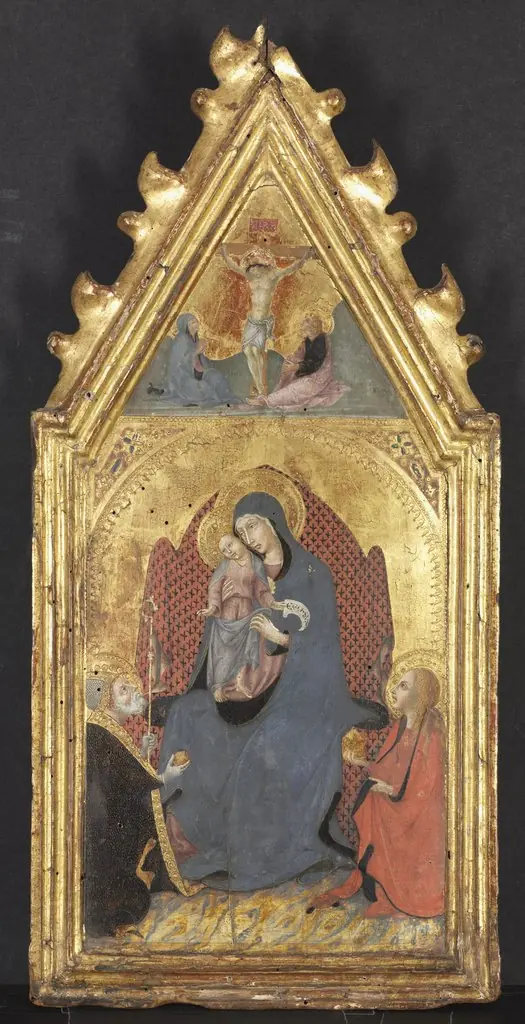 Virgin and Child Adored by Saints Mary Magdalene and Nicolas of Bari; Christ Crucified with the Virgin and Saint John the Evangelist
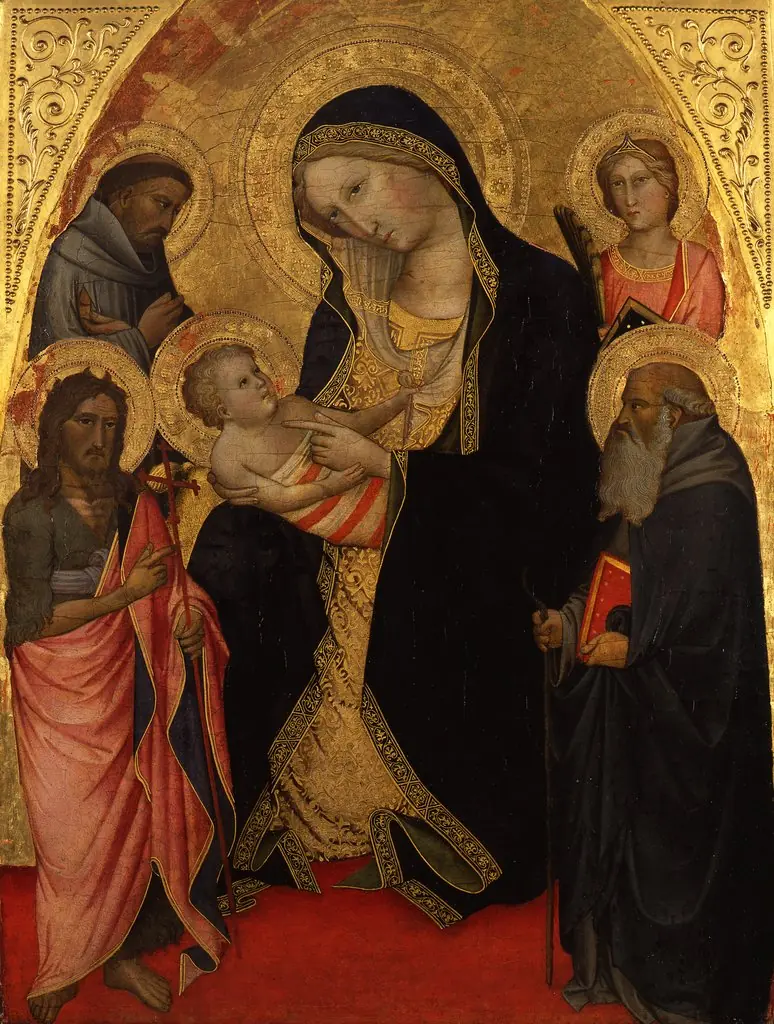 Madonna with the child, St. John the Baptist, St. Francis and St. Anthony and a martyr
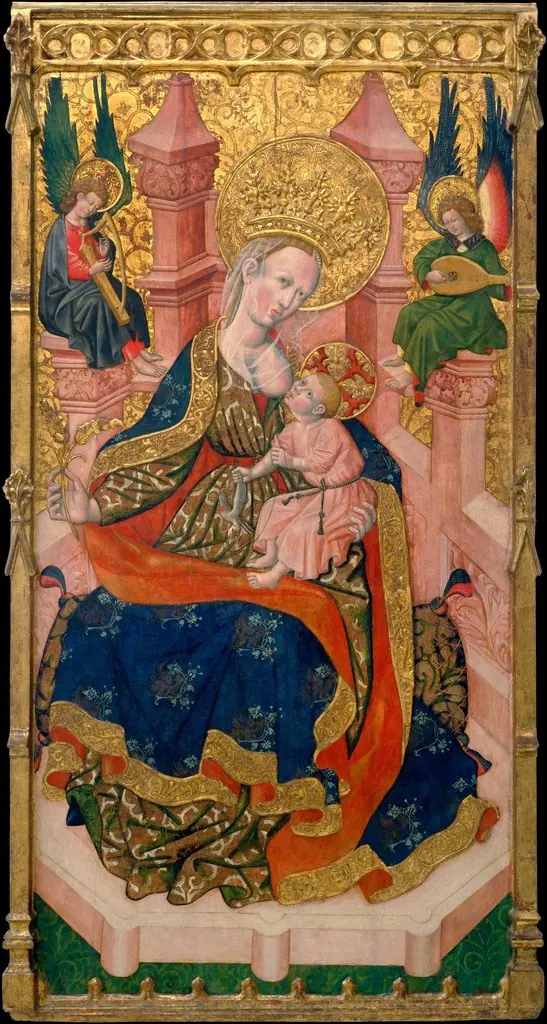 Virgin Suckling the Child
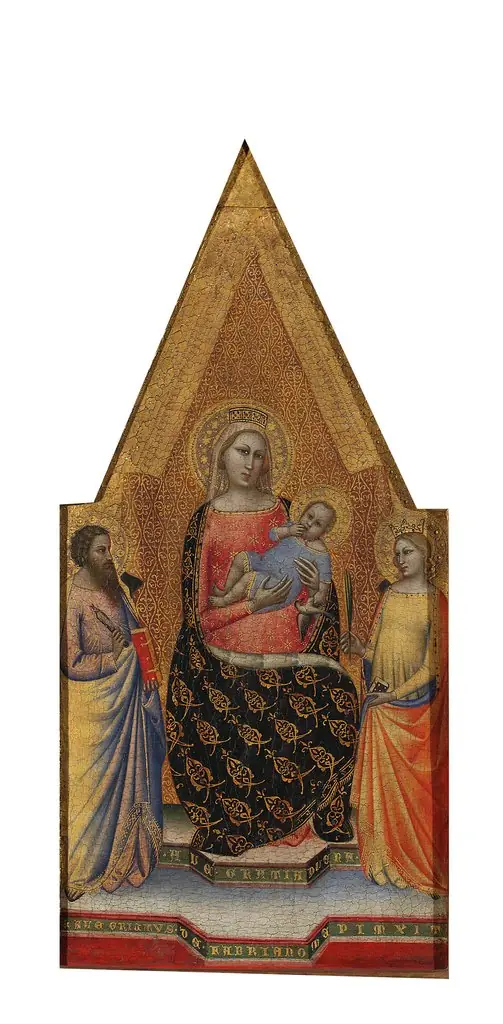 Madonna and Child enthroned with two Saints, Crucifixion
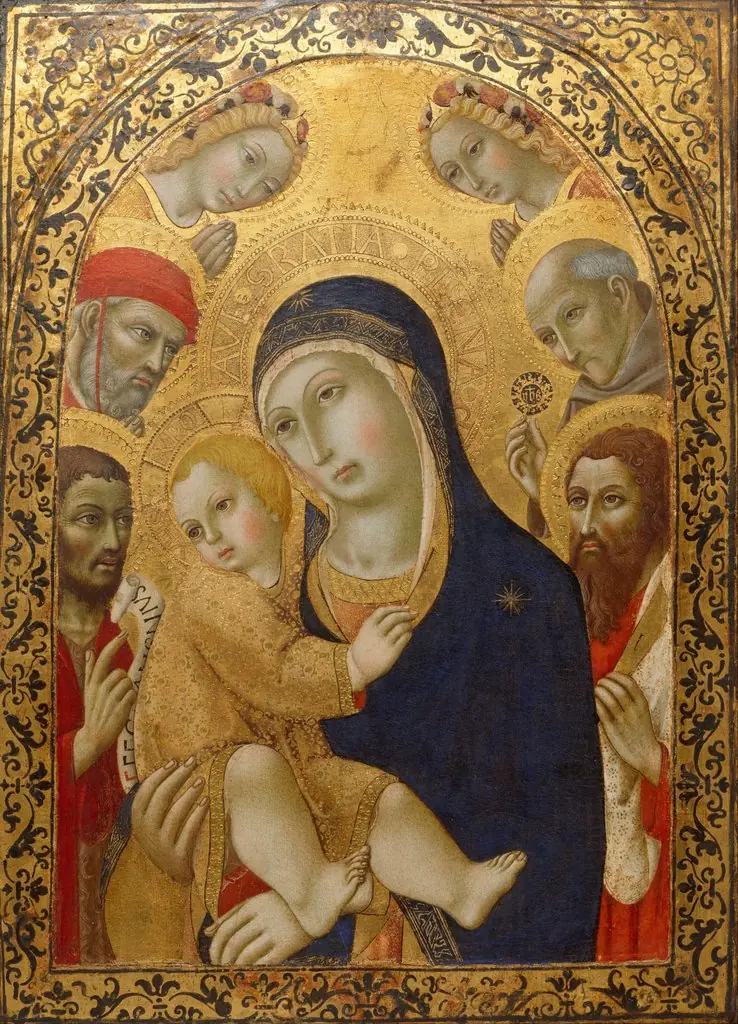 Madonna and Child with Saints Jerome, John the ...
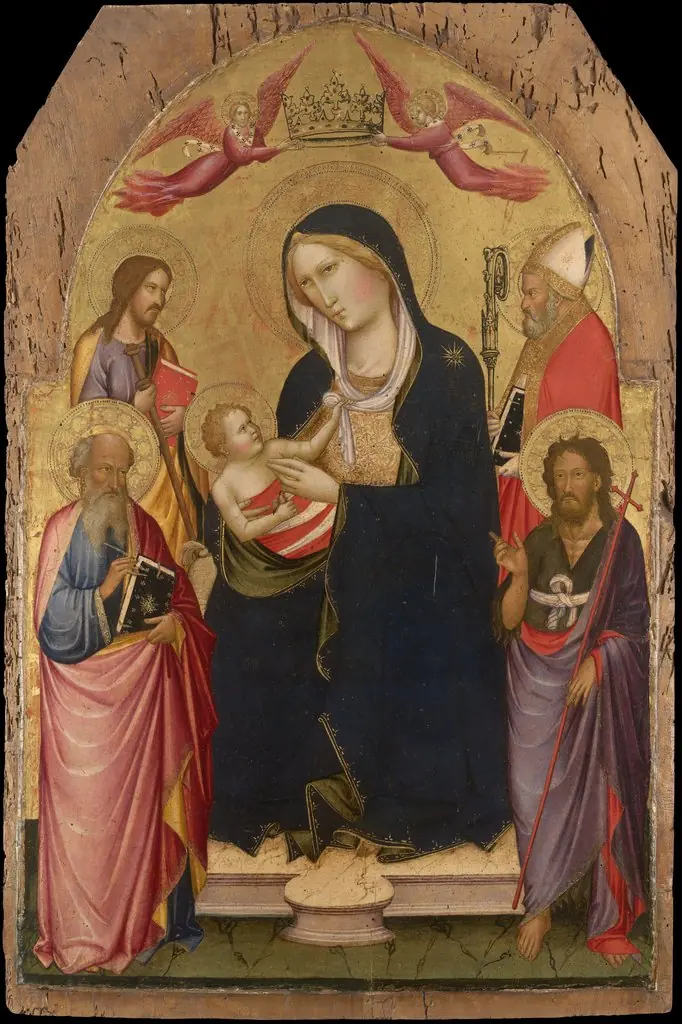 Madonna and Child with SS. John the Evangelist,John the Baptist, James of Compostela and Nicholas of Bari
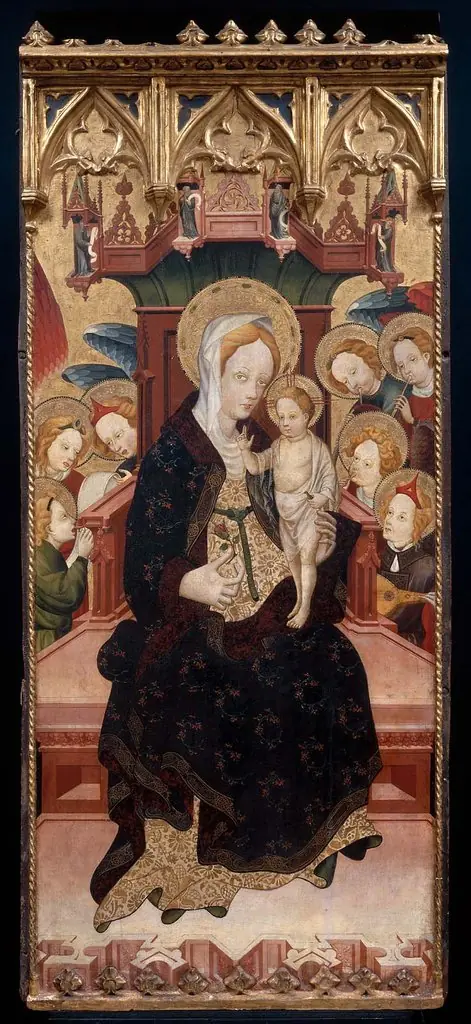 Virgin and Child Enthroned