Artwork
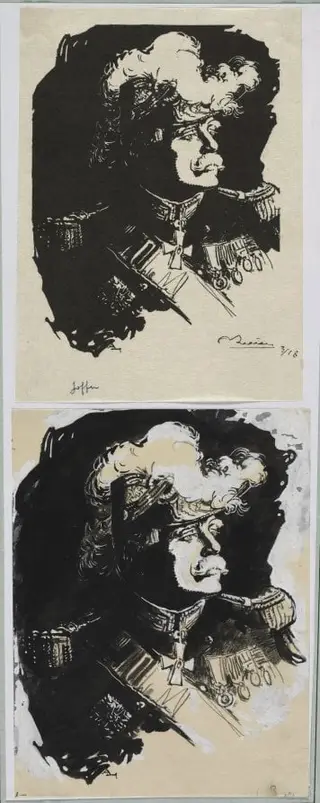
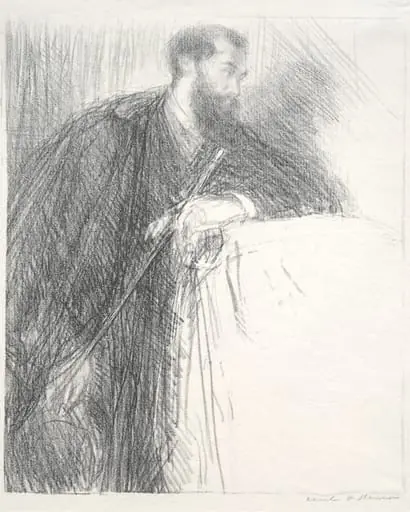
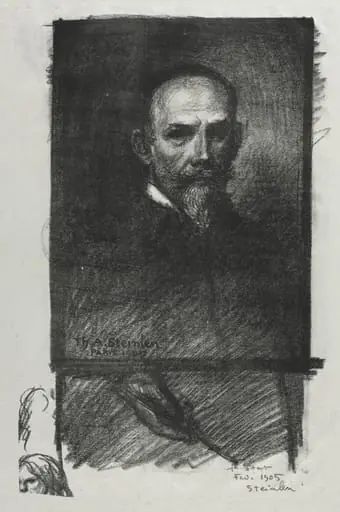
Général de Castelneau
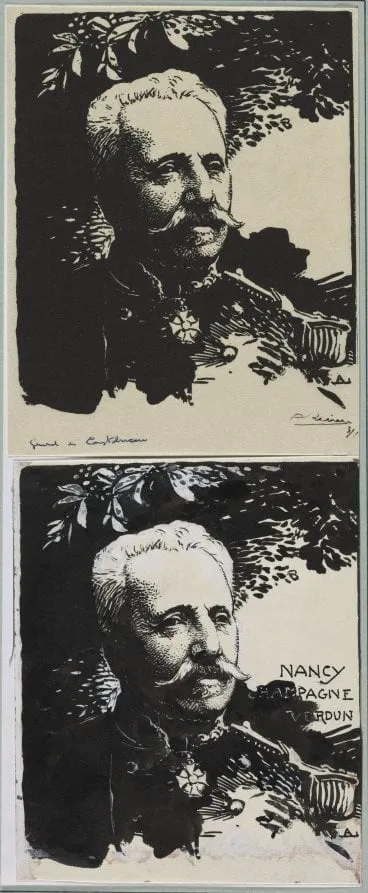
Général de Castelneau is a drawing by Auguste Louis Lepère. It dates from 1914 and is held in the collection of the Cleveland Museum of Art.
- Accession no.
- 1974.158
- Credit line
- Delia E. Holden Fund
About this work
Overview
Executed in a refined graphic style, the work belongs to the Cleveland Museum of Art’s collection and exemplifies Lepère’s mastery of wood engraving techniques.
Created in 1914 by French artist Auguste Louis Lepère, this black-and-white drawing depicts General de Castelneau, a military figure of the era. Executed in a refined graphic style, the work belongs to the Cleveland Museum of Art’s collection and exemplifies Lepère’s mastery of wood engraving techniques. Though modest in scale, the portrait conveys authority through careful tonal control and precise linework, reflecting the artist’s broader commitment to printmaking revival in early 20th-century Europe.
Subject & Meaning
The subject is General de Castelneau, identified by his military uniform and decorated chest, suggesting distinguished service. His serious expression and steady gaze convey gravitas, typical of formal portraiture in wartime contexts. The leafy branches framing his head may symbolize honor or continuity, though no explicit allegory is documented.
The inclusion of his name and signature anchors the image as a record of identity, aligning with the era’s tradition of honoring military leadership through visual documentation.
Technique & Style
Lepère employed stark contrasts of light and shadow, leveraging chiaroscuro to model the general’s features with clarity and depth. Fine, controlled lines define the texture of uniform, beard, and glasses, while the background foliage is rendered with loose, rhythmic strokes that contrast the subject’s rigidity. The absence of tone gradation beyond black and white emphasizes structure over realism, characteristic of wood engraving’s graphic economy and Lepère’s disciplined approach to the medium.
History & Provenance
The drawing entered the Cleveland Museum of Art’s collection as part of its broader acquisition of modern European prints. While specific details of its creation and early ownership are not widely recorded, its date, 1914, places it near the outbreak of World War I, a time when Lepère was actively engaged in printmaking circles. The work’s preservation in a major institution underscores its recognition within the context of early 20th-century French graphic art.
Context
Lepère was a central figure in the revival of wood engraving in France, advocating for the technique as a legitimate art form alongside painting and lithography. During this period, portraiture in print remained a respected genre, particularly for depicting public figures. This drawing reflects a broader cultural interest in documenting military leaders as national symbols, even as the medium itself was being redefined by artists seeking precision and expressive simplicity.
Legacy
Though not among Lepère’s most widely reproduced works, this portrait exemplifies his technical discipline and commitment to printmaking’s potential for dignified representation. It contributes to the historical record of how military figures were visually memorialized in the early 20th century, and it remains a quiet testament to the enduring value of handcrafted graphic art in an age of increasing mechanical reproduction.
Artist & collection

Artist
Louis-Auguste Lepère (30 November 1849 – 20 November 1918) was a French painter and etcher. Lepère is also considered a leader in the creative revival of wood engraving in Europe.