Artwork
Moret - Le moulin à tan
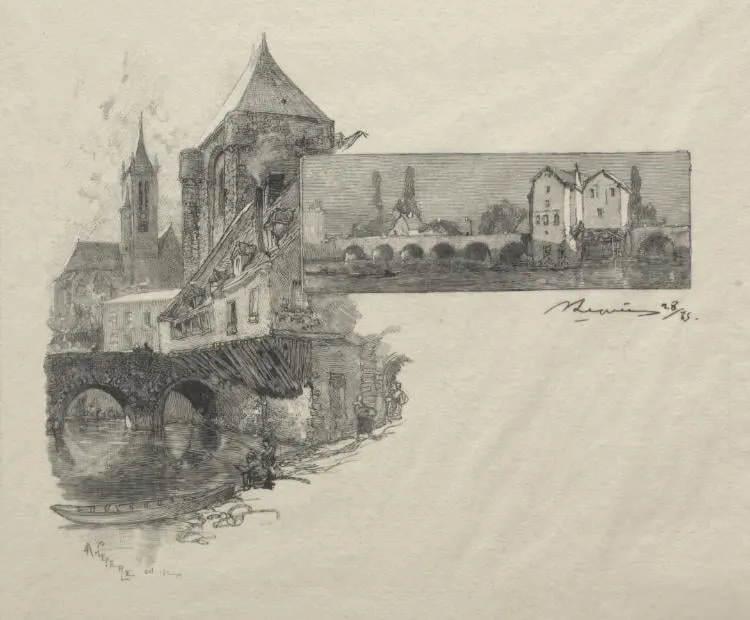
Moret - Le moulin à tan is a print by the Impressionist artist Auguste Louis Lepère. It dates from 1889 and is held in the collection of the Cleveland Museum of Art.
- Accession no.
- 1921.1387
- Credit line
- Gift of Leonard C. Hanna Jr.
About this work
Overview
Lepère, a key figure in the revival of wood engraving as a fine art medium, used precise incisions to render light, texture, and spatial depth.
Created in 1889 by French artist Auguste Louis Lepère, Moret - Le moulin à tan is a wood engraving that captures a quiet rural scene in the village of Moret-sur-Loing. Lepère, a key figure in the revival of wood engraving as a fine art medium, used precise incisions to render light, texture, and spatial depth. The work belongs to the collection of The Cleveland Museum of Art and exemplifies his commitment to elevating printmaking through technical rigor and observational clarity.
Subject & Meaning
The scene depicts a modest riverside settlement centered on a tannery mill, a functional structure used to grind tree bark for leather production. Flanking it are a stone bridge, a slender tower likely part of a church, and a small dwelling across the water. Lepère avoids romanticism, presenting these structures as integral to daily life.
The focus on utilitarian architecture underscores the dignity of ordinary labor and the quiet rhythm of provincial existence.
Technique & Style
Lepère employed wood engraving, carving fine lines into the end grain of boxwood to achieve subtle tonal gradations. The composition relies on controlled contrasts of black and white, with soft hatching suggesting atmospheric depth and the play of light on stone and water. Forms are simplified, details minimized, and perspective flattened to emphasize structure over ornament. This restrained approach aligns with the principles of Realism, prioritizing truth to observed reality over idealization.
History & Provenance
The print was made during a period when Lepère was actively promoting wood engraving as a legitimate artistic medium in France, countering the dominance of photographic reproduction. It entered The Cleveland Museum of Art’s collection through established acquisition channels in the early 20th century, reflecting the museum’s early interest in European graphic arts. Its provenance remains unbroken, with no record of significant ownership changes beyond institutional custody.
Context
In late 19th-century France, artists increasingly turned to rural subjects as industrialization reshaped urban life. Lepère’s work resonated with broader movements like Realism and the Barbizon School, which valued honest depictions of the countryside. His choice of Moret, a village known for its artisanal trades, reflected a cultural interest in preserving the visual memory of traditional crafts before they vanished under modernization.
Legacy
Lepère’s prints, including this one, helped redefine wood engraving as a medium for artistic expression rather than mere illustration. His technical precision and commitment to everyday subjects influenced a generation of printmakers in Europe and beyond. Though less widely known today, his contributions remain foundational to the revival of handcrafted printmaking in the modern era.
Artist & collection

Artist
Louis-Auguste Lepère (30 November 1849 – 20 November 1918) was a French painter and etcher. Lepère is also considered a leader in the creative revival of wood engraving in Europe.

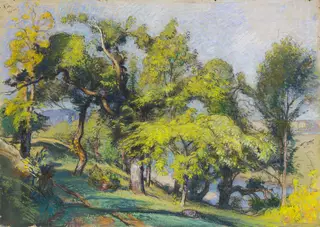
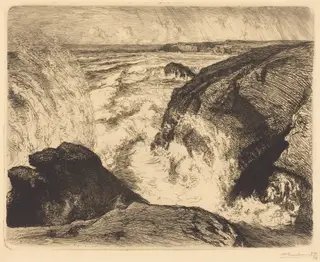
- Worth: A Lane
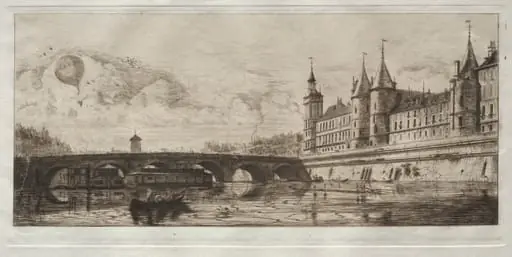 Le Pont-au-Change
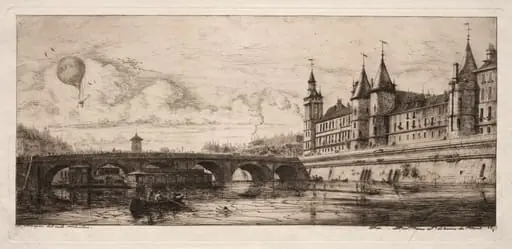 Etchings of Paris: The Exchange Bridge
 St. Julien le Pauvre: Le Presbytère
 Gaube
Gaube Selection of Twenty of the Most Picturesque Views in Paris:View of Pont au Change
 A Selection of Twenty of the Most Picturesque Views in Paris: View of Pont au Change, the City Theatre, Pont Neuf, Conciergerie Prison, and taken from Pont Notre Dame
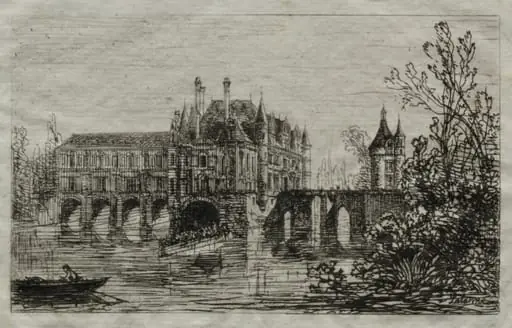 Château de Chenonceau
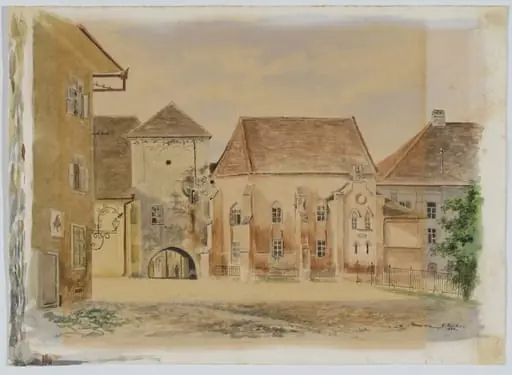 Capela Sf. Jakob și Turnul preoților
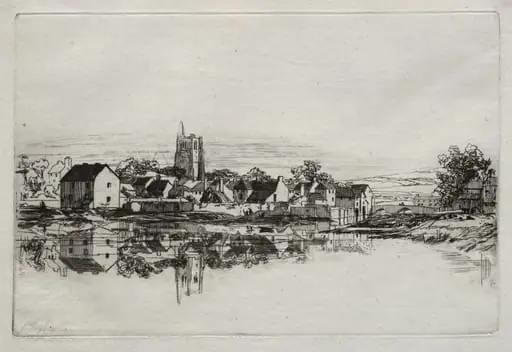 Kidwelly Town
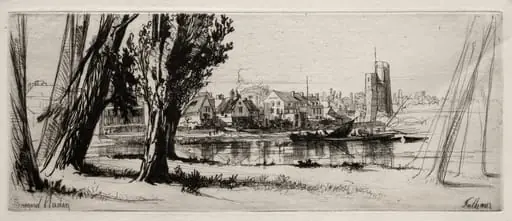 Fulham
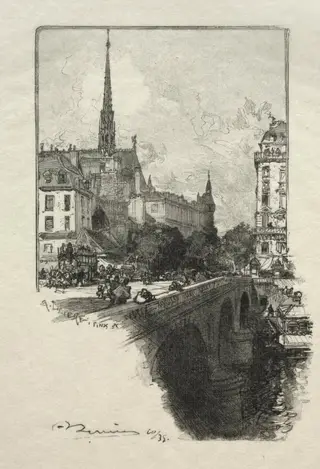 Le Pont St. Michel