Artwork
Feast of Herod with the Beheading of St John the Baptist
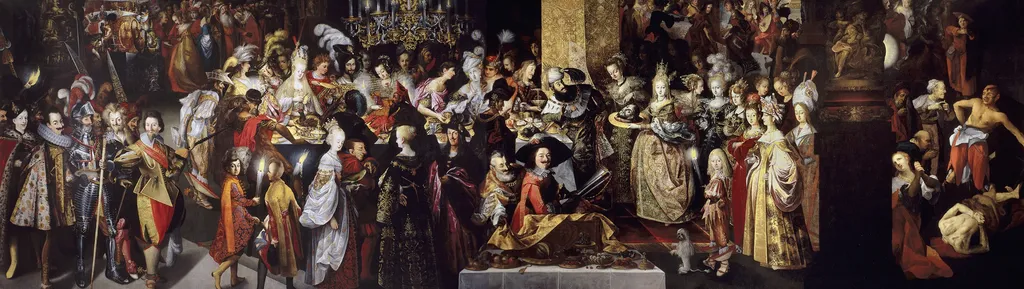
Feast of Herod with the Beheading of St John the Baptist is an oil painting by the Flemish Baroque painting artist Bartlomiej Strobel. It dates from 1630 and is held in the collection of the Museo del Prado. Bartholomeus Strobel the Younger’s monumental canvas, measuring roughly 2.
About this work
Subject & Meaning
The Feast of Herod with the Beheading of St John the Baptist depicts two moments from the biblical narrative of John the Baptist's death: the banquet of Herod Antipas where Salome presents the severed head, and the separate execution scene placed to the right of a dividing column. Symbolically, the work functions as an allegory for the suffering of Silesia during the Thirty Years' War, with the severed head of John the Baptist, rendered in the likeness of Duke John Christian of Brieg, referencing Strobel's lost homeland. The painting incorporates numerous portraits of contemporary European political and military figures, including representatives from Saxony, France, England, Spain, and the Dutch Republic, reflecting the broader European context of the conflict. Interpretations of the allegory emphasize a plea for Christian unity to save a war-torn region, using the banquet setting to juxtapose indifference with the dramatic presentation of martyrdom.
Technique & Style
Many costumes are rendered in precise detail, though the fashions range from 1630s French styles to Polish dress, with some purely fanciful elements.
The work is executed in oil on canvas, an exceptionally large support measuring 2.80 by 9.52 metres. Strobel divides the composition with a column, placing the banquet scene on the left and relegating the much smaller beheading scene to the right, pushing this traditional bipartite arrangement to an extreme. The style of the figures varies markedly within a single group, mixing realistic portraiture with generalized, idealized faces, particularly among the women, and expressive caricature. Many costumes are rendered in precise detail, though the fashions range from 1630s French styles to Polish dress, with some purely fanciful elements. Two boys at the left end of the table wear Polish styles, including a distinctive szkofia three-plumed hat badge and a curved szabla sabre, while a figure behind them wears the modified Roman military uniform typical of goddesses and allegorical figures in Northern Mannerism. The mixture of facial types and clothing recalls northern Passion paintings of the fifteenth and sixteenth centuries, with echoes of the fantastical style of the printmaker Jacques Bellange.
History & Provenance
The painting is dated between about 1630 and 1643, with technical files at the Museo del Prado listing c. 1630. Provenance research links the work to Elbing in the early 1640s, where it was likely commissioned by Gerhard and Margarethe von Dönhoff, Silesian nobles connected to the court of Władysław IV Vasa. An alternative hypothesis proposes Władysław IV himself as the patron, given Strobel’s appointment as court artist in 1639. Earlier attributions suggest a commission from Charles Ferdinand Vasa, prince-bishop of Breslau, before Strobel left the city in 1634. By the nineteenth century the canvas was in the Spanish royal collection, recorded under Philip V, Elisabeth Farnese, Charles III, and Ferdinand VII, and subsequently transferred to the Museo del Prado in Madrid, where it remains.
The painting is held by the Museo del Prado in Madrid, where it is currently displayed. According to the Prado's own catalogue entry, the work is dated between 1630 and 1633, earlier than some alternative scholarly datings.
Wikidata records the painting as part of the Museo del Prado collection and lists associated locations including the Royal Palace of Aranjuez and the Royal Palace of La Granja de San Ildefonso, suggesting it has been held in royal Spanish collections. Provenance traced through ownership records includes Philip V of Spain, Elisabeth Farnese, Charles III of Spain, and Ferdinand VII of Spain, indicating the work passed through successive Spanish royal collections before entering the Prado.
No specific temporary loan exhibitions or travelling shows are documented in the available sources.
Legacy
The painting’s allegorical ambition and crowded gallery of contemporary European leaders have made it a touchstone for interpretations of mid-seventeenth-century political and religious tensions. Scholars read the work as a plea for Silesia’s deliverance during the Thirty Years’ War, aligning the city of Breslau’s heraldic device of John the Baptist’s head with Strobel’s own displacement after 1634. Its monumental scale and synthesis of biblical narrative with identifiable portraits, ranging from Wallenstein and his circle to figures such as Maarten Tromp and Charles I of England, have cemented its status as a visual manifesto of the era’s conflicts. The Prado’s sustained display has entrenched the composition in Spanish royal collections since at least the eighteenth century, reinforcing its canonical place in the museum’s holdings and in broader narratives of European Baroque allegory.
Artist & collection
Artist
Bartholomeus Strobel the Younger or Bartholomäus in German or Bartlomiej in Polish (11 April 1591 (baptised) – after 1650) was a Baroque painter from Silesia, who worked in Prague, Silesia, and finally Poland, where he…

 Elegant company drinking in an interior
 The Senses of Hearing, Touch and Taste
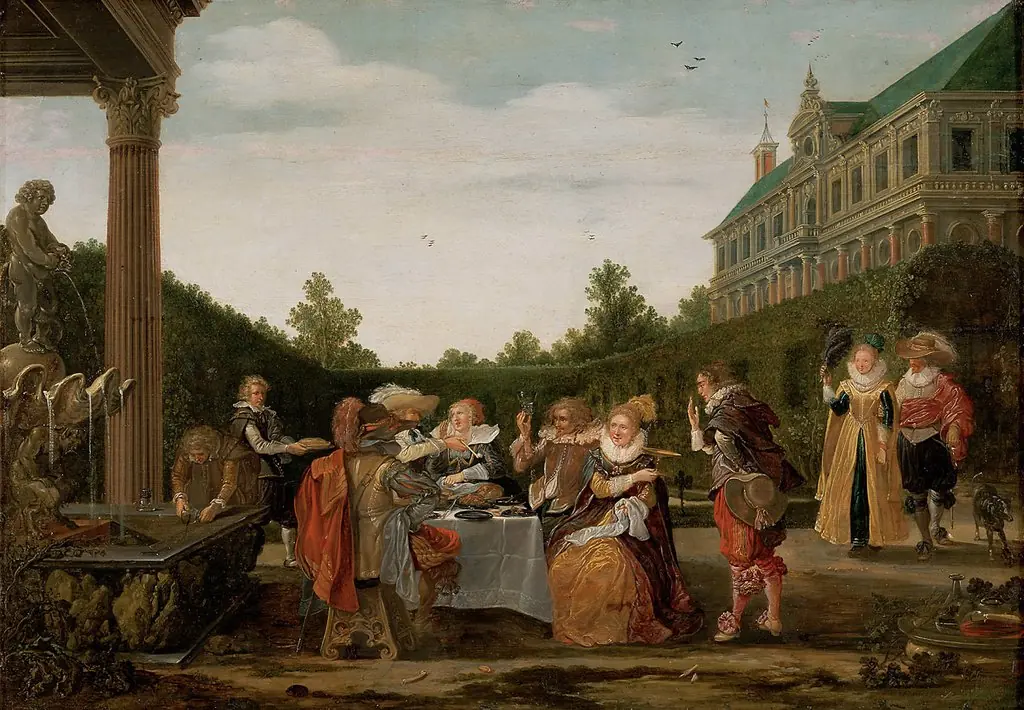 Banquet in a palatial garden, with an elegant company drinking and in conversation
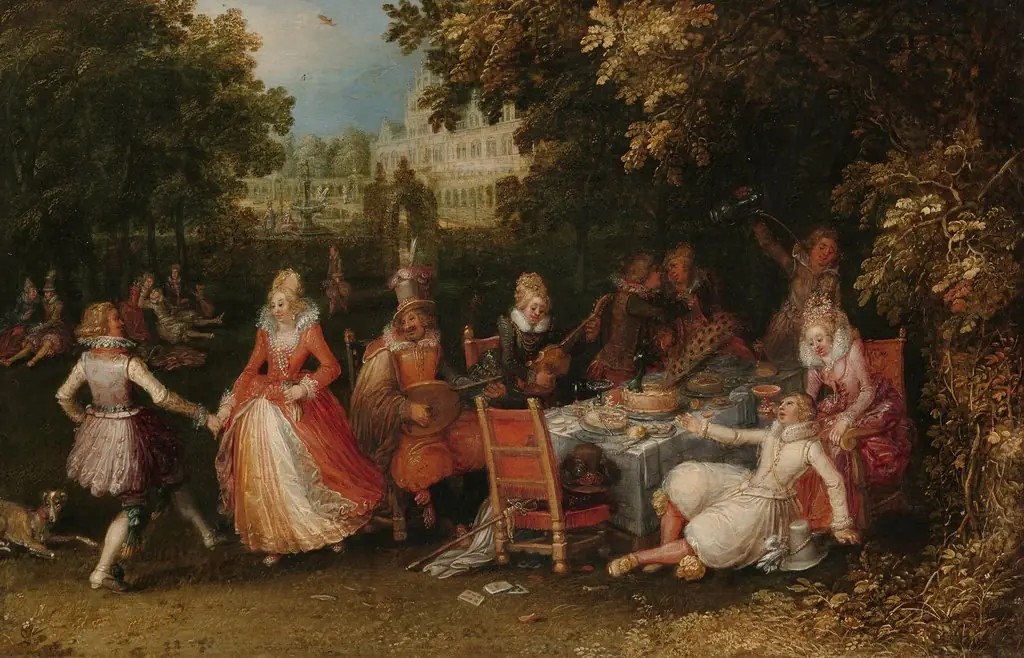 The fête champêtre
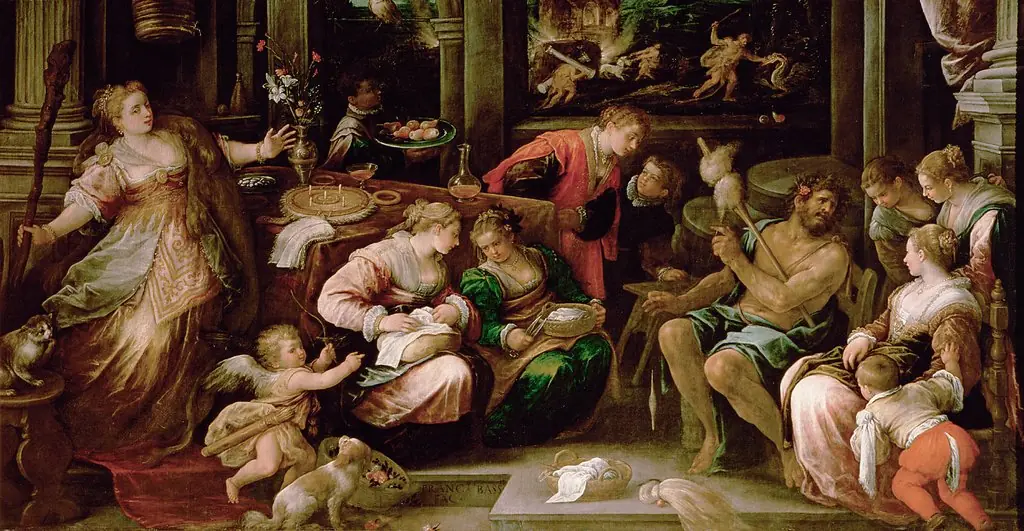 Herkules und Omphale
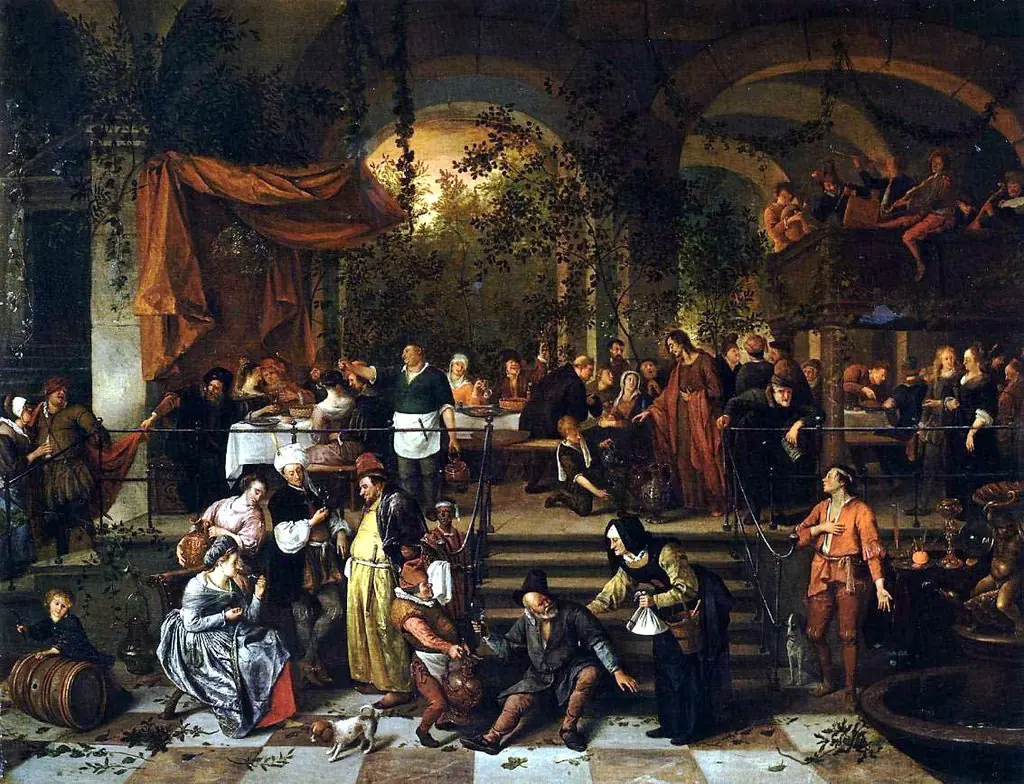 Marriage at Cana
 The Wedding at Cana
 The Wedding at Cana
 Banquet in the Park
 Wedding feast of Grand Duke Ferdinand I of Tuscany (1549-1609)