Movement
Northern Mannerism
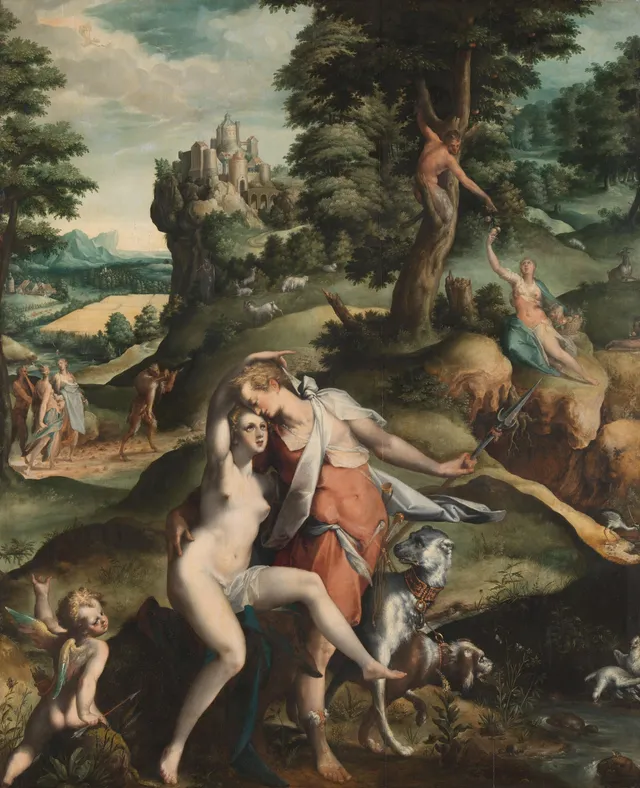
Northern Mannerism is an art movement. The gallery holds 1 work in this movement, including works by Bartholomeus Spranger and Hans Rottenhammer. Browse Northern Mannerism paintings, portraits, pictures and artworks from the world's public-domain museum collections.
Northern Mannerism was the late-sixteenth-century flowering of the Italian Mannerist style north of the Alps, an art of deliberate artifice, elongated grace, and erudite eroticism that took root above all at princely courts and in the cities of the Low Countries. Where the earlier School of Fontainebleau had carried Italian forms into France, the movement's most concentrated phase emerged in the 1580s, fed by Netherlandish artists returning from Rome and by the migration of painters out of Antwerp after its fall to Spain in 1585. Two centres dominated: the cosmopolitan court of the Holy Roman Emperor Rudolf II in Prague, and the Dutch city of Haarlem, where a remarkable group briefly converged.
The style is defined by its self-conscious virtuosity. Figures are elongated and arranged in spiralling, off-balance poses—the so-called figura serpentinata—their anatomy stretched, twisted, and shown from improbable angles, often with a nude seen from behind. Smooth, gleaming flesh, crowded and complex compositions, and a cool decorative sensuality take priority over naturalism. Mythological and biblical subjects became pretexts for displays of the nude in motion, prized by learned collectors who valued ingenuity and difficulty as marks of artistic genius.
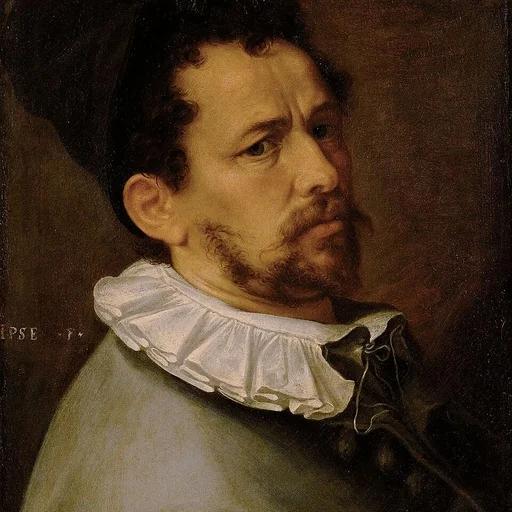
The pivotal figure was the Flemish painter Bartholomeus Spranger (1546–1611), court artist to Rudolf II, whose sensual, elegant manner became the movement's template; the catalogue's Venus and Adonis exemplifies his refined erotic mythologies. In 1585 the painter and theorist Karel van Mander carried Spranger's drawings to Haarlem, where he, the brilliant engraver Hendrick Goltzius, and Cornelis Cornelisz. van Haarlem (1562–1638) formed an influential circle. Goltzius's reproductive prints after Spranger, made around 1585–1590, broadcast the style across Europe, while Cornelis produced its boldest canvases, such as the writhing Massacre of the Innocents. Joachim Wtewael carried the manner to Utrecht, and the German Hans Rottenhammer (1564–1625), also represented in the collection, worked a related vein of small cabinet mythologies.
The movement was as brief as it was intense. By the 1590s its leading practitioners, Goltzius and Cornelis among them, were already turning toward a calmer naturalism that anticipated the Dutch Golden Age and the Baroque. Van Mander codified its ideals in his Schilder-boeck of 1604, and Spranger's example fed directly into Rubens, ensuring that this last, exquisite phase of Mannerism shaped the art that supplanted it.
Key artists
Works
Frequently asked questions
What is Northern Mannerism?
Northern Mannerism is an art movement. The Mannerist style as practiced north of the Alps — in the Habsburg Netherlands, Germany, and Prague — from the late 16th century.
Who are the key Northern Mannerism artists?
Key Northern Mannerism artists in the collection include Bartholomeus Spranger and Hans Rottenhammer.
Where can I see Northern Mannerism works?
Northern Mannerism works in the collection are held by Rijksmuseum.