Artwork
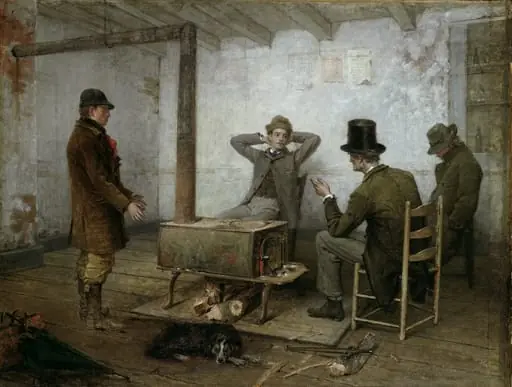
Nearing the Issue at the Cockpit
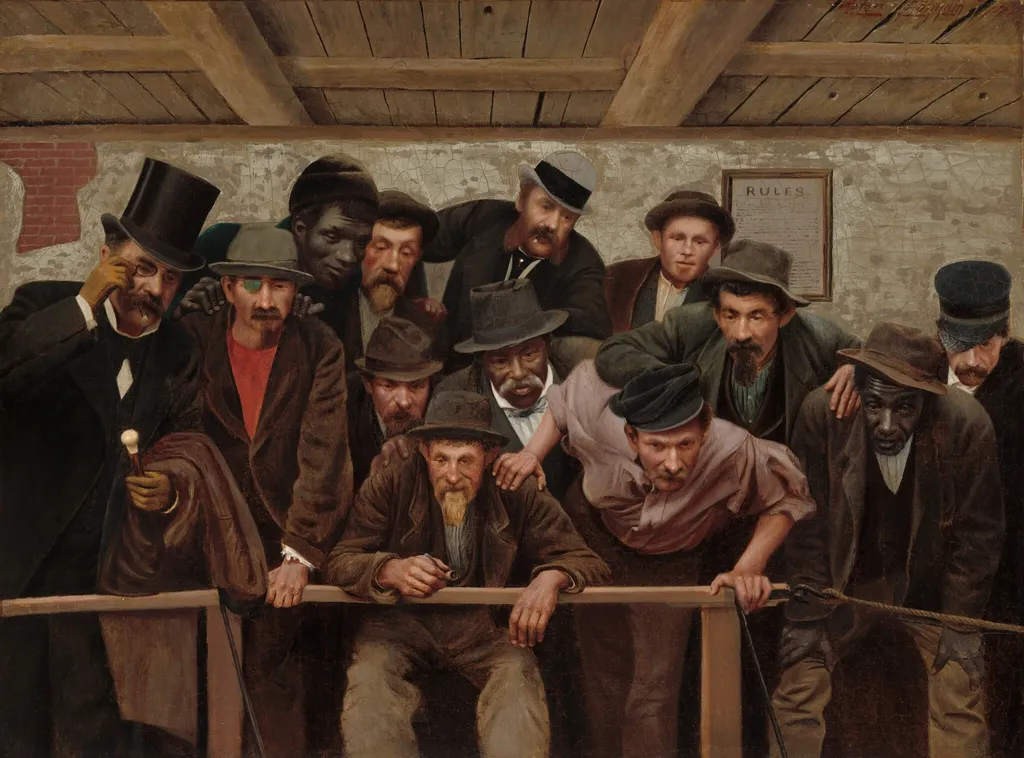
Nearing the Issue at the Cockpit is an oil painting by the Impressionist artist Horace Bonham. It dates from 1879 and is held in the collection of the National Gallery of Art.
- Inscription
- Inscribed:upper right: Horace Bonham / 79-
About this work
Subject & Meaning
As a work of American genre painting, it observes a popular 19th-century pastime and the human drama of the crowd.
The painting depicts a group of spectators gathered around a cockpit, a cockfighting arena, at a moment of heightened anticipation as a match nears its decisive turn. Rather than the birds themselves, Bonham focuses on the varied faces and expressions of the onlookers, presenting a cross-section of character types absorbed in the contest. As a work of American genre painting, it observes a popular 19th-century pastime and the human drama of the crowd. The work is held in the collection of the National Gallery of Art, Washington, D.C.
Technique & Style
Horace Bonham's Nearing the Issue at the Cockpit (1879) is executed in oil paint on a canvas support. The work measures 51.1 cm in height and 68.6 cm in width. Historical records indicate the painting suffered from a cracked condition as early as December 1896, a factor that reportedly caused collector Thomas B. Clarke to hesitate before acquiring the piece.
Despite this physical deterioration, the work remained in circulation, appearing in a January 1898 exhibition of loaned paintings at the Union League Club. The painting is currently held by the National Gallery of Art in Washington, D.C.
History & Provenance
The painting was created in 1879 by Horace Bonham. It descended to the artist's wife, Rebekah Lewis Bonham, who retained it until it was purchased between 1896 and 1898 by New York collector Thomas B. Clarke. Clarke lent the work in January 1898 to an exhibition of loaned paintings at the Union League Club.
The painting was later sold at the American Art Association, New York, 14–18 February 1899, lot 232, before entering the Corcoran Gallery of Art. In 2014 the National Gallery of Art, Washington, acquired it from the Corcoran Gallery of Art, where it is held under accession number 2014.13.3.
Context
Nearing the Issue at the Cockpit is regarded as a characteristic example of Horace Bonham's genre painting, valued for its closely observed crowd of spectators. Its provenance, from the artist's widow, Rebekah Lewis Bonham, to Thomas B. Clarke, the 1899 sale, the Corcoran Gallery of Art, and finally the National Gallery of Art in 2014, reflects the work's passage through significant American collections. The painting is discussed within the broader tradition of nineteenth-century American genre and realist painting.
Overview
Horace Bonham’s 1879 oil on canvas, Nearing the Issue at the Cockpit, depicts a cramped interior populated by a heterogeneous group of men. The figures stand behind a low railing, gazing outward toward an unseen focal point. Overhead, exposed wooden beams frame the scene, while a wall-mounted sign reading “Rules” adds a hint of institutional order.
Own this work as a print
Artist & collection