Artwork
East Indian Lotus (Nelumbo nucifera)
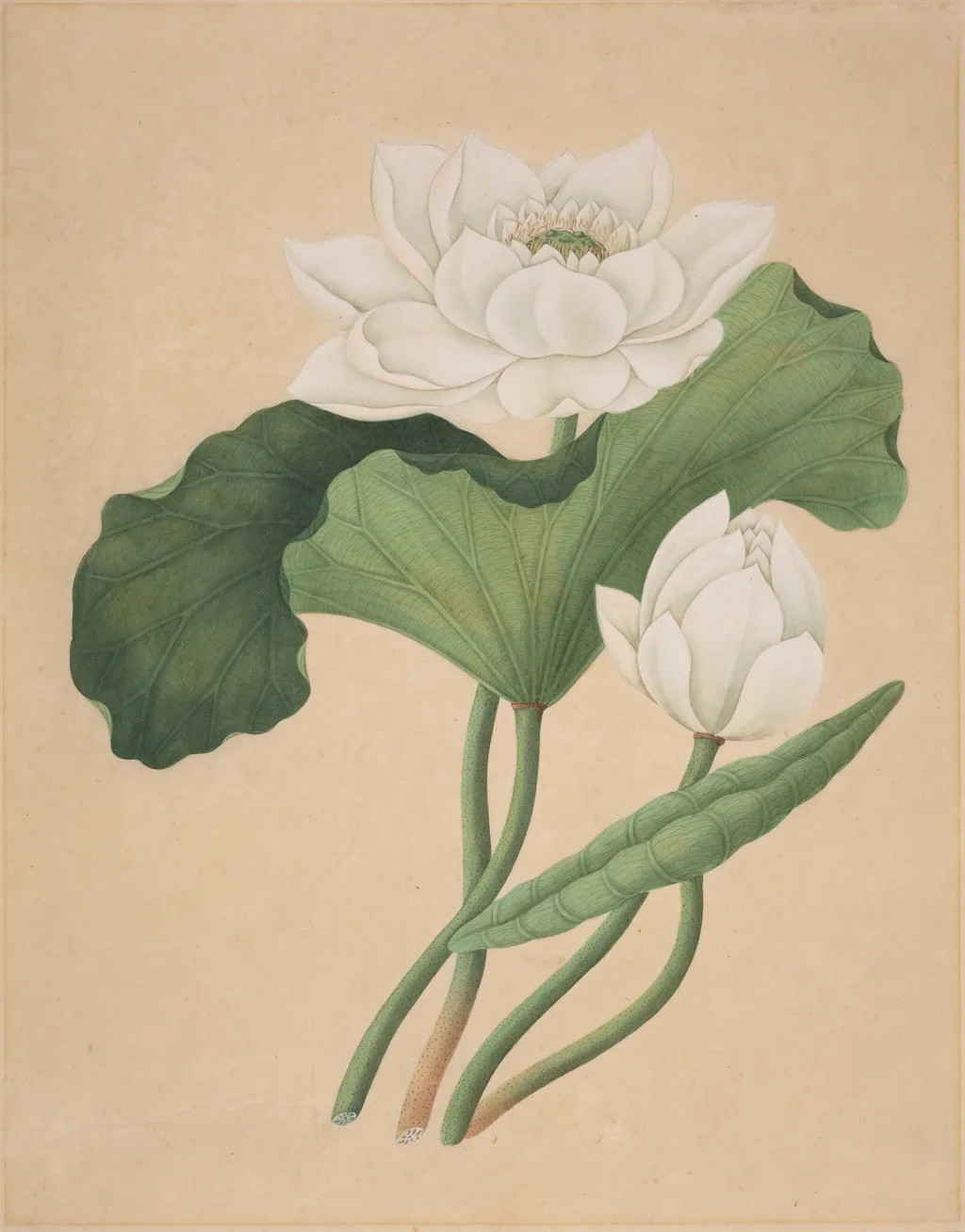
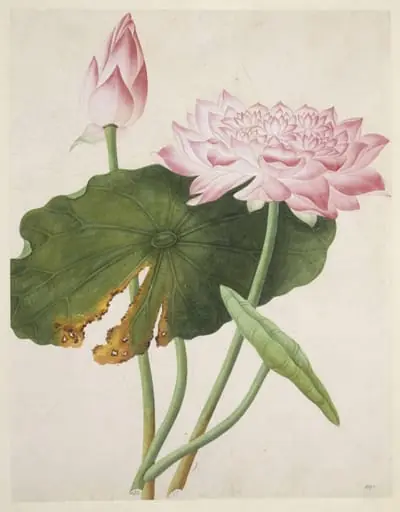
East Indian Lotus (Nelumbo nucifera) is a gouache drawing by the Impressionist artist British 19th Century. It dates from 1801 and is held in the collection of the National Gallery of Art. The work, titled East Indian Lotus, is a drawing executed in opaque watercolor on Xuan paper.
About this work
Overview
Though once dated to 1801 in some records, the National Gallery of Art now assigns it to the late nineteenth century.
East Indian Lotus (Nelumbo nucifera) is an opaque watercolor on xuan paper by an anonymous British artist of the nineteenth century, now held in the National Gallery of Art, Washington, D.C. The work measures 42.2 by 33.4 cm (16 5/8 by 13 1/8 in.) and bears the accession number 1970.19.1. Though once dated to 1801 in some records, the National Gallery of Art now assigns it to the late nineteenth century. The drawing is classified as a still life and belongs to the Ailsa Mellon Bruce Collection, having entered the museum in 1970 through the bequest of Ailsa Mellon Bruce. Its precise botanical rendering of the sacred lotus, executed on oriental paper with gouache-like opaque watercolor, exemplifies the intersection of British colonial interest in Asian flora and the period's tradition of natural-history illustration.
Subject & Meaning
The composition depicts Nelumbo nucifera, the sacred or East Indian lotus, in a vertical arrangement against an empty, uniform pale beige background. The open flower dominates the upper portion, its layered white petals revealing a central cluster of yellow stamens and green pistils. Below and to the right sits a tightly wrapped bud, while two elongated seed pods and three large green leaves occupy the middle and lower ground. One leaf is darker and curled at the left edge, another lighter and more fully extended. The lotus carries profound symbolic weight across Hinduism, Buddhism, Jainism, and Chinese culture, where it signifies purity, enlightenment, spiritual awakening, and divine beauty. It is the national flower of India and holds unofficial status in Vietnam. The absence of water, landscape, or any contextual setting strips the subject to its essential botanical and symbolic form, focusing attention on the plant's life cycle from bud through bloom to seed.
Technique & Style
The medium is opaque watercolor on xuan paper, a Chinese paper noted for its fine, smooth surface that accommodates precise brushwork. The handling is characterized by smooth, almost invisible brushwork that creates a flat, precise finish with no visible texture. Delicate stippling appears on the stems, and fine linear detailing defines the leaf venation. Soft modeling gives gentle volume to petals and leaves without strong shadows. The palette is restrained: whites, graded greens, and subtle earth tones at the cut stem ends. The stems cross near the bottom, where cut ends show pale circular interiors. This meticulous, anti-painterly approach prioritizes scientific accuracy over expressive gesture, aligning the work with natural-history illustration traditions. The technique reflects the influence of Chinese export painting methods, adapted by British practitioners for documentary purposes.
History & Provenance
The work was acquired from Kennedy and Co., New York, by Ailsa Mellon Bruce, the philanthropist and art collector who was a major benefactor of the National Gallery of Art. Upon her death, her estate gave the drawing to the museum in 1970. It is now held in the National Gallery of Art, Washington, D.C., as part of the Ailsa Mellon Bruce Collection, with accession number 1970.19.1. The provenance chain is relatively short and well-documented, typical of works that entered American public collections through the largesse of Gilded Age and early twentieth-century collectors interested in fine and decorative arts.
Context
The attribution "British 19th Century" signals both the anonymity of the maker and the broader phenomenon of British artists working in a documentary mode during the colonial period. The choice of xuan paper and the precise, flat technique suggest engagement with Chinese artistic materials and methods, possibly through the thriving export art markets of Canton (Guangzhou) or through direct contact with Asian botanical traditions. The late nineteenth-century dating places the work in a period of intensified British colonial presence in Asia and growing scientific interest in cataloging imperial flora. The National Gallery of Art's classification of the work as a drawing rather than a painting, despite its use of opaque watercolor, reflects institutional conventions that privilege medium and support over visual effect. The work has not been associated with a named artist, which has limited its integration into monographic studies but has not diminished its value as a document of cross-cultural artistic exchange.
Legacy
East Indian Lotus remains a relatively little-studied work within the National Gallery of Art's holdings, its significance lying partly in what it represents about collecting patterns and the categorization of colonial-era art. As part of the Ailsa Mellon Bruce Collection, it benefits from association with one of the most important American collections of European and decorative arts, though its own aesthetic modesty and anonymous authorship have kept it from major scholarly attention. The work's afterlife is primarily institutional: it is preserved, digitized, and made available through Creative Commons licensing by the National Gallery of Art, ensuring its continued accessibility for researchers interested in botanical art, British colonial visual culture, and the material techniques of nineteenth-century natural-history illustration. Its presence in online databases and stock-image repositories indicates a modest but steady circulation in digital art-historical discourse.
Artist & collection

Artist
A short life left behind a quiet obsession with water: the churn of a mill wheel, the choppy waves off England's south coast, the light bouncing off pond lilies.