Artwork
Portrait of Lucrezia Panciatichi
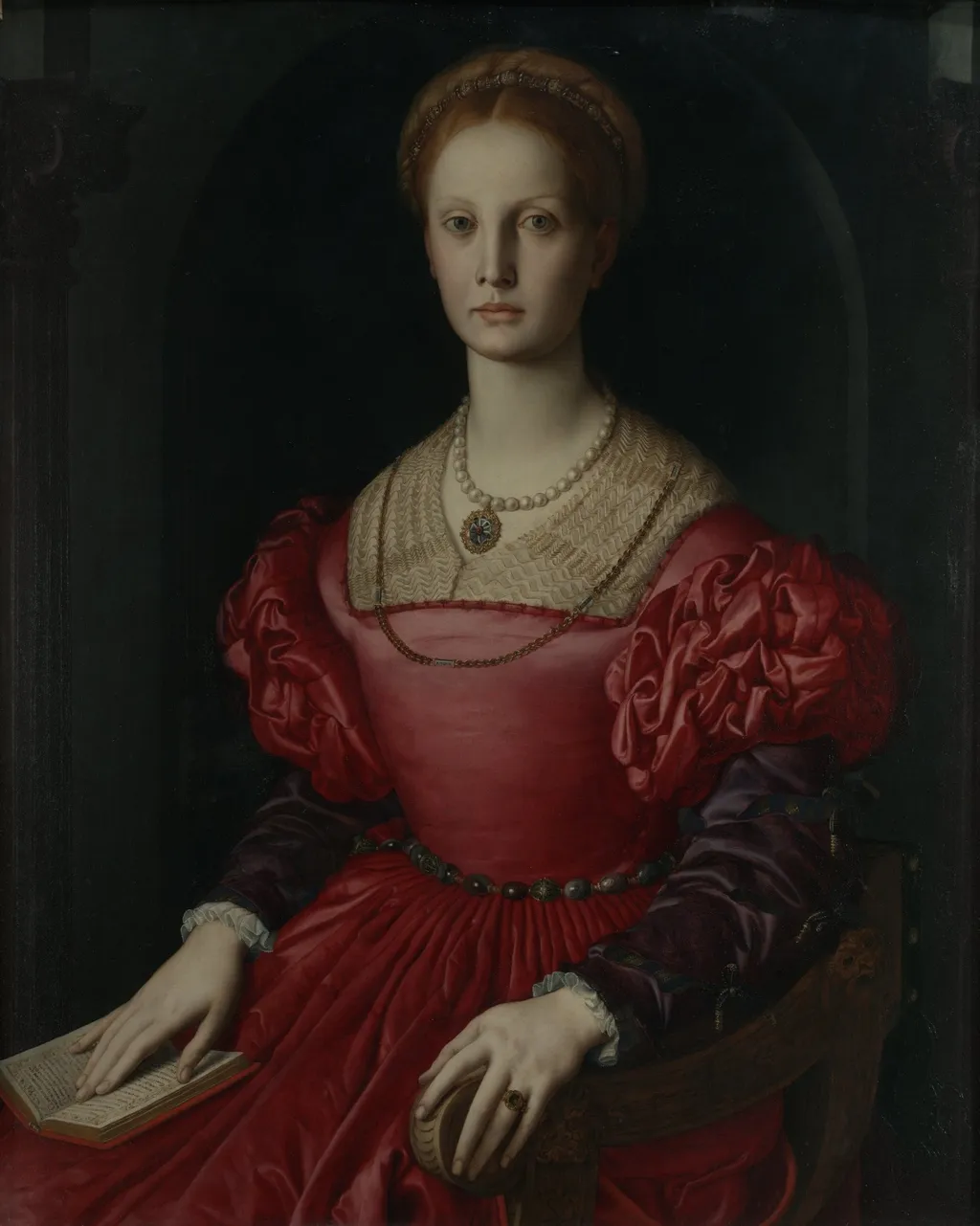
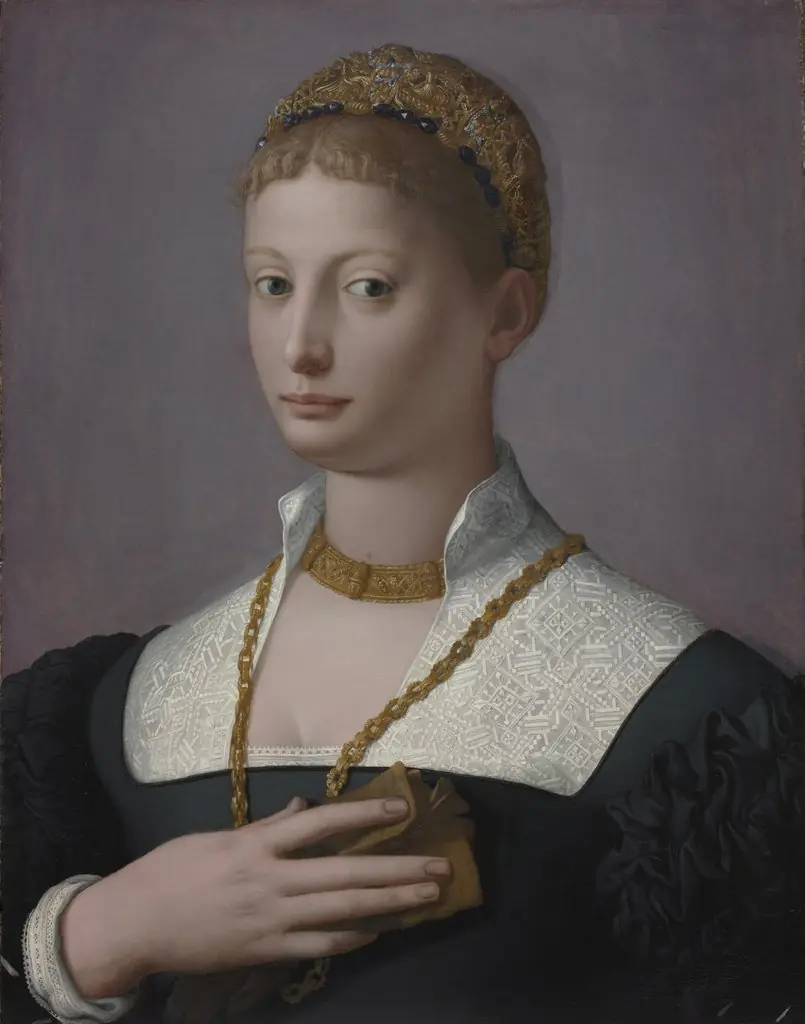
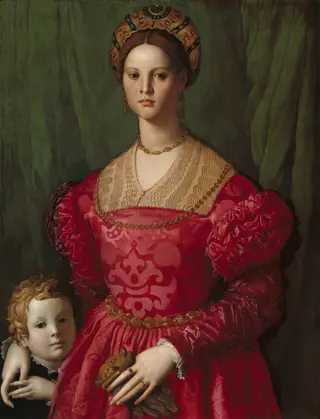
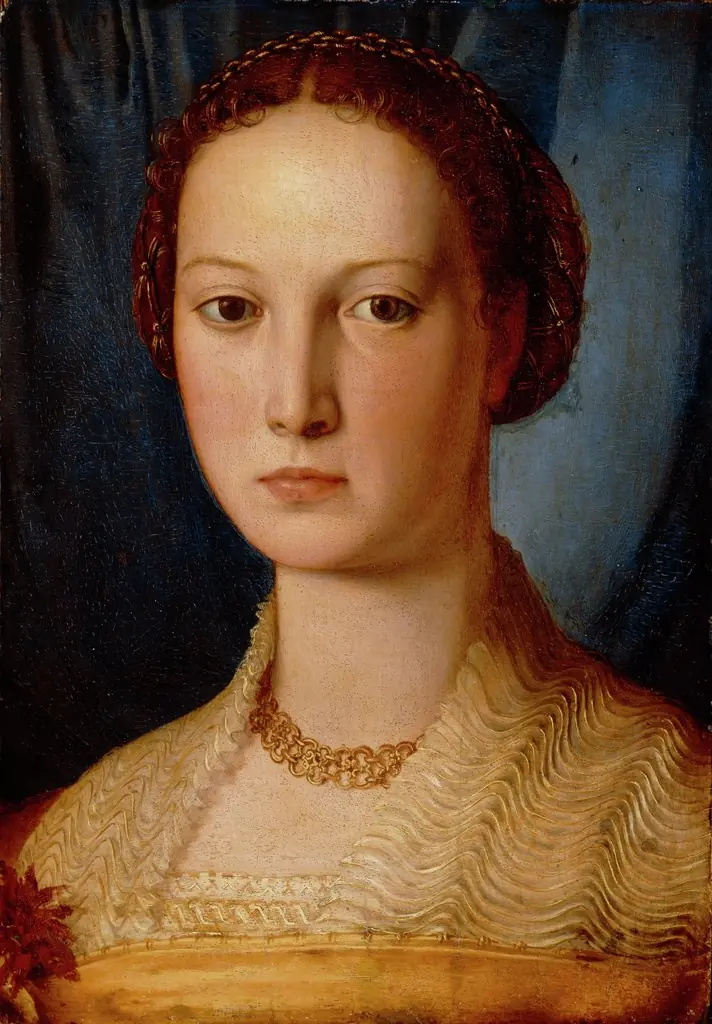
Portrait of Lucrezia Panciatichi is an oil painting by the Mannerist artist Bronzino. It dates from 1545 and is held in the collection of the Uffizi Gallery.
About this work
Subject & Meaning
The work remains central to discussions of Renaissance portraiture's psychological depth and symbolic complexity.
The Portrait of Lucrezia Panciatichi depicts Lucrezia di Sigismondo Pucci, a Florentine noblewoman and wife of humanist Bartolomeo Panciatichi, as an emblem of elite status and marital devotion. Her refined attire, gold necklace bearing the motto 'Amour dure sans fin', and symbolic objects, including an open book on her lap and a pendant with intertwined lovers' names, convey both her aristocratic identity and a personal narrative of enduring love commissioned by the Medici court. Giorgio Vasari noted the portraits' lifelike quality, while later writers like Henry James interpreted their cool melancholy as a study in contrasts between outer restraint and inner passion. The work remains central to discussions of Renaissance portraiture's psychological depth and symbolic complexity.
Technique & Style
The Portrait of Lucrezia Panciatichi is an oil on panel painting created around 1545 by Agnolo di Cosimo, known as Bronzino. Executed in oil paint on wooden support, the work measures 102 by 85 centimeters and belongs to the Uffizi Gallery in Florence. Bronzino rendered Lucrezia in a richly detailed red dress with lace trim, puffed and pleated sleeves, and a jeweled belt, while her posture and expression convey aristocratic detachment.
Two gold necklaces encircle her neck, one bearing the motto 'amour dure sans fin' engraved in looping script, symbolizing enduring love. The painting combines refined elegance with symbolic precision, reflecting Renaissance ideals of proportion, harmony, and personal narrative through costume, jewelry, and subtle facial expression.
History & Provenance
The Portrait of Lucrezia Panciatichi was commissioned by Bartolomeo Panciatichi, husband of the sitter, likely in connection with his entry into the Florentine Academy in 1541. The commission may have formed a pair with Bronzino's portrait of Bartolomeo himself.
The painting remained with the Panciatichi family for generations. In 1584, Vincenzo Borghini saw both portraits in the collection of Carlo Panciatichi, son of the couple. The work stayed in family possession until 1704, when it entered the Uffizi Gallery in Florence, where it remains today.
Bronzino painted the portrait around 1545 (sources variously suggest circa 1541), in oil on panel. Giorgio Vasari praised the work in 1550 for its extraordinary naturalism, remarking that the portraits seemed truly alive.
The Portrait of Lucrezia Panciatichi is held by the Uffizi Gallery in Florence. The painting and its pendant remained with the Panciatichi family for generations until they entered the Uffizi collection in 1704. The gallery has historically kept the pendants together and never loaned them separately.
Initially displayed in the museum's Tribuna, the artwork was relocated in 2012 to the red rooms of the Nuovi Uffizi, specifically Room D14, which is dedicated to Bronzino.
Context
The portrait is widely regarded as an exemplary work of Mannerism, the late-Renaissance movement that emphasized elegance and personal expression. Giorgio Vasari praised the paired portraits of Lucrezia and Bartolomeo Panciatichi in 1550 as "so natural that they seem truly living," a judgment echoed across early sources. The painting's refined symbolism, including the motto "amour dure sans fin" on her necklace, has attracted sustained scholarly attention, with the inscription linked to a 1547 treatise on love by Cosimo I de' Medici.
Later writers have found the portrait equally compelling. Henry James celebrated its "undercooled melancholy" as inspiration for female characters in his fiction; Vernon Lee drew on its haunting quality for her ghost story "Amour Dure." In art-historical scholarship, Umberto Eco used the image to illustrate grace and subjective beauty in his History of Beauty.
The work also occupies a place in institutional memory: long displayed in the Tribuna of the Uffizi, it was moved to the museum's redesigned galleries in 2012.
Legacy
The portrait has maintained significant cultural resonance across centuries. Giorgio Vasari praised the paired portraits of Lucrezia and Bartolomeo Panciatichi as "so natural that they seem truly living," a judgment recorded by 1550. In literature, the painting's apparent melancholy inspired Vernon Lee's Victorian ghost story "Amour Dure" and influenced Henry James, who mentioned it in The Wings of the Dove (1902) and drew on its "undercooled melancholy" for several female characters.
Umberto Eco later used the portrait in his History of Beauty to illustrate the theme of grace and the emergence of subjective notions of beauty. The French historian Paul Veyne included it in his "imaginary museum," discussed in his book Mon musée imaginaire. The work is also frequently mistaken for a portrait of Elizabeth Báthory, indicating its persistent presence in popular imagination.
Since 1704 it has remained in the Uffizi Gallery, where it continues to be exhibited as an exemplar of Mannerist portraiture.
Overview
Created circa 1545, the oil on panel portrait of Lucrezia Panciatichi is attributed to Agnolo di Cosimo, known as Bronzino. The work forms a paired composition with a companion portrait of her husband, Bartolomeo Panciatichi, and both are presently housed in the Uffizi Gallery in Florence.
Own this work as a print
Artist & collection
Artist
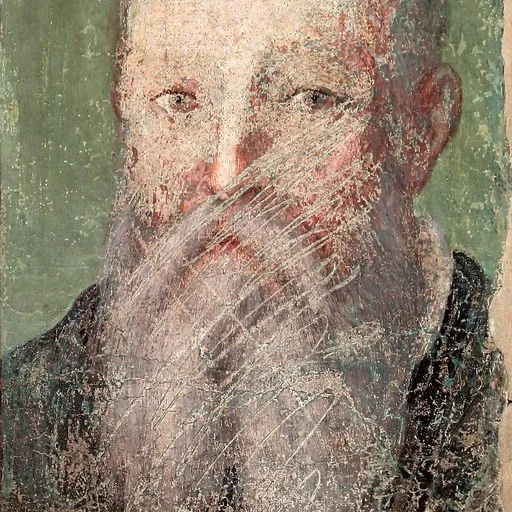
Agnolo di Cosimo (Italian:; 17 November 1503 – 23 November 1572), usually known as Bronzino (Italian: Il Bronzino ) or Agnolo Bronzino, was an Italian Mannerist painter from Florence.