Artwork
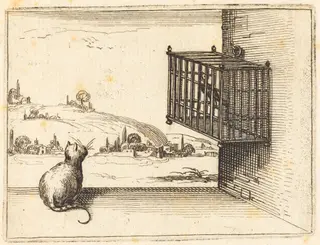
Cat Watching Caged Bird
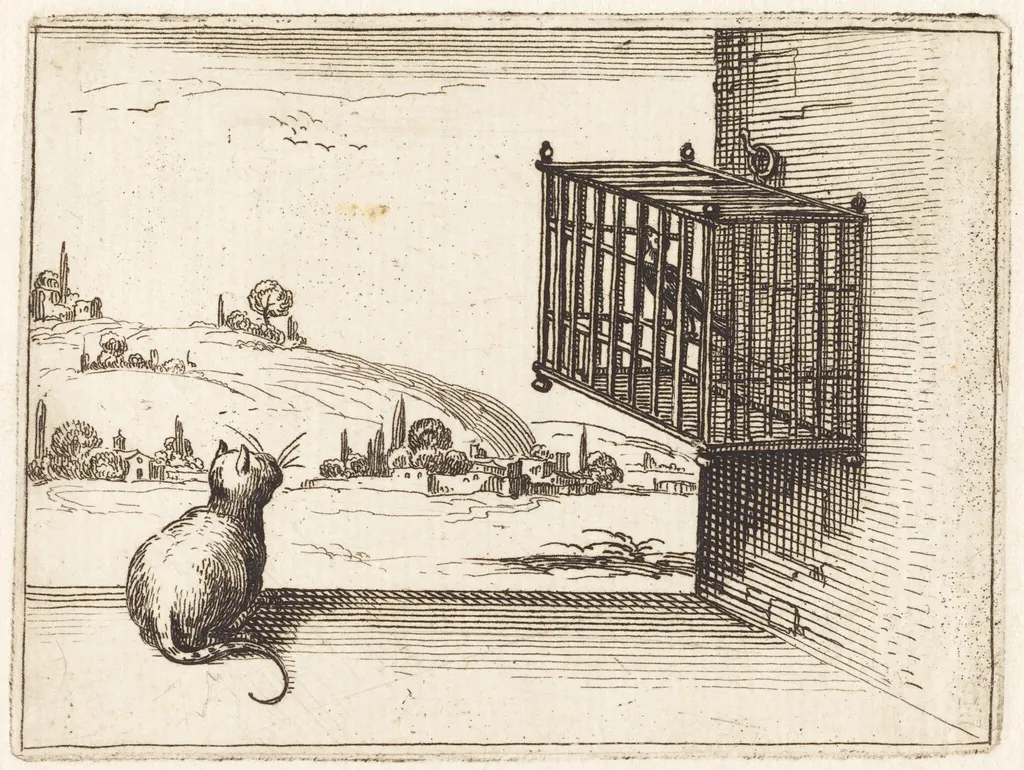
Cat Watching Caged Bird is an ink print by the Baroque artist Jacques Callot. It dates from 1628 and is held in the collection of the National Gallery of Art.
About this work
Overview
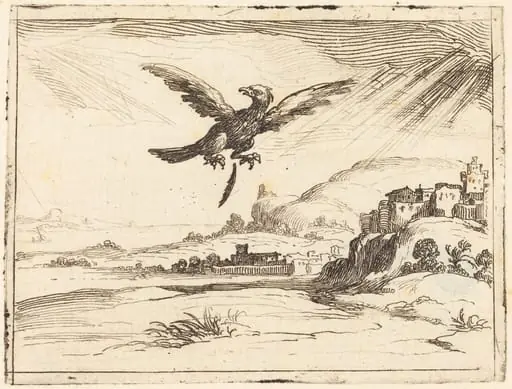
Jacques Callow’s 1628 etching titled Cat Watching Caged Bird portrays a domestic scene rendered on laid paper. The composition centers on a cat perched on a windowsill, gazing toward an empty birdcage placed on the ledge. Beyond the window, a modest town with spires and trees rises over gently rolling hills, providing a quiet backdrop to the animal tableau.
Subject & Meaning
The work captures a moment of anticipation: the cat’s attention is directed at a bird that is absent from the cage, suggesting themes of longing, patience, or the tension between desire and emptiness. By focusing on everyday objects and animals, the image invites contemplation of ordinary life’s subtle narratives without explicit moralizing.
Technique & Style
Executed through etching, Callow incised fine lines into a copper plate, allowing for delicate rendering of textures such as the cat’s fur and the cage’s metal bars. The use of laid paper contributes a subtle grain that enhances the tonal contrast. The overall style reflects Baroque sensibilities, precise detail combined with a narrative composition that guides the viewer’s eye across the scene.
History & Provenance
Jacques Callow, a prolific printmaker from the Duchy of Lorraine, produced more than 1,400 etchings documenting soldiers, beggars, courtly life, and religious subjects. Cat Watching Caged Bird fits within his broader oeuvre of everyday observations. The print entered several European collections in the 18th century, later appearing in museum holdings that specialize in Baroque graphic art.
Own this work as a print
Artist & collection
Artist
Jacques Callot (French: ; c. 1592 – 1635) was a baroque printmaker and draftsman from the Duchy of Lorraine. He is an important person in the development of the old master print. He made more than 1,400 etchings that…

 Holy Family at supper
 Restoration of the Aqueduct at Pisa
 Restoration of the Aqueduct at Pisa
 Square in Paris with Many Figures
 Square in Paris with Many Figures
 Horsemen Attacked by Robbers
 HOW WILL A COVERED PART BE CORRECTED?HOW WIKA A COVERED HEART DEED CORRECTED?
![Christ Walking on the Water [second plate], by Jacques Callot](https://artifactworldgallery.com/img/jacques-callot--christ-walking-on-the-water-second-plate--2069f3bfe4cb2126-w320.webp) Christ Walking on the Water [second plate]
Christ Walking on the Water [second plate]