Artwork
H Beard Print Collection
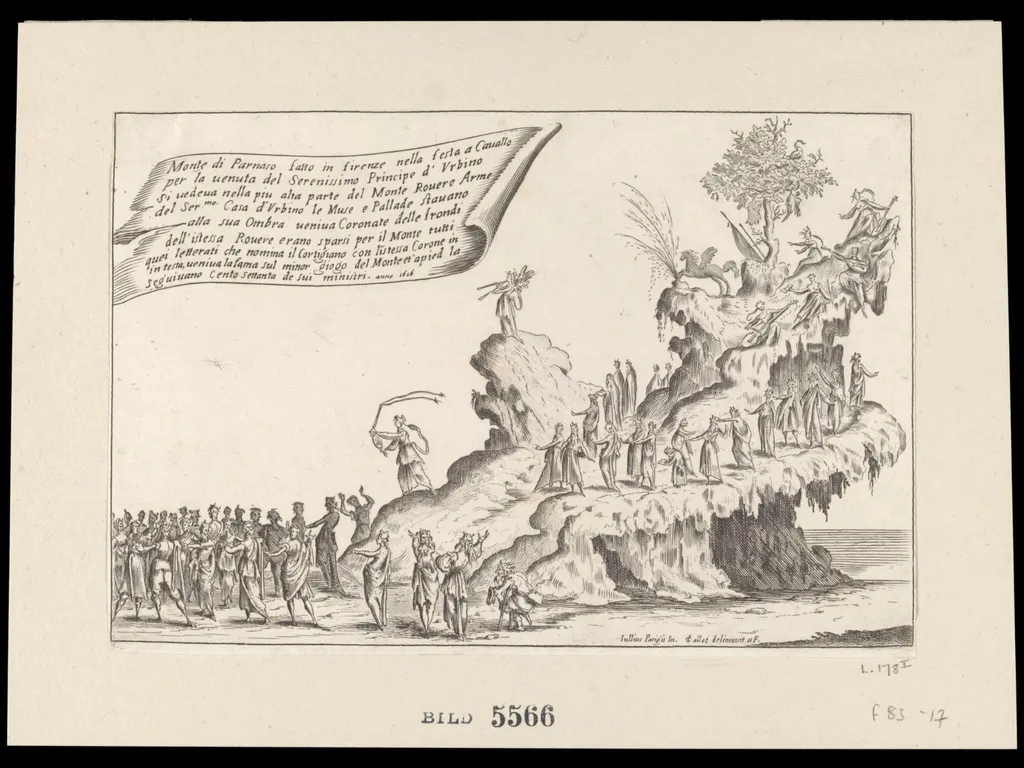
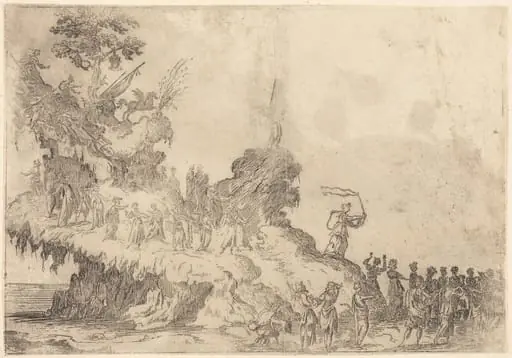
H Beard Print Collection is a print by the Baroque artist Jacques Callot. It dates from 1616 and is held in the collection of the Victoria and Albert Museum. This 1616 Florentine print captures a temporary ceremonial structure built for an equestrian festival honoring the Prince of Urbino.
About this work
The artist packed every inch with detail, faces, banners, even leafy wreaths.
This print shows a crowded mountain scene. Hundreds of tiny figures climb steep slopes under a grand arch. At the top sits a throne with a coat of arms.
It’s an old parade print from 1616 Florence. The artist packed every inch with detail, faces, banners, even leafy wreaths. You can almost read the tiny Latin captions around the edges.
Look up Callot, Jacques to see more of his busy street scenes.
Overview
This 1616 Florentine print captures a temporary ceremonial structure built for an equestrian festival honoring the Prince of Urbino. Designed as a symbolic Mount Parnassus, it merges real-pageantry with mythological allegory. The print reproduces a large-scale, ephemeral installation, meticulously rendered in fine detail by Jacques Callot, whose skill in engraving allowed for the depiction of hundreds of miniature figures and inscriptions.
Subject & Meaning
The scene reimagines Mount Parnassus as a stage for intellectual homage, with the House of Urbino’s coat of arms dominating the summit. The Muses and Pallas Athena shelter beneath a laurel arch, while scholars and writers, crowned with laurel, ascend the slopes. The imagery aligns literary achievement with princely patronage, suggesting that the prince’s arrival elevates the arts. Below, 170 attendants follow, reinforcing the hierarchy of cultural and political authority.
Technique & Style
Executed in fine-line engraving, the print demonstrates Jacques Callot’s mastery of minute detail. Each figure is individually rendered, with distinct poses, garments, and inscribed labels. The composition is densely packed, using layered perspective to suggest depth within a compressed space.
Tiny Latin captions encircle the scene, adding textual layers to the visual narrative, characteristic of Callot’s documentary approach to public spectacle.
History & Provenance
Created for the 1616 festivities in Florence celebrating the arrival of the Duke of Urbino, the print served as both commemorative artifact and propaganda. The temporary Mount Parnassus was likely constructed by court artists and engineers, then immortalized by Callot for wider circulation. The print’s survival in collections like the H. Beard Print Collection attests to its value as a record of early 17th-century ceremonial culture.
Context
Florence in the early 1600s was a center for elaborate court festivals blending classical myth with political messaging. The use of Mount Parnassus, a traditional symbol of poetic inspiration, was a common trope to honor patrons of the arts. Callot’s depiction reflects the broader trend of using print media to disseminate ephemeral events, making transient spectacles accessible to a literate, international audience.
Legacy
Callot’s print remains a key example of how printmaking transformed temporary court events into enduring visual records. Its intricate detail influenced later topographical and ceremonial prints across Europe. While the original structure vanished, the engraving preserved its symbolic language, offering modern scholars insight into the intersection of art, politics, and performance in Renaissance Italy.
Own this work as a print
Artist & collection
Artist
Jacques Callot (French: ; c. 1592 – 1635) was a baroque printmaker and draftsman from the Duchy of Lorraine. He is an important person in the development of the old master print. He made more than 1,400 etchings that…

 Holy Family at supper
 Restoration of the Aqueduct at Pisa
 Restoration of the Aqueduct at Pisa
 Square in Paris with Many Figures
 Square in Paris with Many Figures
 Horsemen Attacked by Robbers
 HOW WILL A COVERED PART BE CORRECTED?HOW WIKA A COVERED HEART DEED CORRECTED?
![Christ Walking on the Water [second plate], by Jacques Callot](https://artifactworldgallery.com/img/jacques-callot--christ-walking-on-the-water-second-plate--2069f3bfe4cb2126-w320.webp) Christ Walking on the Water [second plate]
Christ Walking on the Water [second plate]
- The Float of Mount Parnassus
 The Float of Mount Parnassus
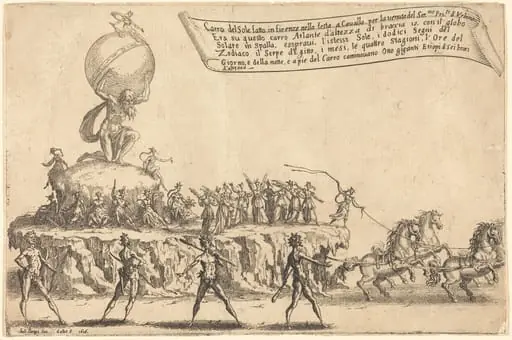 The Float of the Sun
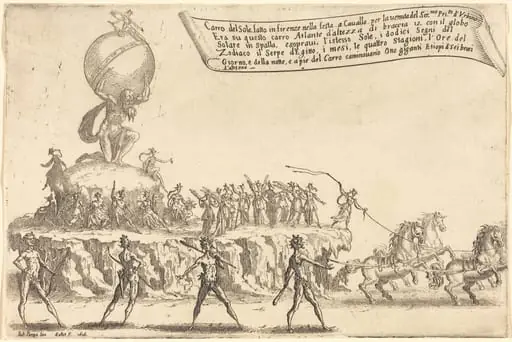 The Float of the Sun
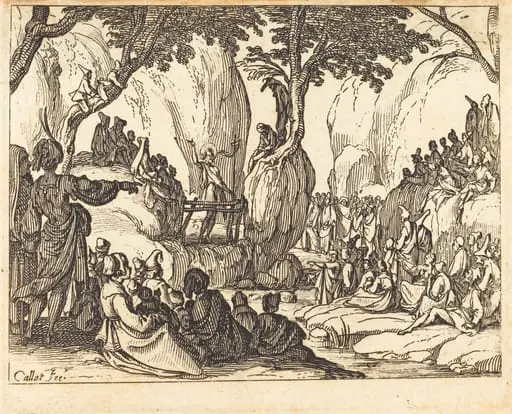 Saint John Preaching in the Desert
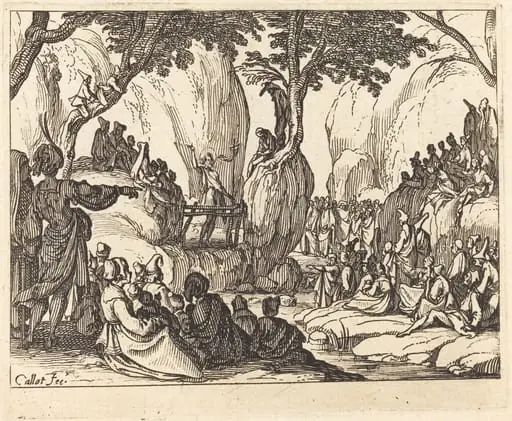 Saint John Preaching in the Desert
 The Float of Mount Parnassus
 The Seconda Macchina for the Chinea of 1738: The Triumph of Bacchus and Ceres
 Master of His Excellency's Stables and Twenty Servants
 Landscape with Ruins
 The Crucifixion of Polycrates
 H Beard Print Collection