Artwork
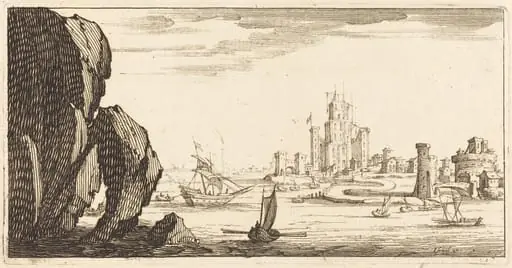
The Large Rock
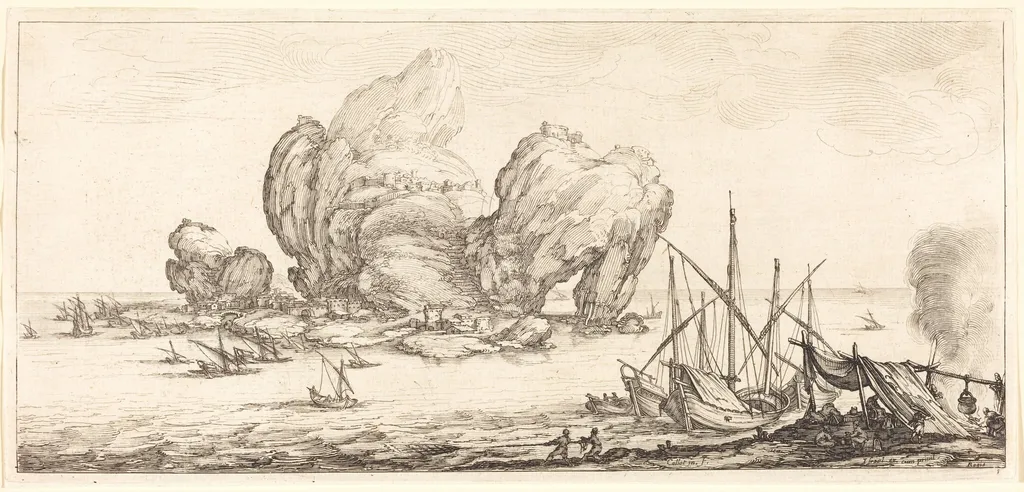
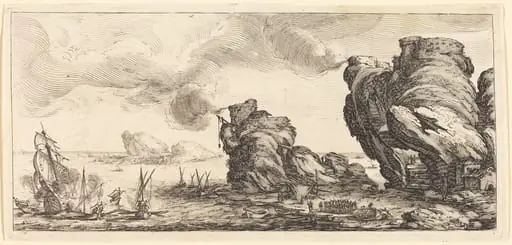
The Large Rock is an ink print by the Baroque artist Jacques Callot. It dates from 1630 and is held in the collection of the National Gallery of Art.
- Inscription
- Inscribed:lower right in plate: Callot in. f. Israel ex. cum privil. Regis
About this work
Overview
The work captures a turbulent seascape with vessels in distress, a rocky island shrouded in storm clouds, and small boats struggling in the waves.
Created around 1630, The Large Rock is an etching on laid paper by Jacques Callot, a pivotal figure in 17th-century printmaking. The work captures a turbulent seascape with vessels in distress, a rocky island shrouded in storm clouds, and small boats struggling in the waves. Callot’s precise line work conveys motion and urgency, characteristic of his technical command over the etching process, which involved incising lines into a metal plate to hold ink.
Subject & Meaning
The scene depicts maritime peril, with ships emitting smoke and tiny figures rowing desperately amid rough waters. The looming rock, half-concealed by dark clouds, suggests an unseen threat. Rather than glorifying adventure, the image conveys vulnerability and the unpredictability of nature.
Callot’s focus on human struggle against elemental forces reflects a broader Baroque interest in transience and the fragility of life.
Technique & Style
Callot employed fine, incised lines to render the chaos of wind, water, and smoke, exploiting etching’s capacity for detail and texture. The sharp, almost scratch-like strokes create a sense of agitation, while the contrast between the dark, heavy rock and the lighter, agitated sea enhances spatial depth. His use of layered lines and controlled hatching demonstrates his refinement of the medium, pushing etching beyond mere reproduction into expressive narrative.
History & Provenance
Produced during Callot’s mature period in Florence, where he worked for the Medici court, The Large Rock belongs to a body of work that includes both courtly scenes and depictions of ordinary hardship. Though the print’s early ownership is undocumented, it aligns with his known output from the 1620s–1630s. As with many of his etchings, it was likely circulated among collectors and artists, contributing to his reputation across Europe.
Context
In early 17th-century Europe, maritime imagery often carried symbolic weight, reflecting fears of loss, divine judgment, or the perils of travel. Callot’s interest in such themes coincided with heightened naval activity and the expansion of trade routes. His etchings, including this one, responded to contemporary anxieties, blending observation with allegory, and offering a quiet counterpoint to the grandeur of painted histories.
Legacy
Callot’s technical innovations in etching influenced generations of printmakers, including Rembrandt. The Large Rock exemplifies his ability to convey drama through line alone, elevating printmaking to a medium capable of complex emotional expression. While not widely exhibited in his lifetime, his works became foundational references for later artists studying composition, movement, and atmospheric tension in graphic art.
Artist & collection
Artist
Jacques Callot (French: ; c. 1592 – 1635) was a baroque printmaker and draftsman from the Duchy of Lorraine. He is an important person in the development of the old master print. He made more than 1,400 etchings that…

 Holy Family at supper
 Restoration of the Aqueduct at Pisa
 Restoration of the Aqueduct at Pisa
 Square in Paris with Many Figures
 Square in Paris with Many Figures
 Horsemen Attacked by Robbers
 HOW WILL A COVERED PART BE CORRECTED?HOW WIKA A COVERED HEART DEED CORRECTED?
![Christ Walking on the Water [second plate], by Jacques Callot](https://artifactworldgallery.com/img/jacques-callot--christ-walking-on-the-water-second-plate--2069f3bfe4cb2126-w320.webp) Christ Walking on the Water [second plate]
Christ Walking on the Water [second plate]